
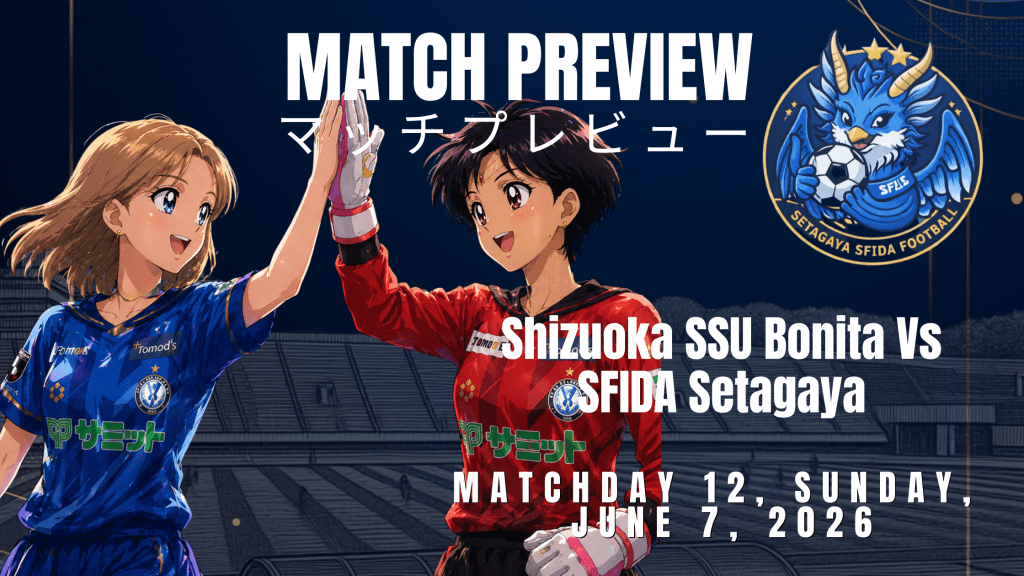
The first thing I thought when this fixture rolled around for the preview, wasn’t tactics.
It was relief.
Last weekend felt strangely empty. No alarm clock set for an unreasonable hour. No frantic checking of line-ups. No emotional investment in a football team from western Tokyo that has developed a worrying habit of dictating my Sunday mood from 6am onwards.
Then again, perhaps that’s what supporting a club like Sfida Setagaya does to you.
One week you’re watching pharmacy workers and supermarket staff throw themselves into tackles with the commitment of World Cup finalists. The next week there’s no match and suddenly the weekend feels incomplete.
Now they’re back.
Unfortunately, they’re travelling to the league leaders.
The Small Matter of Shizuoka
What a week it’s been already.
Work has been relentless. The sort of week that would make an Otemachi salaryman nod approvingly before disappearing into another twelve-hour meeting about synergy. Every project seems to have arrived simultaneously. Every deadline appears to have discovered caffeine.
But Sunday is coming.
And with it comes one of the hardest assignments on Sfida’s schedule.
Shizuoka SSU Bonita are top of the Nadeshiko League for a reason. Eight wins from eleven matches. Thirty-four goals scored. Seven conceded.
Seven.
That isn’t form. That’s a warning label.
The table says they have 26 points and a +27 goal difference. The eye test says something similar. Midori Honda has built a side that plays football with the efficiency of a factory production line. The ball moves quickly. The pressing arrives early. Mistakes are punished.
They don’t mess about.
And we’re travelling away from home.
This is getting worse by the second.
The Ghost of Opening Day
Nobody connected to Sfida has forgotten the opening weekend.
Officially it was Matchday One.
Emotionally it felt more like a public demonstration.
Shizuoka arrived at AGF Field and dismantled Setagaya 6-1.
There are defeats and there are educational experiences. That afternoon somehow managed to be both.
The scoreline exposed everything that was wrong with Sfida’s early-season setup. The high line. The transitional vulnerability. The moments where Hamada-ball crossed the thin border between bravery and outright recklessness.
It stuck.
Not because it was the biggest defeat in the club’s history.
Because everyone knew there was some truth in it.
Minor moments tend to disappear. Major ones become landmarks.
That match became a landmark.
Which is precisely why Sunday’s meeting feels fascinating.
Why Can’t It Be Us?
The funny thing about football is that evidence only matters until it doesn’t.
Shizuoka look unstoppable.
Yet a few weeks ago Nagoya Loveledge beat them.
Last week VONDS Ichihara, currently staring up at everybody else from the bottom of the table, managed to score against them.
Meanwhile Sfida pushed Nagoya right to the edge.
Sfida beat VONDS.
Football logic is often less useful than a chocolate teapot.
So why can’t Setagaya get something here?
We went to second in the league and got a point.
There is a chance.
A small one perhaps.
But a real one.
This league has developed a habit of ignoring narratives whenever people become too comfortable.
Hana Yori Dango FC
There’s an old Japanese phrase.
花より団子.
“Dumplings over flowers.”
Substance over appearance.
Practical value over aesthetics: Like actually going out to schools to help the future generation learn soccer.
It might be the most Sfida phrase imaginable.
Shizuoka are chasing professionalisation. Attendance targets. WE League ambitions. More than 2,000 supporters inside Yamaha Stadium. Corporate growth. Strategic development.
None of that is criticism. It’s simply where they are.
Sfida exist somewhere else entirely.
This is a club where supporters know the players because they have seen them at work during the week.
A defender might be helping customers at Summit.
A midfielder might be stocking shelves.
A forward might be serving someone medicine at Tomod’s.
Then on Sunday they’re expected to stop Kumi Yokoyama.
Football loves talking about authenticity.
Sfida accidentally embodies it.
No marketing department required.
Dre x Bangaranga
I’ve spent far too much of this week listening to Dr Dre.
Which feels oddly relevant.
Because Takashi Hamada’s football resembles a half-finished studio session where somebody accidentally unplugged the mixing desk but decided to release the track anyway.
The bass is enormous.
The structure occasionally disappears.
The whole thing somehow works.
When Hamada-ball is functioning, what you really get is Bangaranga.
Not just ordinary Bangaranga either.
The good stuff.
The sort of Bangaranga that feels like a surprise collaboration between Dr Dre and DARA. Which, let’s be honest, would be absolutely tremendous.
Momentum swings.
Turnovers.
Counter-attacks.
Players appearing in places they have no business being.
A game that looks stable one minute and resembles a shopping trolley hurtling downhill the next.
This is what Sfida need.
Not caution.
Not neat little passing triangles.
Bangaranga.
The footballing equivalent of somebody turning the volume knob until it snaps off completely.
The problem is that Shizuoka might be one of the few teams capable of matching it.
Honda’s side also wants vertical football.
They also want transitions.
They also want pressure.
Which means Sunday’s match could become a strange remix where both teams keep trying to play the loudest track in the room.
This has all the ingredients required for a tactical masterpiece.
Or a tactical dystopia.
Possibly both.
The Women Who Decide Everything
Most previews eventually become player discussions.
This one probably starts there.
Misuzu Uchida has nine league goals.
Mizuki Horie has seven.
Oh and how good was Nana Watanabe in the last match against Ehime?

We all dream of eleven Watanabes
Together they give Sfida hope.
Horie in particular feels custom-built for awkward away games. At 174cm she doesn’t so much occupy defenders as inconvenience them. Three goals against Shizuoka during 2025 suggest she enjoys this fixture.
Then there is Kumi Yokoyama.
Eight goals.
Four away from the all-time league scoring record.
Every defence knows exactly what’s coming.
Most still can’t stop it.
Football has always loved inevitability. Yokoyama carries that feeling around with her.
Not unlike a Mechagodzilla stomping through a carefully constructed city model. Everyone can see it approaching. The problem isn’t awareness. It’s surviving the impact.
Sfida’s answer will likely involve Nana Watanabe and goalkeeper Mio Otsuka.
Which feels a bit like asking two people to hold back the tide using a rake and positive thinking.
Still.
Football occasionally rewards optimism.
The Attendance Match
One of the more interesting subplots isn’t on the pitch.
Shizuoka have designated this a major attendance push.
More than 2,000 supporters are the target.
There will be children’s tournaments.
Tea girls serving local shincha.
Family activities.
Community engagement.
Everything required to demonstrate readiness for a professional future.
It’s admirable.
And it creates an unusual atmosphere.
Inside the stadium twenty-two players will be trying to destroy each other through transitional football.
Civilisation is a thin layer sometimes.
Prediction? Not Really
People always want predictions.
Football rarely cooperates.
Shizuoka should win.
The table says so.
The statistics say so.
The opening-day massacre certainly says so.
But football remains stubbornly resistant to common sense.
A few months ago nobody expected VONDS to trouble them.
Nobody expected Nagoya to beat them.
Nobody expected Sfida to spend large parts of this season reinventing themselves after the defensive disasters of spring.
Yet here we are.
Sunday morning will arrive.
Coffee will be poured.
The rest of Britain will resemble a paused loading screen.
And somewhere in Iwata, a group of footballers balancing ordinary jobs and extraordinary ambitions will try to upset the best team in the division.
It feels unlikely.
Which usually means there’s a chance.
One prediction: They’ll probably be more goals in this then there was in the last game against Ehime FC.
Going to the game?
Good luck as well to anyone brave enough to make the away trip.
The football itself looks difficult enough. Getting there might be the tougher challenge.
For those contemplating a Sunday pilgrimage to Iwata Sports Exchange Village Yumeria Stadium, a name that somehow sounds both entirely real and completely made up, the most sensible route appears to be Shinagawa, Shinkansen to Hamamatsu, local train to Iwata and then either a bus or a walk to the ground depending on your appetite for adventure.
The good news is that Japan tends to reward these journeys.
The bad news is that, should you arrive early, your local sightseeing options include the Yamaha headquarters and the Museum of Fragrance.
Which is one way of spending a Sunday afternoon.
Still, football away days have never really been about efficiency. They’re about convincing yourself that a six-hour round trip to watch your team potentially lose 4-1 was actually a perfectly rational decision.
Safe travels, enjoy the tea, and may the Bangaranga be with you.
Thanks
Oh, and thanks to everyone who took the time to read the FC Tokyo merger article.
I spent an alarming amount of time thinking about club identities, corporate football and the future of a semi-professional women’s team from western Tokyo, so it was nice to see so many people reading it.
The numbers were far better than expected, which either means people genuinely care about what happens to Sfida Setagaya, or we have all become strangely fascinated by football mergers and existential dread. Or just my ramblings.
Either way, thank you.





3 responses to “Searching for Bangaranga in Shizuoka”
[…] my preview I had confidently discussed the match taking place at the Iwata Sports Exchange Village Yumeria […]
LikeLike
[…] 以前のプレビュー記事で、この試合は「磐田市スポーツ交流村 ゆめりあスタジアム」で行われると、自信満々に書いていた。 […]
LikeLike
[…] Shizuoka SSU Bonita arrived unbeaten at home. They had battered us 6-1 earlier in the season and sat proudly at the top of the Nadeshiko League table. […]
LikeLike