
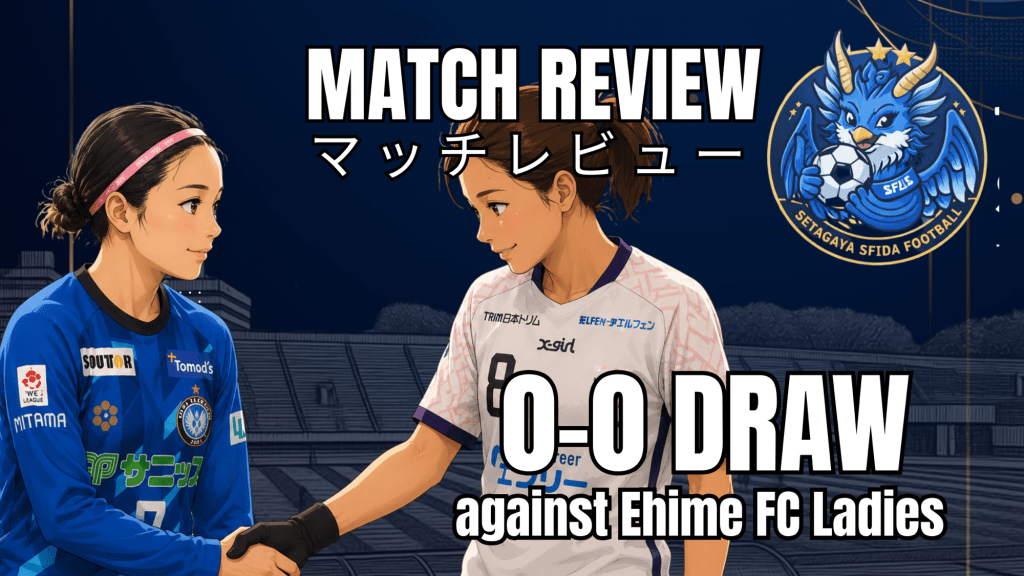
There are football clubs you support because they win trophies.
There are football clubs you support because your family supported them.
And then there is SFIDA Setagaya FC.
A club from Setagaya City that somehow convinces sensible adults to wake up at ridiculous hours and emotionally invest themselves in a semi-professional team playing in Japan’s second tier of the women’s soccer league.
This was Tomod’s Match.
A celebration of the wonderfully strange reality that several SFIDA players spend part of their week working ordinary jobs before pulling on a women’s soccer jersey and representing the club on Sundays. It remains one of the most charming things in football. The person selling allergy tablets on Wednesday might be marking a striker on Sunday. The person helping somebody choose toothpaste could be making a goal-saving clearance three days later.
Moeno Matsubara, who literally works for Tomod’s, was handed her first league start on the afternoon the company sponsored the match. It felt almost too neat to be accidental.
The setting was Ajinomoto Field Nishigaoka.
A stadium where mistakes echo.
A stadium where supporters sit close enough to hear instructions.
A stadium where, coming into this match, SFIDA had not lost in five seasons.
Ten wins. Three draws. Nine clean sheets.
The fortress remained intact.
Just.
The Match I Nearly Missed

Unfortunately, I wasn’t watching live.
Not because of work.
Not because of travel.
Because my laptop very nearly died.
I woke at 6am ready for the usual routine. Coffee. Nadeshiko League YouTube stream. Emotional instability.
Instead I discovered a full glass of water had somehow emptied itself over my laptop overnight after a piece of furniture collapsed with all the grace of a wrestling heel turn.
Several hours of panic followed.
Fortunately years of accumulated anime stickers and Japanese craft beer stickers absorbed most of the moisture like tiny volunteer firefighters.
Amazingly the machine survived.
The Curious Case of the 4-2-4
Before kickoff one thing immediately caught my eye.
The shape.
Nominally it looked like a 4-4-2.
In reality it resembled a 4-2-4.
An actual, honest-to-goodness 4-2-4.
The kind of formation you accidentally create after selecting Ultra Attacking on Football Manager while simultaneously convincing yourself you are the reincarnation of Arrigo Sacchi.
Whether Takashi Hamada intended it or whether circumstances pushed SFIDA there is difficult to know.
What became obvious throughout the afternoon was how exposed the midfield became.
Whenever SFIDA attacked, space opened everywhere.
Whenever possession changed hands, structure disappeared.
It was thrilling.
It was terrifying.
It was occasionally difficult to understand.
Afterward Hamada himself sounded deeply frustrated.
“The result was a scoreless draw, but content-wise, it felt like a complete defeat,” he admitted.
That felt honest.
Perhaps brutally so.
Ayaka Nemoto Starts the Day
The first real encouragement arrived after three minutes.
Ayaka Nemoto delivered a genuinely excellent ball into the area.
The initial danger was cleared but Maasa Taguchi gathered possession and fired narrowly over.
For a brief period SFIDA looked comfortable.
Then football remembered football exists.
Ehime immediately began growing into the match.
The first warning came through Sawa Kuroiwa, whose strike forced Mio Otsuka into action.
That moment altered the game’s rhythm.
From then onward the visitors increasingly looked the more dangerous side.
Mio Otsuka and the Art of Refusing Disaster
The best player on the pitch was probably not a defender.
It was not a striker.
It was nineteen-year-old goalkeeper Mio Otsuka.
At 180cm she already looks imposing.
On this afternoon she looked almost supernatural.
Corner after corner arrived.
Cross after cross arrived.
Shots appeared through traffic.
Otsuka dealt with them.
One save.
Then another.
Then another.
The statistics tell their own story.
Ehime finished with seven shots to SFIDA’s four and won ten corners compared to SFIDA’s single corner. They created the overwhelming majority of dangerous situations. Yet they left with nothing.
Because every time the structure cracked, Otsuka appeared.
By the second half she was operating less like a goalkeeper and more like a video game raid boss.
We Dream of Eleven: Nana Watanabe
The best outfield player on the pitch was Nana Watanabe.
At least for SFIDA.
Possibly by some distance.
Football supporters have a habit of romanticising defensive performances. Every crunching tackle becomes heroic. Every clearance becomes a war story. This was not one of those occasions.
Watanabe was genuinely exceptional.
For ninety minutes she seemed to exist in a permanent state of anticipation. Stepping into passing lanes before they fully appeared. Organising those around her. Reading danger early enough that most problems never became emergencies. Whenever Ehime looked ready to build something threatening, Watanabe arrived to quietly dismantle it.
What makes her fascinating is that she does not defend with drama.
She defends with process.
The club website still shows her with bright blonde hair, the sort of look that makes somebody resemble the protagonist of a football anime. In reality the blonde has mostly disappeared now. She looks less like the hero of a coming-of-age story and more like a hardened vice-captain who has spent several years solving other people’s problems.
Which, coincidentally, is exactly what she spent this match doing.
At one point she produced a sliding challenge so clean it felt almost rude. Another attack gone. Another dangerous sequence erased. Another promising Ehime move quietly redirected into irrelevance.
Earlier this season I compared her defending to a Fenner Dunlop conveyor system, and honestly the metaphor survives further inspection.
Danger arrives.
Nana processes it.
Danger disappears.
No panic. No fuss. Just relentless mechanical efficiency, as if opposition attacks are simply products moving along a production line towards inevitable disposal.
The remarkable thing was that she never stopped. Deep into stoppage time, after spending most of the afternoon extinguishing fires, she was still making overlapping runs into attacking positions while everyone else looked ready for a cold drink and a lie down.
By the second half I had completely convinced myself of the obvious conclusion:
🎵 We all dream of eleven Watanabes 🎵
Ridiculous.
Perfect.
And after watching that performance, not entirely unreasonable either.
Dragon Quest Football
The longer the game continued, the stranger it became.
The midfield increasingly vanished.
Possession changed hands constantly.
Nobody controlled anything.
The match started resembling a JRPG.
SFIDA attacks.
Turn ends.
Ehime attacks.
Turn ends.
SFIDA attacks again.
The energy of semi-professional football often creates this phenomenon.
These players balance work, travel and football simultaneously. Fatigue becomes a tactical factor.
By the final thirty minutes structure often gives way to survival.
This was one of those afternoons.
Misuzu Uchida Keeps Fighting
SFIDA’s leading scorer Misuzu Uchida never received much clean service.
Yet she never stopped competing.
One moment around the thirty-fourth minute captured her entire afternoon.
Receiving possession near the left side, she attempted to battle through multiple defenders despite having little support and almost no obvious route toward goal.
Most players would recycle possession.
Uchida simply kept going.
Later she nearly forced a winner by charging down goalkeeper Moeka Fujita.
The chance vanished.
The effort remained.
There is something oddly admirable about forwards who continue believing opportunities exist long after evidence suggests otherwise.
The Offside Apocalypse
One of the game’s recurring themes was offside.
Ehime repeatedly found themselves caught beyond the defensive line.
Then SFIDA inherited the same curse.
The defining moment arrived in the eighty-third minute.
The visitors worked a move brilliantly.
The ball ended up in the net.
Celebrations began.
The scoreboard operator briefly updated the score.
Then the assistant referee raised the flag.
No goal.
Chaos restored.
A Draw Nobody Quite Understood
At full-time the scoreboard read 0-0.
A result that felt simultaneously fair and slightly bizarre.
Ehime created more.
SFIDA defended better.
The visitors broke through repeatedly but were denied by offside calls and Otsuka.
The hosts struggled for rhythm but somehow remained standing.
Perhaps that explains why Hamada sounded so disappointed afterwards.
A clean sheet should feel positive.
Instead it felt like survival.
Still, survival matters.
SFIDA remain unbeaten at Nishigaoka.
The fortress still stands.
The clean sheet was their third of the season.
And while the football occasionally resembled a tactical experiment conducted by people who had misplaced the instruction manual, the point keeps them above the worst of the relegation anxiety as the season reaches its halfway point.
Unfortunate, I Have To Say
Before finishing, one final point. While putting this report together, I came across a post on X from a fellow supporter regarding abusive language directed towards SFIDA players during the match. I did not hear it myself while watching the stream and do not know the full context, but if somebody felt strongly enough to raise the issue publicly, it is worth all of us reflecting on. These players are not distant celebrities. Many balance football with full-time jobs and everyday responsibilities before giving everything they have for this club each weekend. Supporters are entitled to opinions, frustrations and debate, but personal abuse helps nobody. Please remember there are real people behind these shirts. Support passionately, disagree respectfully, and above all, be kind to one another. SFIDA Setagaya deserves that kind of atmosphere. Full statement.




2 responses to “SFIDA Setagaya vs. Ehime FC Ladies: Tomod’s Match, Laptop Survival, and Nana Watanabe”
[…] SFIDA has repeatedly faced challenges related to stadium requirements and financial scale. FC Tokyo possess many of the resources needed to address those problems. […]
LikeLike
[…] One prediction: They’ll probably be more goals in this then there was in the last game against Ehime FC. […]
LikeLike