
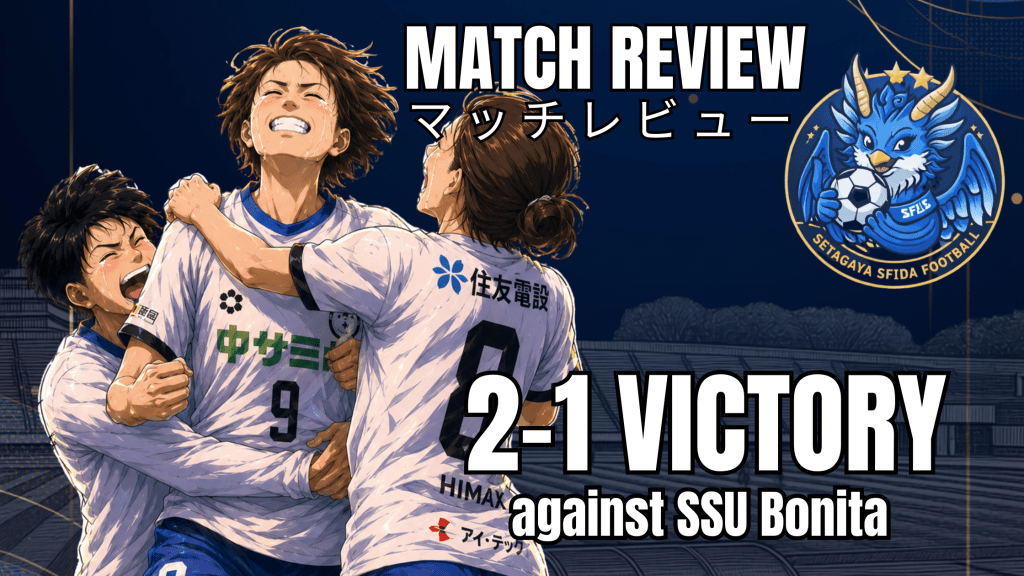
Sunday morning.
7am.
The sort of kick-off time that makes you question both your life choices and your commitment to Japanese women’s football.
Then again, this is how supporting SFIDA Setagaya from England tends to work. While sensible people are making coffee, walking dogs, or pretending they will finally sort out the garage, I’m sat in front of a screen watching a football match taking place on the opposite side of the planet.
This week it was Shizuoka SSU Bonita against SFIDA Setagaya.
Top of the league against ninth.
An unbeaten home side against a team that had gone three matches without a win.
A team that had demolished SFIDA 6-1 on opening day against a side still trying to prove that result belonged to a different era. And perhaps that last point mattered most.
Because while the table says this is merely Matchday 12 of the Nadeshiko League season, it never really felt like that.
This is SFIDA’s final season before becoming FC Tokyo Sfida. The countdown has already started.
Every victory feels slightly more valuable. Every away trip feels slightly more significant. Every good performance feels like evidence that this club is more than a merger waiting to happen.
The Museum of Fragrance Apology Tour
Before kick-off I discovered I had made a slight error.
Or, depending on your perspective, a catastrophic one.
In my preview I had confidently discussed the match taking place at the Iwata Sports Exchange Village Yumeria Stadium.
A magnificent name.
The sort of venue name that sounds less like a football ground and more like a location where a side quest begins in a Nintendo game.
Unfortunately, the match was actually being played at Yamaha Stadium. My bad.
The proper stadium.
The big one. The one that Jubilo Iwata play at.
If anyone happened to make travel arrangements based on my geographical expertise, then all I can do is apologise.
Although trusting a man in Yorkshire to accurately navigate rural Shizuoka is probably as much your fault, as it is mine.
Hopefully you enjoyed the Museum of Fragrance.
Why Are They All So Happy?
One of the first things that struck me before kick-off wasn’t tactical or statistical.
It was Bonita’s player photos.
Every player seemed delighted to be there. Smiling, holding plush toys, pulling slightly ridiculous poses. They looked less like members of a title-chasing football team and more like participants in a local festival.
Football usually takes itself far too seriously for that. Most player portraits resemble passport photos taken moments after receiving bad news from an accountant.
Yet Bonita looked genuinely happy.
Perhaps that isn’t a coincidence.
Teams spend fortunes trying to manufacture culture. Bonita’s culture appears to be simply enjoying itself, and they arrived at the top of the table.
Meanwhile, SFIDA looked relaxed during the warm-up despite everything stacked against them. The bookmakers had them around 5/1. Most people expected the league leaders to continue rolling forward.
The script had already been written.
Which is usually where football starts causing problems.
The League Leaders Forget They’re the League Leaders
The opening ten minutes were bizarre.
Not dramatic, not chaotic.
Just odd.
SFIDA looked better. Not slightly better. Actually better.
The passing was cleaner, and the pressing was sharper.
The confidence was visible.
After six minutes, I found myself wondering whether Bonita had accidentally forgotten they were top of the league.
Then they remembered, quite suddenly.
The shift wasn’t tactical so much as atmospheric.
The passing accelerated.
The movement became sharper.
The spaces SFIDA had enjoyed were starting to disappear.
Watching it unfold felt like standing beside a giant machine as somebody finally switches the power on.
Football occasionally produces teams that operate like low-battery Mechagodzilla.
Quiet. Dormant. Almost unimpressive.
Then, suddenly, every system activates at once, and entire city blocks start disappearing.
Bonita spent ten minutes looking mortal.
Then they remembered they were Bonita.
Which is actually a lot better premise than the American Godzilla film from 2014. I watched that last night; it was really bad. The first time you see Godzilla is like an hour in. Awful.
The Kumi Yokoyama Experience
It is impossible to discuss this match without discussing Kumi Yokoyama.
A fascinating footballer.
A brilliant footballer.
An occasionally infuriating footballer.
And almost certainly one of the most entertaining footballers in the division. Yokoyama arrived needing two goals to equal Shinobu Ohno’s all-time Nadeshiko League scoring record. Perhaps that explains some of what followed.
Or perhaps they simply enjoy shooting. A lot.
By twenty minutes, I had watched attempts from distances normally associated with public transport routes.
Some flew over.
One struck the bar.
Others forced saves.
Each attempt carried genuine danger.
Yet there was also something faintly absurd about it.
If I were managing them in Football Manager, there would be a team meeting.
A PowerPoint presentation.
Possibly intervention.
“Discourage Long Shots” would be selected.
The thing is, footballers like Yokoyama operate on a different wavelength.
What appears selfish occasionally becomes genius.
What appears ridiculous occasionally becomes history.
And because of that, nobody really tells them to stop.
Mio Otsuka and the Business of Ruining Good Chances
Bonita finished the afternoon with nineteen shots.
SFIDA managed seven.
If you handed those numbers to somebody without any context, they would probably assume the league leaders won comfortably. Perhaps 2-0. Maybe 3-1. The sort of result that gets filed away without much further discussion.
The statistics, however, neglected to mention Mio Otsuka.
Which felt like a fairly significant omission.
Standing at 180cm, SFIDA’s nineteen-year-old goalkeeper spent most of the afternoon making life increasingly frustrating for a Bonita side that arrived expecting to strengthen their grip on top spot. There are goalkeeping performances where a keeper makes lots of routine saves and accumulates a respectable highlight reel. This was not one of those afternoons.
This was closer to a sustained campaign of obstruction.
Bonita’s attackers kept arriving at the same conclusion. They had found space. They had worked an opening. They had finally generated the chance they wanted.
Then there was Otsuka.
The first thing that stands out is her size. Japanese women’s football is not overflowing with goalkeepers standing 180cm tall, and Bonita seemed aware of it from the outset. Shots that might trouble other goalkeepers were being comfortably gathered. Crosses suddenly looked less inviting. Angles became smaller. Decisions became harder.
The psychological effect was almost as important as the saves themselves.
Every attack carried an additional question.
Can we actually get this past her?
Kumi Yokoyama certainly tried often enough.
The league’s star forward spent much of the afternoon searching for Goal Number 182 of their Nadeshiko League career. Some attempts were ambitious. Others were genuinely excellent. Yet time and again Otsuka remained calm. One-on-one situations that might have become defining moments instead became routine interventions. Late in the match, with SFIDA desperately protecting their lead, Yokoyama found space just off the penalty spot and unleashed a dangerous effort that seemed destined to drag Bonita level.
Otsuka saved it.
Of course she did.
Sayuna Nakajima suffered similar frustrations. One particularly sharp turnaround effort required Otsuka to leap across goal and claw the ball away, a save that briefly reminded everyone why goalkeeping remains the strangest position in sport. One second you’re standing around observing events. The next you’re expected to launch yourself through the air and prevent disaster.
What impressed me most wasn’t necessarily the athleticism.
It was the complete absence of panic.
There was one moment late in the first half that probably should have ended badly. Otsuka had played the ball out, found herself slightly stranded, and suddenly Nakajima was breaking towards goal. The situation looked uncomfortable. Then impossible.
Yet somehow Otsuka recovered.
She sprinted back, reset herself, made the save, and carried on as though absolutely nothing unusual had happened.
The commentator’s response became increasingly familiar throughout the afternoon.
“NICE SAVE OTSUKA!”
Again.
“NICE SAVE OTSUKA!”
And again.
Eventually it stopped feeling like commentary and started sounding like an unavoidable fact of life.
What made it even funnier was Otsuka’s complete refusal to react. Most goalkeepers celebrate big saves. They roar. They punch the air. They demand applause. Otsuka would throw herself full length to preserve SFIDA’s lead and then immediately return to looking like somebody waiting for a train.
No emotion.
No theatrics.
Just another day at the office.
As the game entered its final stages, another side of her performance emerged. Bonita were becoming increasingly desperate. The crowd sensed urgency. The home side sensed urgency. Otsuka sensed something else entirely.
Opportunity.
The ball suddenly took slightly longer to retrieve. Restarts became wonderfully unhurried. The tempo slowed.
Bonita’s attackers became visibly irritated. I hesitate to call it time-wasting because that feels unfair.
Let’s call it strategic irritation. Or perhaps low-level trolling.
Either way, it worked.
The most revealing moment arrived when Yokoyama charged down a backpass, looking to force a mistake and reignite Bonita’s comeback hopes. Lesser goalkeepers might have panicked. Otsuka barely seemed to register the danger. She calmly cleared the ball and carried on.
The Goal Nobody Expected
The irony of football remains undefeated.
After spending much of the first half attempting increasingly ambitious finishes, Bonita finally scored from something much simpler.
A mistake.
The most reliable chance creator in football history.
Otsuka was stranded.
Yokoyama found the empty net.
1-0.
No spectacular finish. No world-class strike. No glorious piece of technical artistry.
Just a ball in a net. They had tried the spectacular all game at this point – but found success with a modest attempt.
Football enjoys jokes like that.
Bonita had controlled proceedings.
SFIDA looked increasingly cautious.
The game settled into a pattern that suggested the league leaders would eventually pull away.
At half-time I wasn’t optimistic.
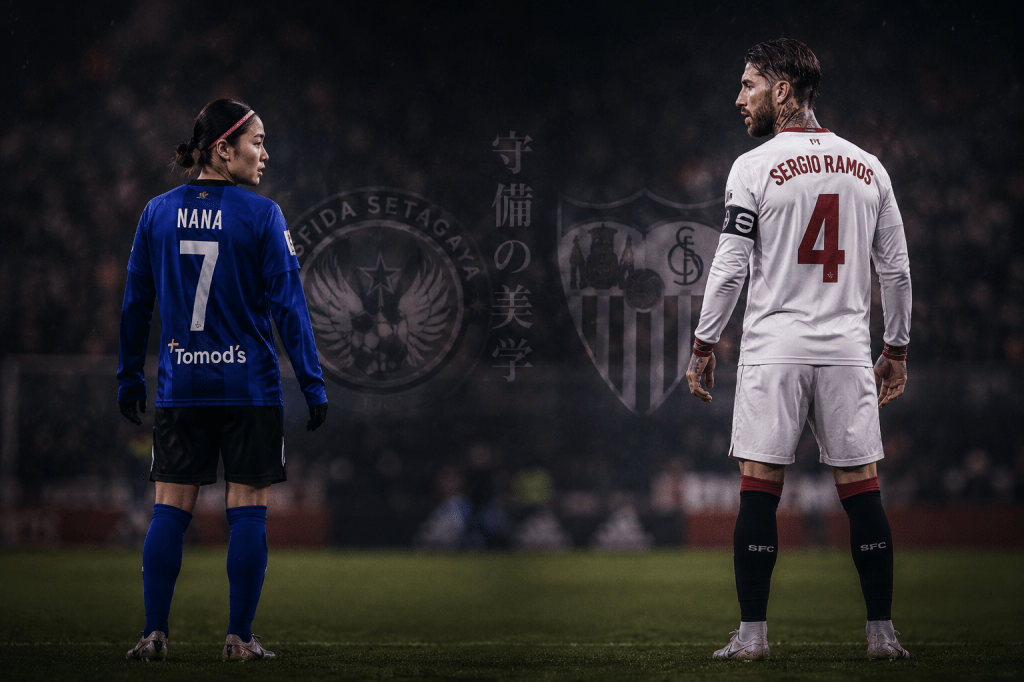
The Ramos of Setagaya: Nana Watanabe
The second half belonged to several players.
One of them was Nana Watanabe.
At this point I have compared her to Sergio Ramos so many times that it is becoming less of a football observation and more of a deeply ingrained personality flaw. Every week I promise myself I will stop doing it. Every week she produces another performance that makes it impossible.
Part of it is visual.
The long hair.
The headband.
The sleeves.
The position.
The aura.
If somebody told me a young Ramos had accidentally wandered into the Nadeshiko League after taking a wrong turn somewhere between Madrid and Monterrey, I would at least hear them out.
But the comparison goes much deeper than appearances.
When people discuss the most famous football defenders, they often focus on tackles, blocks and clearances. The obvious moments. The moments television producers can easily package into montages. What made Sergio Ramos special throughout his career, whether during the Spain FIFA World Cup winners era or later chapters of his journey, including his recent spell at Monterrey, was often something else entirely.
Ownership.
The sense that certain areas of the pitch belonged to him.
Watanabe has that.
Most defenders react to danger.
Watanabe appears to identify danger while it is still filling out paperwork.
She spent much of the afternoon stepping forward before attacks could properly form. A pass would be travelling towards a Bonita attacker and somehow Watanabe would already be there. A runner would spot space developing and Watanabe would arrive to close it before the opportunity fully existed.
Watching her defend is a bit like watching somebody spot smoke on the horizon and immediately run towards it carrying a bucket.
There is a confidence to it that borders on audacity.
She does not simply survive football matches.
She attempts to control them.
Like many of the Sergio Ramos career highlights people remember, the defending isn’t passive. It is confrontational. She wants duels. She wants aerial battles. She wants to impose herself physically and mentally on the opposition. Throughout the match she seemed to appear everywhere at once, breaking up attacks, recovering possession, then calmly helping SFIDA begin attacks of their own.
The other thing that stands out is her influence over the emotional temperature of the game.
Bonita had long spells of pressure.
The crowd sensed momentum.
Yet whenever things threatened to become chaotic, Watanabe seemed to restore order. A clearance. A tackle. A calm pass into midfield. Nothing spectacular individually. Yet collectively they acted as a kind of footballing fire extinguisher.
The Ramos comparison does eventually break down in one important area.
Discipline.
Where Ramos often played with the energy of a man attempting to collect every yellow and red card available in European football, Watanabe is considerably more measured. She brings the aggression, leadership and front-foot defending without the occasional descent into beautiful madness.
Perhaps the best description is that she is 70% Sergio Ramos, 20% Virgil van Dijk, and 10% Japanese tactical discipline.
Whatever the formula, it worked.
Bonita spent much of the afternoon trying to create decisive moments.
Nana Watanabe spent much of the afternoon quietly deleting them.
Then Goals Returned
Football changes quickly, sometimes absurdly quickly.
For over an hour, SFIDA had competed admirably without ever really looking likely to win.
Then everything changed.
Minute 66.
Miu Kashiwabara works the ball back. Saya Shinohara lifts a cross towards the far post.
The goalkeeper commits. Mitsuki Horie doesn’t hesitate.
Header.
Goal.
1-1.
The reaction fascinated me almost as much as the finish. Players celebrate every goal.
That part is routine. This felt different.
Almost the entire SFIDA side arrived at once. Not because celebration is expected. Because they genuinely wanted to be there in the moment.
Relief.
Belief.
Joy.
Something larger than simple excitement. Four minutes later came the second.
The winner.
Misuzu Uchida’s 200th league appearance.
A looping ball arrives. A touch. A strike. The ball bounces awkwardly. Then settles in the net.
2-1.
The sort of goal that makes football writers immediately start searching for symbolism. There probably wasn’t any. But it felt important. And sometimes that is enough.
Twenty Minutes That Lasted About Three Years
The final stages were exhausting.
Bonita attacked relentlessly. Yokoyama continued shooting.
Some efforts were magnificent.
Some optimistic.
All dangerous – but all probably a bit selfish.
Yet something interesting was happening.
The more desperate Bonita became, the calmer SFIDA looked. The home side possessed the league’s most gifted individual. The visitors increasingly resembled a collective.
Every clearance had purpose.
Every tackle had commitment.
Every player appeared connected to every other player.
This is the thing I’ve spent most of the season calling Bangaranga. Well, since I heard a cool song by that name on Eurovision.
Not a tactic nor a formation.
A feeling.
A team operating as one unit.
The opposite of individualism. The opposite of ego.
The opposite of waiting for somebody else to solve the problem. With rhythm.
By the final minutes, Bonita looked like they were searching for a hero. SFIDA looked like they already had eleven.
By full-time, Bonita had created enough chances to win many football matches. Mio Otsuka simply wasn’t interested in allowing this one to be among them.
What I Remember Most
The final whistle eventually arrived.
The result matters. The three points matter. The league table matters.
But what I suspect I’ll remember is the handshake line afterwards.
Yokoyama moved quickly through the formalities. They made it a real effort to bow before everyone else. Offered a single hand in the handshake when others were giving two – and could be seen pulling away their hand as soon as they touched.
Frustrated. Disappointed. Understandably so…but don’t be disrespectful to your opposition because they were better on the day.
That frustration appeared to boil over in the closing stages. Around the 89th minute, Yokoyama collided with Sfida defender Ayaka Nemoto while chasing a loose ball and came away limping from what observers described as a robust but fair challenge. Moments later, however, the veteran forward turned her attention toward the referee, engaging in a heated exchange.
The official match report confirms the outcome: a yellow card in the 90th minute for dissent, capping an afternoon where Bonita’s growing irritation mirrored the unravelling of their unbeaten home record.
Twenty yards away, SFIDA were celebrating together.
Players.
Substitutes.
Staff.
Everyone.
One giant huddle. One giant release of emotion. One giant reminder of why this team remains worth following.
It means SFIDA are not simply waiting for FC Tokyo.
Not simply preserving energy for some future identity. Not simply making up the numbers.
They went to the home of the league leaders. They faced the division’s biggest star.
They were given very little chance.
And they won.






2 responses to “We Found Success: SFIDA Setagaya Victorious in Shizuoka”
[…] Last weekend we went to the league leaders’ house and beat them. […]
LikeLike
[…] the final chapter contained flowers, a milestone goal, a record crowd, a brilliant fightback from the opposition and a result that nobody […]
LikeLike