
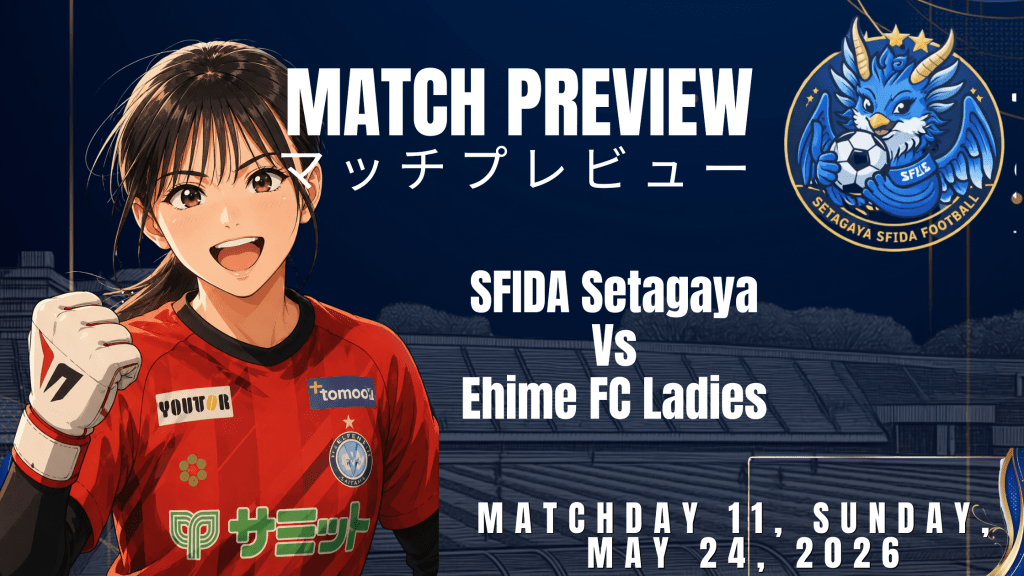
There is something faintly ridiculous about willingly waking up at 5am in England to watch a football match from western Tokyo.
Not tragic. Not heroic. Just slightly absurd in that specifically football-supporter way where the brain quietly stops applying normal life standards to itself.
The alarm goes off. The room is still dark. The kettle sounds louder than it should. Somewhere outside, Britain is still half-asleep beneath grey skies and delivery vans. Meanwhile, in Tokyo, the sun is already sitting over Ajinomoto Field Nishigaoka waiting for another ninety minutes of emotional cardiovascular testing.
And somehow this becomes your routine.
SFIDA Setagaya vs Ehime FC Ladies this Sunday is one of those matches that looks small from the outside until you stand too close to it. Then suddenly everything feels compressed. Table position. Momentum. Fatigue. Pride. The strange emotional economy of semi-professional football.
Ninth versus eighth.
Eleven points versus twelve.
One place apart and yet psychologically miles from safety.
These are the fixtures where entire seasons quietly change direction without anybody outside the division noticing.
Which, to be fair, is often how this league operates.
The Miyazaki Draw Changed Something
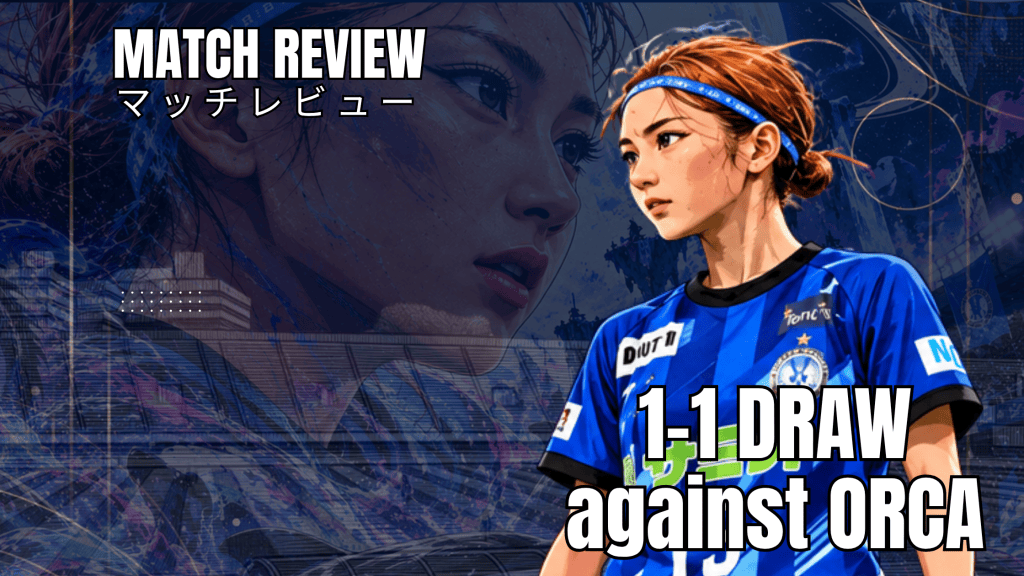
The 1-1 draw away to Viamaterras Miyazaki last weekend felt important in a way league tables do not always explain.
A month ago, SFIDA looked haunted by their own endings. Conceding late. Folding under pressure. Drifting into those familiar emotional sinkholes teams like this sometimes develop after major squad upheaval.
And the upheaval was brutal.
Over fifteen departures in the off-season. Veterans gone. Stability evaporated. Identity temporarily misplaced somewhere between rebuilding optimism and low-level panic. The kind of turnover that usually leaves clubs wandering around like Mechagodzilla after somebody unplugged half the control room.
But Miyazaki felt different.
Going behind away from home against one of the league’s strongest sides would previously have triggered collapse. Instead, SFIDA stayed calm. Mature, even. Which is not always a word associated with transition-heavy chaos football played by emotionally combustible teams.
They responded.
That mattered.
Not because draws are glamorous. They are not. Draws are football’s equivalent of replying “fine” when somebody asks how life is going.
But because the reaction suggested something sturdier is beginning to exist beneath the noise.
Tomod’s MATCH and Football in Its Purest Form
This weekend is officially “Tomod’s MATCH”.
And honestly, that alone makes the whole thing strangely beautiful.
Tomod’s, the Japanese pharmacy chain, sponsors the fixture because several SFIDA players literally work there during the week before playing top-flight football on Sundays.
That detail sticks.
Not because it is quirky. Modern football increasingly treats “authenticity” as a branding exercise anyway. But because this is authenticity without performance. Nobody is trying to manufacture romance from it. These players genuinely clock into work.
One imagines a customer buying cold medicine on Wednesday and then seeing the same woman chasing a counter-pressing trigger at Nishigaoka four days later.
“The person you always see every day is today’s star on the pitch.”
It is such a simple slogan that it almost catches you off guard.
Elite football has become obsessed with separation. VIP tunnels. Executive glass boxes. Players treated like distant financial assets wrapped in sponsored headphones.
SFIDA feels closer to the original French meaning of amateurism. Amateur. For the love of.
Not lesser.
Just purer.
Which perhaps explains why these matches feel emotionally heavier than they logically should.
Ehime Are Dangerous, But They Leak Emotionally
Ehime arrive after beating Nippatsu Yokohama 3-1 last weekend.
An important result too, because beforehand they had won just once in four matches. Their season has carried that unstable energy of a team permanently trying to outrun exhaustion.
Manager Ayumu Hasegawa has implemented a highly aggressive vertical style built around pressing intensity and transitional volume. In theory, it is modern and brave. In reality, it occasionally resembles people sprinting through a burning building carrying tactical whiteboards.
The problem is obvious.
Most of these players also work full-time jobs.
Eventually the legs go.
And when the legs go, the structure follows shortly after.
Ehime’s defence currently feels like one of those old apartment doors that technically locks but still rattles ominously all night whenever the wind changes direction. Six straight matches without a clean sheet tells its own story.
Nobody really mentions the psychological exhaustion of semi-professional football enough either.
The physical fatigue is obvious. But the emotional fatigue is worse.
Commute. Work. Training. Travel. Tactical meetings. Then ninety minutes of football where one small mistake can ruin an entire week.
People wonder why these matches become chaotic late on.
That is why.
Mizuki Horie and the Memory of Previous Damage
Some players simply enjoy certain opponents too much.
Mizuki Horie appears to enjoy Ehime in a way that probably feels borderline personal for them now.
Three goals against them in 2025 alone. Late goals too. The damaging sort. The ones that stay in dressing rooms longer than they should.
Football people pretend not to believe in psychological residue, but everybody does really.
Horie at times feels less like a striker and more like a recurring weather event. At 174cm she dominates space awkwardly, dragging defenders into uncomfortable areas before matches devolve into second-ball warfare.
Then there is Misuzu Uchida, SFIDA’s emotional metronome, forever arriving in spaces milliseconds before defenders properly register danger. And Kokone Kitagawa, who thrives once games stop obeying tactical instructions entirely.
Which they probably will.
These fixtures usually do.
The Tactical and Managerial Battle
The tactical battle here feels less like two managers trying to control a football match and more like two men deliberately setting small fires and trusting their own players to survive the smoke longer than the opposition. Takashi Hamada’s SFIDA Setagaya are no longer the recklessly open side that spent the early weeks of 2026 collapsing under their own ambition, but the instinct toward disruption still defines everything they do. Hamada-ball remains deeply suspicious of calmness.
Even after lowering the defensive line and introducing a more compact mid-block, the philosophy still revolves around emotional acceleration and transitional violence. SFIDA do not really want matches to settle into rhythm. They want games to become unstable enough that structure itself starts sweating. Once momentum swings begin, they attack spaces in frantic waves, flooding broken defensive shapes with runners and second-ball pressure like some slightly overclocked Mechagodzilla stomping through carefully arranged city planning. It looks chaotic because, to a large extent, it is. Deliberately so.
Ehime FC Ladies under Ayumu Hasegawa arrive carrying a different type of danger. Their football is built on labour. Relentless, exhausting, deeply admirable labour. The pressing is aggressive, the vertical transitions immediate, the overlaps constant. At their best they can suffocate teams through sheer collective intensity, dragging opponents into physical survival contests rather than tactical ones. But there is a visible human cost to maintaining that style while balancing ordinary working lives away from football. As matches stretch into the final half hour, the spacing often begins to fray. Midfield slides arrive half a second late. Recovery runs shorten slightly.
Concentration drips away possession by possession. And unfortunately for Ehime, those are precisely the moments SFIDA tend to enjoy most. Hamada’s system thrives once games lose organisational clarity. So this fixture may ultimately become less about who controls the match and more about who survives the emotional and physical exhaustion that inevitably arrives once the structure begins to crack.
Nishigaoka Compresses Everything
Ajinomoto Field Nishigaoka does not allow emotional distance.
That is its gift.
And occasionally its threat.
The harisen clappers crack through the air with alarming sharpness. Sound rebounds off the stands. Every transition feels faster there. Every mistake louder.
Some stadiums create atmosphere.
Nishigaoka creates pressure.
Watching streams from England somehow intensifies that weird intimacy. The camera angle sits close enough that you hear instructions, applause, frustration. It feels less like watching a broadcast and more like accidentally eavesdropping on someone else’s sporting anxiety.
There is a faint Journey’s End quality to these sorts of clubs too.
Not the war itself. The hierarchy.
Stanhope raging because Raleigh ate with the men rather than preserving officer distance. Football still carries those invisible structures everywhere. Elite clubs demand separation. Controlled image. Protocol. Distance between labour and status.
But at clubs like SFIDA, the distance collapses.
Players work ordinary jobs beside ordinary people and then stand beneath floodlights hours later carrying the same emotional burdens as everyone watching them. There is no illusion of aristocracy here. No polished corporate mythology.
Just exhausted people trying to win football matches.
Which, oddly enough, makes the stakes feel more real.
This Feels Like A Chance
That is probably what this match ultimately is.
A chance.
Not for promotion. Not for glory. Not for narrative nonsense about “statement victories”, which usually just means somebody in the media team needs content before the deadline.
A chance to breathe.
A chance to leapfrog Ehime.
A chance to finally create separation from the ugly gravitational pull near the bottom of the table.
Because these positions matter psychologically long before they matter mathematically.
And SFIDA suddenly feel alive again.
Not fixed.
Not stable.
Just alive.
Which is often enough.
By Sunday morning in England, the coffee will already be cold again. The curtains will still be shut. The rest of the country will still be asleep while a handful of us watch football from Tokyo, wondering why this strange ritual matters so much.
It just does.
These are the moments people later pretend to forget.
They rarely do.




4 responses to “SFIDA Setagaya vs Ehime and the Sense a Corner Might Finally Be Turning”
[…] Rather read in English? […]
LikeLike
[…] is perhaps no stranger subplot in this entire Leicester collapse than Alisha Lehmann. One of women’s football’s global […]
LikeLike
[…] Ehime immediately began growing into the match. […]
LikeLike
[…] Women’s football in Japan has changed. […]
LikeLike