
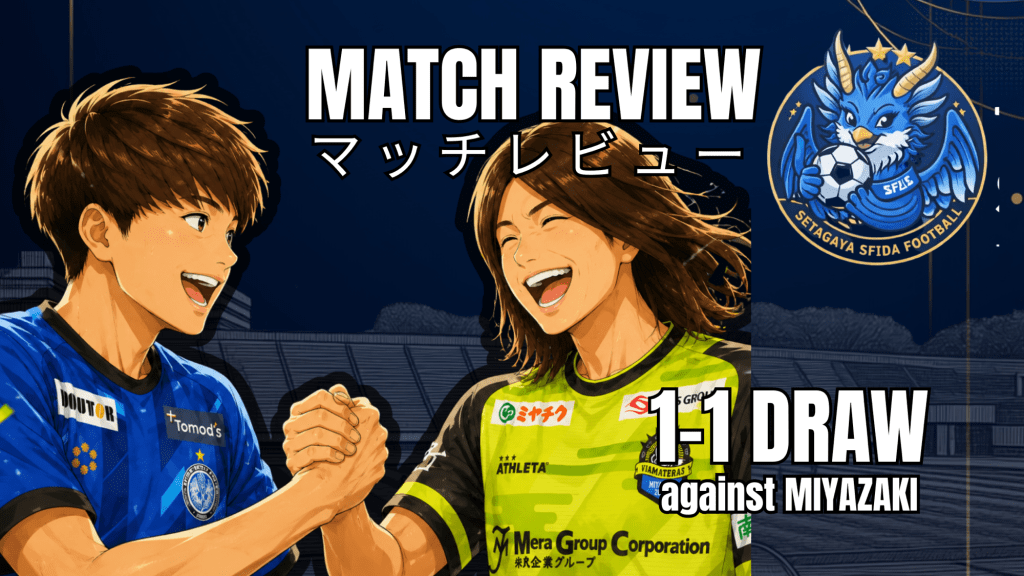
Another early Sunday morning. Another Sfida Setagaya FC match. Another coffee poured while the rest of England still resembles a paused loading screen.
6am. Digestible.
Or at least that is what I told myself before kickoff against Viamaterras Miyazaki.
Second in the league. Tropical conditions. 1,170 home fans. A team that entered the day smelling blood after league leaders Shizuoka dropped points elsewhere. Meanwhile SFIDA arrived in ninth, somewhere between “dangerously inconsistent” and “annoyingly difficult to kill.”
Honestly, I expected punishment.
Not romantic punishment either. Not some poetic “football humbles us all” type thing. I mean actual sporting suffocation. The type where by 6:18am you are staring at the wall wondering why you voluntarily rearranged your sleep cycle to watch your football club get folded into geometric shapes like a polygon in a maths textbook designed by sadists.
But football rarely behaves the way you expect.
That is why we keep returning to it.
Even at 6am.
Viamaterras Miyazaki’s Support System
The first thing that struck me was the noise. Miyazaki’s supporters were loud immediately. No slow burn. No polite applause while people finished convenience store coffee. Straight into it. Drums. Rhythm. Constant pressure.
The kits helped too. Miyazaki in violent neon. SFIDA in white. It looked less like a football match and more like two rival corporations settling a dispute over ownership of the future.
Then the football started and Miyazaki looked frightening.
Not theatrical. Not flashy. Just intensely competent.
Within minutes they were moving the ball around with the kind of accuracy you’d expect from a Canon imagePROGRAF PRO-300 firing out a full-colour print. Crisp. Precise. Ruthless.
Every pass arrived exactly where it needed to be, their defenders recycling possession like a production line running at full tilt. High pressure. High tempo. No hesitation. A long-range effort from Riho Sakamoto forced an early save, and from there the tone was set like wet ink drying instantly onto the page.
You could see immediately why they are second.
There was one sequence around the five-minute mark that basically explained the entire club. One of their defenders overhit a pass toward the touchline. For most teams, that becomes an opposition throw-in and everybody resets shape.
Not here.
Their winger practically folded herself backwards, sprinted full speed, hooked the ball back into play before it crossed the line, and suddenly Miyazaki were attacking again like nothing happened.
No pause. No surrender. No wasted motion.
It was like watching the Miyazaki Expressway after dark, headlights threading through the mountains between Ebino Interchange and Kiyotake Junction at speeds that should not really work in harmony with physics. Cars flying at 100 km/h, yet never touching. Every lane change calculated. Every movement understood before it happened. Controlled chaos. Precision inside aggression.
Miyazaki moved the ball with that same expressway rhythm, surging forward in sharp bursts before calmly recycling possession again, like traffic flowing cleanly through the E10 under neon signs and distant service area lights.
SFIDA looked shell-shocked early on.
Seven minutes in, I genuinely do not think we had meaningful possession. Never mind a shot.
And yet something strange happened after the opening storm.
Calming the Waters of Miyazaki
We stabilised the game.
Not elegantly. Not beautifully. But visibly.
Miyazaki were still superior territorially, but SFIDA started contesting second balls. Started blocking passing lanes. Started dragging the match into something uncomfortable and scrappy. Hamada Takashi clearly understood the danger beforehand too, later saying:
“Against Miyazaki, whose strength is their forward propulsion, we approached the game with the intention of playing compactly and collectively.”
That compactness mattered.
Because Miyazaki’s attack looked terrifying until the final pass.
Again and again they reached dangerous areas only for the decisive ball to fail them. One forward run arrived into empty space with nobody attacking it. Another shot drifted wide. Another sequence collapsed right at the edge of completion.
Meanwhile SFIDA’s attacks resembled somebody assembling IKEA furniture using emotional instinct instead of instructions.
There were moments.
But they rarely connected.
Still, there were signs of life. Rina Sato battled in midfield. Ayaka Shimada would later change the game entirely after coming on. And at the back, Nana Watanabe looked remarkably calm under pressure, constantly trying to reset possession while the rest of the match threatened to become a tropical knife fight.
Also, I need to discuss Miyazaki’s captain properly.
Riho Sakamoto wearing long sleeves in 29-degree heat is one of the most outrageous things I have seen all season.
Everybody else looked like they were slowly dissolving under the sun and she was out there dressed like she had accidentally wandered into Hokkaido Snow Festival.
Completely absurd behaviour.
Excellent footballer though.
Everywhere.
Defending. Passing. Drifting into midfield. Drawing fouls with the kind of theatrical timing that would make veteran wrestling heels nod respectfully from backstage.
By the cooling break around 24 minutes, the match had settled into this fascinating rhythm where Miyazaki controlled the game but SFIDA controlled the emotional temperature of it.
The longer it stayed 0-0, the stranger the atmosphere became.
And honestly, the surroundings made it even stranger.
This stadium exists in one of those uniquely Japanese layouts that feels like somebody accidentally overlapped three different The Sims expansion packs onto the same map. Directly behind the halfway line sat a surprisingly luxurious housing estate filled with spotless people-carriers and immaculate balconies. Right beside that was another sports facility entirely. Which itself appeared to be hosting another football match at the exact same time. Everything felt stacked together with this strange, hyper-efficient logic that should look chaotic but somehow doesn’t.
Only in Japan can a potential title-impacting football match exist beside what looks like a family leisure complex and somehow it all feels perfectly coherent.
The crowd soundtrack helped too.
One drummer in particular was magnificent. During stoppages he started throwing in fills like he’d spent twenty years performing in smoky basement bars somewhere in downtown Miyazaki. You could almost hear fragments of classic rock buried inside the rhythm. Smoke on the Water. I Predict a Riot. Probably a few Japanese punk songs hidden in there too.
Then somebody introduced a cowbell. Awful.
The second half began with the same uneasy balance. Miyazaki pressing. SFIDA resisting. The heat slowly eating everybody alive.
And then came the sequence that changed how I felt about the game entirely.
55 Minutes and the Change
SFIDA finally broke properly.
A flowing move down the right. No.16 drove forward brilliantly and released No.8 into the box. Suddenly Miyazaki’s structure cracked open. Defender beaten. Space everywhere.
The square pass arrived perfectly to Misuzu Uchida.
And she put it wide.
Nine goals already this season. The league’s deadliest finisher. A conversion rate bordering on supernatural.
Not narrowly wide either.
The kind of miss that follows you home afterwards and waits silently in the kitchen.
That was the moment I realised SFIDA could actually get something here.
Not because they were better.
But because football punishes hesitation with horrifying efficiency.
Still, Miyazaki kept coming.
Their passing remained beautiful. Their transitions remained sharp. Their substitutes added fresh legs. Veteran Ayako Shimada especially transformed their buildup with one-touch combinations that suddenly accelerated everything.
And eventually the pressure broke through.
72 minutes.
Corner.
Chaos.
Shot against the bar.
Loose ball.
Yuzuki Tsuchiya reacts first.
1-0.
Deserved? Probably. Having lost last week, it was a bit of a gut punch.
The celebration told its own story too. Six-player pile-on. Pure release. Then the Dragon Ball fusion pose afterward. Not subtle. Not restrained. Just total emotional detonation under the Miyazaki sun.
From my sofa in England, slightly sleep-deprived and running entirely on Brown Bear Coffee, it genuinely felt like the game might finally tilt away from SFIDA completely.
But three minutes later everything changed.
SFIDA suddenly found rhythm.
Sayo Shinohara glided through midfield beautifully. Nodoka Ishiura produced this ridiculous Zidane-style turn under pressure. The move flowed naturally toward Mizuki Horie and she finished with the composure of somebody refusing to acknowledge pressure exists.
1-1.
Sixth goal of the season for Horie.
And suddenly the entire emotional geometry of the match flipped.
Now Miyazaki looked nervous.
Now SFIDA looked dangerous.
Now every counterattack carried genuine threat.
The final fifteen minutes were magnificent chaos.
SFIDA goalkeeper Mio Otsuka spent half the match operating like an emergency sweeper from a futuristic anime football series, racing miles outside her box to intercept long passes before they became disasters. One clearance especially felt absurdly risky. The ball bouncing in the wind. Attackers charging in. Otsuka heading it clear at full stretch anyway.
Living dangerously.
Then came Uchida hitting the post in the 86th minute.
I think my soul temporarily exited my body.
At that point SFIDA genuinely looked more likely to win. Miyazaki’s structure had started fraying under fatigue. The substitutions shifted momentum. SFIDA’s individual quality began appearing in flashes while Miyazaki’s attacks became increasingly frantic.
One move from Miyazaki’s No.24 perfectly summed it up. She had Sakamoto clean through centrally but instead chose to shoot herself. Saved.
Decision-making collapsing under pressure.
Meanwhile SFIDA kept surging forward.
By added time, neither side remotely resembled a team protecting a draw. Miyazaki attacked recklessly. SFIDA countered immediately. The game became stretched and unstable and brilliant.
Then Miyazaki nearly won it anyway with a shot that missed by millimetres.
Actual millimetres.
At 6:52am on a Sunday morning, I nearly needed sake.
Instead, full time arrived.
1-1.
And strangely, it felt right.
End of the Game
Miyazaki looked like a genuinely excellent football team. Organised. intense. Physically relentless. You can see exactly why they are chasing the title. Sato Takanori later admitted his side became too cautious against SFIDA’s reputation, saying:
“We were too conscious of the opponent and were a little defensive, so we couldn’t show our usual strength.”
That probably explains why the game became so psychologically strange.
But SFIDA showed something important too.
Resilience. Adaptation. Patience.
This was not the performance of a weak mid-table side merely surviving.
It was the performance of a team rediscovering belief in itself.
By the end, SFIDA were still standing in the rubble, bruised but grinning slightly.
And honestly?
At 6am in England, with coffee gone cold and sleep completely ruined, that felt more than acceptable.
The Players’ Perspectives: Frustration & Hunger
For Viamaterras Miyazaki, the final whistle brought the bitter taste of an opportunity squandered, while Sfida Setagaya felt the surging momentum of a near-upset.
Ayano Mitsui (Miyazaki DF): The Heartbreak of a Momentary Lapse Mitsui captured the emotional toll of conceding just three minutes after taking the lead. She expressed deep frustration but immense gratitude for the local faithful.
“We were beaten in a moment of weakness. It’s very frustrating. I wanted to win no matter what. We will switch our focus and keep looking forward together so that we can definitely win the next one. To the people who supported us in the heat, and the people who operated the stadium for a long time for the double-header, thank you very much.”
Ayako Shimada (Miyazaki MF): The Veteran’s Lament Subbed on in the 63rd minute to break the deadlock, the veteran playmaker provided the spark Miyazaki needed but was left ruing the team’s inability to manage the game.
“As a substitute, I was conscious of coming into the game in a way that would give the team momentum… It was good that I was able to get involved in the opening goal. We told each other to be especially focused for the five minutes after scoring. However, we conceded from a situation we shouldn’t have during that time, and as a result, it ended in a draw. It was a match with many things to reflect on.”
Yuzuki Tsuchiya (Miyazaki FW): The Striker’s Insatiable Hunger Despite scoring the go-ahead goal, the breakout star was highly critical of her own output, admitting her goal had a touch of fortune and demanding more of herself.
“The ball spilled right in front of me, and I just swung my foot at it. Normally, I don’t shoot much with my right foot in those situations, but I was able to take a bold swing… It felt more like the ball fortunately met my foot rather than me aiming perfectly. Luck was on my side. But I realized again that one goal is not enough to win. As a forward, I must not be satisfied with one goal; I have to become a presence who can score two or three.”
Sfida Setagaya FC (Official Camp): The Taste of Near-Victory The Setagaya camp recognized that they had weathered a massive storm before finding their teeth in the dying minutes. They praised their towering goalkeeper, Mio Otsuka, for keeping them alive during Miyazaki’s onslaught.
“In the first half, when we were pushed back by the opponent for long periods, the defense, centered around GK Otsuka, defended tenaciously… After equalizing, we created multiple decisive chances and closed in on the opponent’s goal, but we were just one step short of a winning goal.”
Who scored in Viamaterras Miyazaki vs SFIDA Setagaya?
Viamaterras Miyazaki took the lead through Yuzuki Tsuchiya in the 72nd minute before SFIDA Setagaya FC equalised via Mizuki Horie three minutes later in a dramatic 1-1 draw in the 2026 Plenus Nadeshiko League Division 1 season.
Why was the Miyazaki vs SFIDA match significant?
The draw carried major title-race implications because league leaders Shizuoka SSU Bonita had dropped points earlier in the weekend. A win would have allowed Viamaterras Miyazaki to close the gap significantly, while SFIDA earned a valuable point against one of the division’s strongest sides.
Who is Misuzu Uchida?
Misuzu Uchida is one of SFIDA Setagaya FC’s most dangerous attacking players and entered the Miyazaki match with nine league goals in the 2026 season. She missed a huge second-half chance in the draw, later hitting the post during SFIDA’s late surge.
How can fans watch the Nadeshiko League overseas?
Many Nadeshiko League matches are streamed free internationally on the official Nadeshiko League YouTube channel. Overseas fans often watch early morning kickoffs due to Japan’s time difference, especially supporters following clubs like SFIDA Setagaya FC from Europe





One response to “6am in England, 29 Degrees in Miyazaki: Watching SFIDA Setagaya Hold the Line”
[…] 1-1 draw away to Viamaterras Miyazaki last weekend felt important in a way league tables do not always […]
LikeLike