
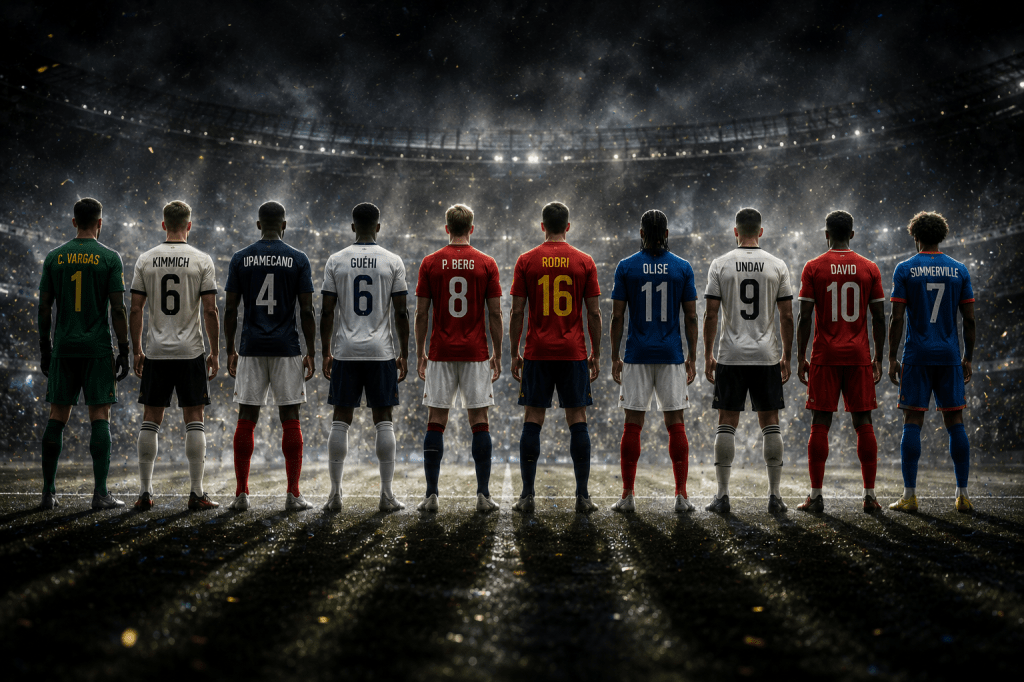
Every World Cup ends with an official Team of the Tournament.
FIFA selects one. Broadcasters produce another. Statistical models generate their own versions before the trophy has even been lifted. Most are perfectly sensible, rewarding the winners, the biggest names and the standout performances.
There’s nothing wrong with that. This isn’t one of those teams. Assigning a formation? Calling this a formation is probably generous.
There isn’t a conventional left-back, largely because Keito Nakamura and Crysencio Summerville have already wandered into the same part of the pitch and decided they’re staying there. Joshua Kimmich provides the width from the right, Rodri attempts to maintain some semblance of order, while Marc Guéhi and Dayot Upamecano are left with the unenviable task of defending whatever space remains.
Camilo Vargas World Cup Stats
Camilo Vargas spent years travelling to international tournaments without being allowed to do very much.
He was part of Colombia’s squads at the 2014 and 2018 World Cups, but remained an unused substitute. He also watched several Copa América campaigns from the bench, occupying that strange goalkeeping purgatory where a player is important enough to travel but not quite important enough to play.
Then, at 37, his moment finally arrived.
Vargas started all five of Colombia’s matches at the 2026 FIFA World Cup, playing 480 minutes and conceding only once outside the penalty shoot-out that ended their tournament.
He kept four clean sheets and recorded an 85.7 per cent save percentage. Those numbers are impressive on their own, but they also describe the exact sort of goalkeeper wanted in this team. He was rarely frantic. He did not turn routine catches into theatrical events. He simply stood where he was supposed to stand and prevented the ball from entering the net.
Goalkeeping, in theory, remains a fairly straightforward profession.
Against Portugal in Miami, Vargas made a point-blank save from Bruno Fernandes to preserve a goalless draw. Against DR Congo, he produced another clean sheet as Colombia secured their place in the knockout rounds.
Then came Switzerland in Vancouver.
Vargas survived 120 minutes without conceding, making two important saves and registering his fourth clean sheet in five matches. Colombia still went out on penalties because football occasionally asks one player to preserve a match for two hours before allowing several teammates to kick the opportunity away.
It was cruel, but also strangely fitting.
For years, Vargas waited for a World Cup opportunity. When it arrived, he played almost flawlessly and was eliminated without conceding from open play.
Joshua Kimmich World Cup Stats
Joshua Kimmich is playing at right-back.
Sorry.
He is listed as a right-back. He has played as a right-back. He can also play in midfield, which apparently means every selection involving him must now be preceded by a tactical tribunal.
At the 2026 World Cup, Kimmich played all four of Germany’s matches, registering two assists, creating 10 chances and completing 95 per cent of his passes. He also played 84 passes into the final third, one of the highest totals in the tournament.
Most importantly for this particular construction, he attempted 31 crosses.
That is useful because this team contains Deniz Undav, Michael Olise, Keito Nakamura and Crysencio Summerville. Somebody needs to deliver the ball towards them rather than joining the queue of players waiting to dribble inside.
Kimmich was particularly influential in Germany’s 7-1 win over Curaçao, providing two assists and five key passes. Against Paraguay, he played the full 120 minutes and converted his penalty during the shoot-out, although Germany were still eliminated.
Afterwards, he said Germany deserved to go out.
International captains are normally expected to speak about learning experiences, fine margins and the importance of staying together. Kimmich instead looked at the evidence and reached the conclusion available to everybody else.
There is something reassuring about that.
He provides passing, leadership and crossing from the right. He may also wander into central midfield whenever he feels the team lacks supervision.
Dayot Upamecano World Cup Stats
Defenders should win the ball.
This sounds obvious, but modern football has developed several ways of discussing defending without mentioning the actual removal of possession from an opponent.
Dayot Upamecano made interceptions. He won tackles. He cleared danger. More importantly, he often managed these things without first striking an attacker somewhere above the ankle.
Technical skill.
Upamecano played eight matches for France at the 2026 World Cup, completing 95 per cent of his passes while recording 38 clearances and winning 14 of his 17 attempted tackles.
He did not receive a yellow card.
That last statistic matters. There is a particular type of centre-back who approaches every challenge as though auditioning for a commemorative DVD titled Football’s Most Fearsome Warriors. Upamecano largely resisted this temptation.
France kept four clean sheets during the tournament, with Upamecano anchoring the defence against Iraq, Sweden and Paraguay. Even during the semi-final defeat to Spain, he recorded eight clearances.
His most curious contribution came in the third-place play-off against England.
France were trailing 4-0 when he was introduced at half-time. His arrival stabilised the defence, helped trigger a ridiculous French comeback and included an assist for Ousmane Dembélé. England eventually won 6-4, because the match had abandoned normal football and become a school playground argument with television cameras.
Marc Guéhi World Cup Stats
Marc Guéhi is here because somebody eventually has to defend.
England’s tournament ended painfully, but Guéhi emerged with his reputation enhanced. He was composed, consistent and particularly impressive when dealing with Erling Haaland during the quarter-final against Norway.
Containing Haaland is never a solitary task. It usually involves several defenders, a carefully organised midfield and at least one moment in which everyone looks towards the referee with desperate administrative hope.
Alongside Upamecano, he gives this otherwise mildly irresponsible World Cup XI another centre-back capable of stepping forward, winning possession and passing the ball without creating an international incident.
Guéhi fills an actual structural need. There is no glamour in that sentence, which is perhaps why it feels important.
Tournament teams often become collections of famous names rather than functioning football sides. Players are pushed into inappropriate positions because leaving them out feels impolite.
He is simply a very good centre-back who played well at the World Cup. To be fair, that should be enough.
Rodri World Cup Stats
Rodri won 20 tackles at the tournament.
His purpose in this team is therefore straightforward. He wins the ball before it becomes Upamecano’s problem.
Rodri captained Spain to the 2026 World Cup and won the Golden Ball as the tournament’s best player. He started all eight matches, completed 692 passes and maintained a passing accuracy of 94 per cent.
He did not score. He did not provide an assist.
This is useful because it reminds everyone that influence is not always delivered in brightly coloured statistical packaging.
Rodri controlled matches.
Against Portugal in the Round of 16, he recorded 106 touches and completed 87 passes. Against France in the semi-final, he won 11 individual duels, more than the entire French midfield combined.
In the final against Argentina, he completed 93 of his 99 passes and helped prevent Argentina from recording a shot on target during regulation time. Spain eventually won 1-0 after extra time.
This was described as control.
For once, it actually looked like it.
Rodri gives this team the illusion of responsibility. While Kimmich advances down the right and Nakamura drifts wherever he pleases, Rodri will remain in midfield, receiving possession, closing passing lanes and quietly preventing catastrophe.
Every irresponsible side needs one adult.
Spain had several. This team has Rodri.
Patrick Berg World Cup Stats
Patrick Berg will not sell as many shirts as some of the players around him.
Norway’s run to the quarter-finals was understandably framed around Erling Haaland. This tends to happen when one player is enormous, scores goals and appears on enough advertising boards to qualify as urban infrastructure.
But Norway were not simply Haaland plus ten witnesses.
Berg quietly knitted their midfield together. He pressed, recycled possession and gave the more expressive players permission to move forward without leaving the entire structure unattended.
He complements Rodri because he does not need to dominate the ball. He can receive it, move it quickly and then occupy the correct space, an activity that appears unremarkable until a midfielder stops doing it.
Berg represents the players whose contribution becomes clearest when they are absent.
There is no need to build the team around him. He does not require three tactical diagrams and a personal documentary. He simply improves the conditions around everyone else.
Keito Nakamura World Cup Stats
Keito Nakamura technically begins from the left.
Positions, however, are merely polite suggestions in this team.
Nakamura was one of Japan’s brightest performers at the 2026 World Cup and emerged as one of the tournament’s breakout players. His performance in Japan’s 4-0 victory over Tunisia was particularly memorable, helping turn the match into one of the Samurai Blue’s finest World Cup displays.
Here, he operates as a drifting left-sided number 10 behind Undav.
This will create an overcrowded arcade of dribblers involving Nakamura, Summerville and whichever opposing defender has been unfortunate enough to stand nearby.
In theory, Nakamura should remain central.
He carries the ball elegantly, finds small spaces and gives this XI another player capable of making a routine possession feel as though something might happen.
Some players improve a team’s probability of winning.
Others make you look up from your phone.
Nakamura did both.
Crysencio Summerville World Cup Stats
Crysencio Summerville recorded two goals and two assists in four appearances for the Netherlands.
He scored on his World Cup debut against Japan, curling the ball in from the left during a 2-2 draw. Against Sweden, he entered at half-time and produced a goal and an assist in a 5-1 win.
He then created Cody Gakpo’s goal against Morocco in the Round of 16, although he missed during the penalty shoot-out that eliminated the Netherlands.
That miss should not erase the rest.
Penalty shoot-outs have a peculiar ability to reduce an entire tournament to one kick. A player can contribute for several matches, create goals and alter games, only to be remembered through a brief clip of the ball travelling in the wrong direction.
Summerville was exciting throughout the tournament.
He carried the ball directly, attacked defenders and produced the sort of movement that makes a wide player feel dangerous before anything has actually happened.
He also has a place in my footballing memory from his time at Leeds United, which absolutely affects this selection.
Objectivity has already left the building. There is, however, one condition.
Obviously, if Summerville joins Manchester United, we can forget about all this. They are awful. They lost to Wrexham.
There are limits to sentimentality.
Michael Olise World Cup Stats
Michael Olise recorded seven assists at the 2026 World Cup.
Seven.
That broke Pelé’s record of six assists from the 1970 tournament and made Olise the most productive creator across a single men’s World Cup.
He created 22 chances, completed 86 per cent of his passes and started all eight of France’s matches.
He did not score despite attempting 14 shots.
This feels almost reassuring. Even historic tournaments require one mildly inconvenient statistic to stop them becoming propaganda.
Olise provided two assists against Iraq, another two against Sweden and created the chance for Kylian Mbappé’s opening goal against Senegal.
He then assisted both of Mbappé’s goals during the chaotic 6-4 defeat to England in the third-place play-off, breaking Pelé’s record in a match that appeared to have been designed by somebody testing the limits of a football video game.
Seven assists is not simply a large number. It suggests sustained creativity across an entire tournament.
Do you think that if I wrote Olise a nice letter explaining that he is very good and should come play for England, he would consider it?
I would use quality paper. Perhaps a fountain pen.
France may object, but nothing has been formally drafted yet.
Jonathan David World Cup Stats
Jonathan David completes this team because every memorable World Cup needs a player who carries the hopes of an entire nation without ever looking overwhelmed by the responsibility.
Canada’s run to the Round of 16 was one of the stories of the tournament, and David was at the centre of it. He started all five matches, scored three goals and played over 420 minutes, but it was one afternoon against Qatar that transformed a very good tournament into a piece of Canadian football history.
His hat-trick in the 6-0 victory delivered Canada’s first ever men’s World Cup win, making him the first Canadian man to score a World Cup hat-trick and the first player representing a host nation to achieve the feat since 1966. These are the sort of statistics that feel almost too neat, as though football had been waiting decades for somebody to claim them.
The rest of his tournament perhaps lacked the same fireworks, but that hardly matters. Great World Cups are often remembered through individual moments rather than relentless consistency. David’s performance against Qatar immediately became one of those moments, while his tireless running helped Canada reach the knockout stages for the first time before Morocco finally brought the adventure to an end.
This team already has creators in Michael Olise, dribblers in Crysencio Summerville and Keito Nakamura, and a wonderfully chaotic goalscorer in Deniz Undav. Jonathan David ties them together. He can lead the line, drift into space and quietly improve everyone around him without demanding to be the centre of every highlight reel.
Besides, every slightly unorthodox World Cup XI deserves a striker who helped write a chapter of football history. Canada’s finest tournament finally arrived in 2026, and Jonathan David was the player holding the pen.
Deniz Undav World Cup Stats
Deniz Undav produced 2.98 direct goal contributions per 90 minutes.
That is not a normal statistic.
If you want Messi, instead, feel free to go on every other football site. Or read the article about Messi and John Cena.
Undav scored three goals and supplied two assists in just 69 minutes across his first two substitute appearances for Germany.
Against Curaçao, he entered in the 64th minute and recorded one goal and two assists. Against Côte d’Ivoire, he came on after an hour and scored twice, including a winner in the 94th minute.
A goal contribution every 13.8 minutes is less a sustainable attacking rate and more a temporary software malfunction.
Germany used him as a super-sub.
This was logical. Tired defenders had already spent an hour chasing other players before Undav arrived, full of energy and carrying the general demeanour of a man who had been waiting impatiently for permission to join in.
But he starts in this team.
Granted, Undav is a super-sub in real life. Fortunately, this is a hypothetical World Cup XI for fun rather than a hypothesis requiring peer review or a blueprint for lasting global success.
Nobody is financing a stadium based on this decision.
Nobody will be asked to explain it to shareholders.
Undav’s job is to stand between Summerville and Olise, accept the chances they create and continue scoring at a rate that violates several reasonable expectations.
Would this reduce his impact?
Possibly.
Football management is much easier when the players cannot complain. Nor exist.