
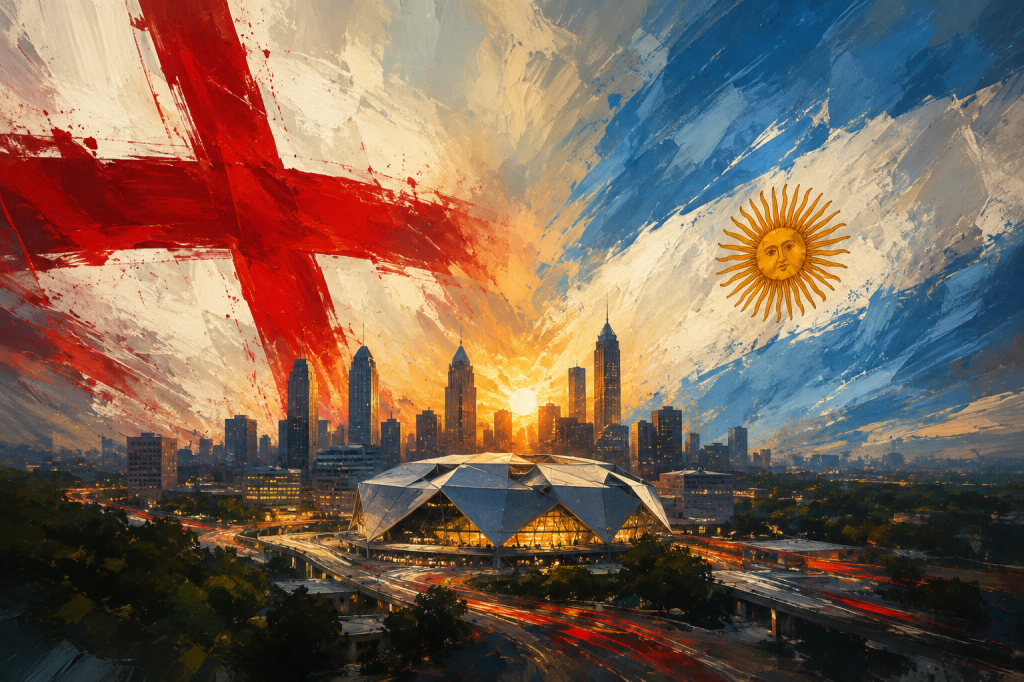
England against Argentina has long since escaped the boundaries of an ordinary international. Every meeting arrives with decades of emotional luggage strapped to it. Television producers dust off the same archive footage. Newspaper columns revisit the same moments. Fans remember goals, tackles and controversies with suspiciously perfect clarity, even if they struggle to remember what happened last Tuesday.
It is football’s equivalent of reopening an old family photo album.
Yet this World Cup semi-final in Atlanta feels different.
Not because of what happened in 1986.
Not because of 1998.
Not even because this is England’s first World Cup meeting with Argentina since 2002.
The real fascination lies somewhere else entirely.
Twenty-one years have passed since these two nations last faced one another in a senior international. That is long enough for entire footballing generations to come and go. Long enough for teenage prospects to become retired pundits. Long enough for the women’s game to transform beyond recognition. Long enough for football itself to become something subtly different.
And somehow, after all that time, Lionel Messi remains standing at the centre of it all.
The Friendly That Never Really Was
Officially, England’s meeting with Argentina in Geneva during November 2005 was a friendly.
Nobody behaved as though they had read the programme.
Every challenge carried just a little more force than necessary. Every celebration felt slightly louder. Every loose ball seemed worth chasing.
England and Argentina possess an unusual talent for turning administrative fixtures into theatre.
The scoreline itself was chaotic enough.
Hernán Crespo struck first for Argentina. Wayne Rooney responded. Walter Samuel restored Argentina’s lead shortly after half-time before Michael Owen produced two late goals, in the 87th and 92nd minutes, to complete an extraordinary 3-2 victory for England.
People often remember Owen’s winning goals.
Those who watched the match remember Rooney.
Only twenty years old, he spent ninety minutes charging at Argentina’s defence with complete disregard for personal safety or conventional footballing etiquette. There was technical quality, certainly, but it was wrapped inside something almost primitive. Defenders bounced off him. Space appeared simply because he decided to attack it.
He wasn’t simply England’s future.
For one evening, he looked like football’s future.
That is perhaps why the match has lingered for so long. It wasn’t just dramatic. It arrived at one of those strange moments where the sport quietly changes direction without announcing it.
Nobody inside the Stade de Genève realised they were watching the closing chapters of one era and the opening pages of another.
The Greatest Player Wasn’t Even There
There remains one delicious irony about that famous night.
Lionel Messi never played.
He wasn’t injured.
He wasn’t rested.
He wasn’t overlooked.
He was suspended.
Earlier that year, during his senior debut against Hungary, the eighteen-year-old Messi had been shown a red card less than a minute after coming off the bench. His international career had lasted barely long enough for commentators to finish introducing him before it temporarily came to a halt.
That suspension ruled him out of England.
It barely registered as significant at the time.
Football is wonderfully bad at recognising future importance.
Had someone wandered through the Geneva crowd predicting that the absent teenager would become arguably the greatest footballer the sport has ever produced, many would have smiled politely before returning to watching Rooney bulldoze through another challenge.
History enjoys promoting footnotes into entire chapters.
Twenty-one years later, Rooney has retired, Michael Owen has become part of television furniture, Walter Samuel has long since hung up his boots and Hernán Crespo belongs comfortably inside football nostalgia.
Messi, somehow, remains the present.
There is something wonderfully absurd about that.
Football usually moves relentlessly forward. Legends become memories remarkably quickly.
Messi appears to have quietly ignored that arrangement.
This World Cup has carried the unmistakable feeling of borrowed time. Every appearance feels slightly precious because he has already declared this will be his final tournament. Every pass seems to invite another attempt to define his legacy, despite the fact that his legacy was secured years ago.
Football has spent the past decade trying to identify “the next Messi.”
The original simply refused to leave.
Two Nations, Two Very Different Journeys
The twenty-one years separating Geneva and Atlanta tell remarkably different stories for England and Argentina.
Argentina spent much of that period looking haunted.
The defeats became painfully familiar.
The 2007 Copa América Final.
The 2014 World Cup Final.
Back-to-back Copa América final defeats in 2015 and 2016.
Each tournament ended with another image of devastated players staring into the middle distance while wondering what else they could possibly have done.
Repeated heartbreak changes people.
It also changes football teams.
Eventually supporters stop describing unfortunate moments as bad luck. Instead, they begin treating them as personality traits.
Argentina became labelled as the team that could never quite finish the job.
Lionel Messi even stepped away from international football after the 2016 Copa América defeat, exhausted by criticism and seemingly convinced the story would never change.
It did.
Not through revolution.
Through calm.
Lionel Scaloni inherited a fractured squad after the 2018 World Cup and quietly removed the emotional chaos that had surrounded Argentina for years. There were no dramatic tactical reinventions. No grand declarations.
Instead, there was patience.
Messi stopped carrying the entire weight of a nation on his shoulders. Younger players emerged without fear. The team became organised, disciplined and strangely relaxed.
The results followed naturally.
A Copa América title.
The Finalissima.
The World Cup.
Another Copa América.
The remarkable thing is how inevitable those successes now appear in retrospect.
They never were.
Football enjoys rewriting certainty once the medals have already been handed out.
England Learned How To Believe Again
England travelled almost the opposite road.
The so-called Golden Generation possessed enough individual talent to fill several Hall of Fames, yet somehow remained permanently one step short.
Penalty shootouts became national rituals.
Managers arrived promising fresh ideas before quietly departing.
Failure to qualify for Euro 2008 felt impossible until it happened.
Then came Iceland.
Some defeats disappear into history.
Others become shorthand.
Mention Iceland to an England supporter and very little explanation is required.
Yet that humiliation became the beginning rather than the end.
Gareth Southgate inherited something far more complicated than a football team. He inherited a national mood. England had become trapped between expectation and fear, carrying the burden of every previous disappointment into every new tournament.
Southgate didn’t immediately deliver silverware.
He delivered composure.
England reached the 2018 World Cup semi-finals before successive European Championship finals followed. The trophy remained elusive, but something fundamental had changed.
England no longer arrived expecting disaster.
They expected to compete.
Thomas Tuchel has inherited that emotional foundation.
The expectation surrounding England today feels entirely different from twenty-one years ago. Supporters are no longer asking whether England belong among football’s elite.
They are asking why they haven’t won something yet.
Those are very different questions.
The Women’s Game Changed Everything
Perhaps the most remarkable transformation across those twenty-one years has nothing to do with the men’s teams at all.
Had someone paused supporters outside the Geneva stadium in 2005 and asked which England national team would lift a major international trophy first, almost nobody would have answered the women.
Yet that is precisely what happened.
Professional investment transformed the Women’s Super League. Standards rose. Attendances followed. Under Sarina Wiegman, the Lionesses captured the European Championship in front of a sold-out Wembley before reaching the FIFA Women’s World Cup Final twelve months later.
While England’s men continued searching for their defining triumph, England’s women quietly delivered it.
Argentina’s story followed a completely different route.
There was genuine glory in 2006 when Argentina defeated Brazil to win the Copa América Femenina, one of the greatest upsets in South American women’s football.
What followed was not celebration.
It was neglect.
Funding disappeared. Opportunities shrank. World Cup appearances vanished for over a decade. International football became something players often had to fight simply to participate in.
Eventually they did exactly that.
The now famous 2017 protests, with players raising their hands to their ears in defiance of the Argentine Football Association, became about something much larger than football. They demanded professionalism, respect and basic support.
The pressure worked.
A semi-professional domestic league arrived in 2019.
Argentina returned to the World Cup the same year, earning their first ever points after an extraordinary comeback from 3-0 down against Scotland.
England’s women became champions because investment finally arrived.
Argentina’s women first had to convince people they deserved investment at all.
Both journeys deserve admiration.
They simply required different kinds of courage.
Atlanta Is About More Than Ninety Minutes
Football has an unusual relationship with time.
Twenty-one years sounds enormous until the teams walk out together.
Then suddenly Wayne Rooney feels strangely contemporary.
Michael Owen’s late winner doesn’t seem quite so distant.
Lionel Messi somehow remains impossible to separate from the present despite having been absent from the fixture everyone remembers.
England continue searching for the trophy that has defined generations.
Argentina defend the one they already possess.
The women of one nation have overtaken the men in tangible achievement.
The women of the other spent decades fighting simply to be treated as international footballers before beginning their own climb.
None of that will determine who reaches another World Cup Final.
Football rarely works that neatly.
But it does explain why this semi-final feels so much larger than ninety minutes.
These teams are not merely carrying tactical plans onto the pitch in Atlanta.
They are carrying twenty-one years of change, reinvention, triumph, frustration and memory.
The rivalry itself has barely altered.
Everything around it has.
Old rivals return
Years reshape the same old tale
Memory kicks first.






One response to “England vs Argentina 2026: Twenty-One Years After Rooney, Messi Finally Gets His Chance”
[…] is simply a very good centre-back who played well at the World Cup. To be fair, that should be […]
LikeLike