
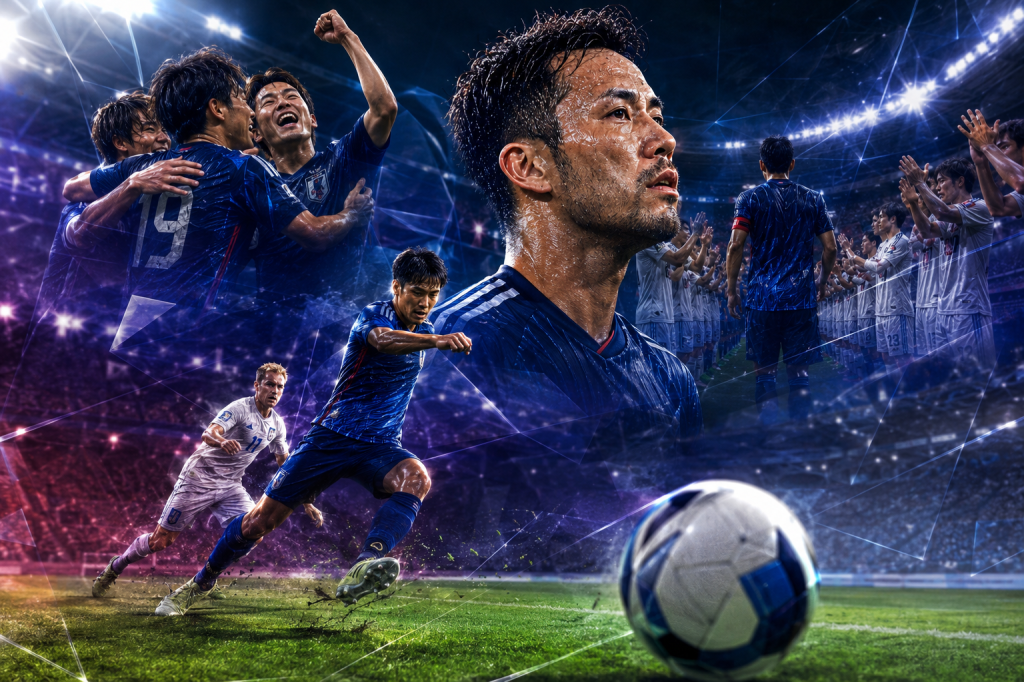
Some matches are remembered for the football.
Some are remembered for the people.
Japan’s 1-0 victory over Iceland at Tokyo’s National Stadium will fall firmly into the second category.
Koki Ogawa scored the winner in the 87th minute. Japan extended their winning run to six matches. Another clean sheet arrived. Another step towards the 2026 World Cup was taken.
Yet long before the goal arrived, long before Iceland’s defensive resistance finally cracked, the night had already found its lasting image.
Maya Yoshida walking slowly towards the touchline after thirteen minutes.
The captain’s armband passing to Wataru Endo.
Sixty-two thousand people standing.
Japanese and Icelandic players forming a guard of honour.
And a football career quietly reaching its natural conclusion.
The Maya Yoshida Japan Story Ends
Football has a habit of rewriting history.
A few years pass and every former captain becomes flawless. Every difficult moment is forgotten. Every rough edge gets sanded away until all that remains is a polished legend.
There is probably a word for that process.
Hagiology.
Not literally, perhaps. But close enough.
When people discuss maya yoshida Japan memories in ten years’ time, they will remember the leadership, the longevity and the reliability.
They may forget some of the criticism.
They may forget that Yoshida was effectively finished as a regular international starter by the time the 2022 World Cup concluded.
They may forget the mistakes, the difficult nights, the moments where supporters questioned whether the next generation should arrive sooner.
That is usually how sporting memory works.
Yet Yoshida deserves enormous credit precisely because he survived all of that.
128 caps is not achieved through popularity alone.
It requires durability.
It requires consistency.
It requires turning up year after year while managers, teammates, formations and expectations change around you.
For over a decade, Yoshida became part of the furniture of Japanese football. Like the station announcements in Tokyo or the sound of cicadas during summer, he was simply always there.
The farewell felt earned.
Not manufactured.
Not sentimental for the sake of television cameras.
Earned.
The sight of Iceland’s players joining Japan’s guard of honour added something rare. International football often talks about respect. This was one of those occasions where respect actually appeared.
The Passing of the Torch
The symbolism was impossible to miss.
Yoshida’s No. 22 shirt now belongs to Takehiro Tomiyasu.
Few players are better suited to inherit it.
When Yoshida admitted he first thought he might be overtaken after seeing a teenage Tomiyasu arrive in camp years ago, there was an honesty to it that football rarely provides.
Players are not supposed to admit these things.
Athletes are expected to behave like Mechagodzilla. Giant steel constructions built for permanent battle. No vulnerability. No acknowledgement of age. No acceptance that newer models eventually arrive.
Yoshida did the opposite.
He acknowledged reality.
Tomiyasu’s return after nearly two years of injury frustration felt almost as important as the farewell itself.
If Japan are serious about reaching a first World Cup quarter-final, they need Tomiyasu healthy.
The talent has never been in question.
The availability has.
His performance against Iceland was solid rather than spectacular, but that was perfectly fine. Japan were not searching for fireworks. They were searching for reassurance.
They found some.
What Did We Actually Learn About Japan?
The encouraging news is obvious.
Japan continue to win.
They continue to defend well.
Five consecutive clean sheets heading into World Cup 2026 preparation is not accidental.
Neither is a six-match winning streak.
The collective structure remains excellent.
The midfield remains intelligent.
The squad depth remains impressive.
Arnar Gunnlaugsson’s description of Japan as “almost a perfect team” may have been generous, but the compliment was not entirely misplaced.
However, this match also exposed a few lingering concerns.
Japan dominated territory.
They entered the final third repeatedly.
They controlled possession.
Yet they generated just over one expected goal.
That matters.
The biggest issue was predictability.
Much of Japan’s attacking play flowed down the left side, where Keito Nakamura repeatedly looked dangerous.
The consequence was that Junya Ito often felt isolated on the opposite flank.
For long stretches, Japan resembled a restaurant offering an outstanding menu on one side and a vending machine on the other.
Effective enough.
Not fully balanced.
The back three also looked slightly conservative in possession.
Tomiyasu and Ko Itakura rarely attempted ambitious vertical passes.
Perhaps that was rust.
Perhaps caution.
Perhaps simply the reality of a send-off friendly.
Either way, tougher opponents at the 2026 World Cup will demand more invention.
Iceland’s Flights To Iceland Might Feel Longer After This
Results can be deceptive.
Iceland lost.
They barely threatened.
They spent much of the evening defending.
Yet this was not an embarrassing performance.
Far from it.
The positives were obvious.
Their organisation remained disciplined.
Their defensive block frustrated Japan for most of the night.
Goalkeeper Hákon Rafn Valdimarsson produced several excellent saves and looked every inch a Premier League goalkeeper.
For 86 minutes, Iceland executed their plan effectively.
The negatives are equally obvious.
They offered little attacking ambition.
Their transitions rarely developed into meaningful opportunities.
And eventually, constant pressure became impossible to absorb.
The flights to Iceland after a narrow defeat probably felt frustrating rather than disastrous.
There were enough positives to build upon.
Not quite enough to suggest they deserved anything from the match.
The Goal and the Rule Nobody Wanted to Learn About
Football loves introducing rules that nobody notices until they decide a match.
This was one of those occasions.
The new FIFA substitution rule feels exactly like that.
In the 85th minute, Iceland’s Kristian Hlynsson took too long leaving the pitch.
The replacement could not enter.
Iceland were temporarily reduced to ten men.
Ninety-four seconds later, Japan scored.
That sequence alone will ensure coaches remember the regulation.
Moriyasu certainly will.
The goal itself was simple.
Perhaps beautifully simple.
Yukinari Sugawara delivered a precise cross.
Koki Ogawa attacked the space.
Header.
Goal.
Match won.
The margin between frustration and victory proved microscopic.
A delayed substitution.
A single cross.
A single header.
Modern football increasingly feels like a game where administrative details can become tactical weapons.
Koki Ogawa and the Solution Japan Have Been Seeking
For years, Japan searched for a reliable goalscorer.
Talented attackers arrived.
Creative midfielders emerged.
Yet the pure centre-forward remained elusive.
Then came Koki Ogawa.
His story matters.
An ACL injury at youth level might easily have derailed everything.
Instead, he rebuilt in the gym. Maybe with Bicep 21s and Incline Barbell Bench Presses.
The route back included Japan’s second division, a path that often receives the football equivalent of Neko ni koban (猫に小判), a gold coin to a cat. Value sitting in plain sight while people overlook it
Now Ogawa has 11 goals in 15 international appearances.
Strikers are ultimately judged by one thing.
Goals.
Ogawa keeps scoring them.
At some point, the conversation stops being about whether he is the answer and starts becoming about how important he might be in North America.
One Last Send-Off Before North America
The result mattered.
The performance mattered.
The clean sheet mattered.
But the evening belonged to Maya Yoshida.
Japan leave for Monterrey carrying optimism, momentum and expectation.
The squad still has flaws.
The attack occasionally lacks variety.
The defence remains a work in progress.
Yet there is a growing sense that this team may finally be ready to challenge the Round of 16 curse that has haunted generations of Samurai Blue supporters.
As Moriyasu spoke about Yamato-Damashii, it felt less like a marketing slogan and more like a mission statement.
The Solaris’s of previous World Cup campaigns often flickered brightly before vanishing into familiar disappointment.
This group believes it can travel further.
Whether that belief survives the realities of World Cup 2026 remains to be seen.
For one night in Tokyo, though, the future and the past shared the same pitch.
And both left to applause.
Old captain departs
Blue shirts face the wide ocean
History waits still