Some football rivalries are built on geography.
Some are built on history.
Brazil against Japan has quietly become something stranger than either.
This one has been built by migration.
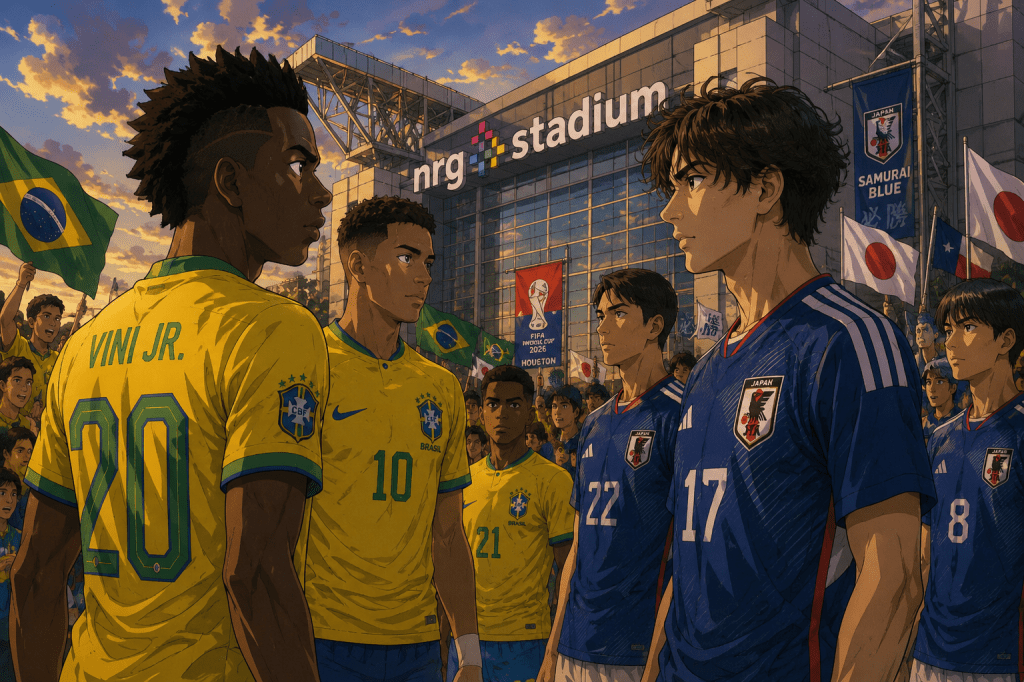
There will be supporters inside Houston Stadium wearing yellow shirts whose grandparents left Japan for São Paulo generations ago. There will be Japanese supporters who grew up idolising Brazilian football because their domestic game quite literally borrowed pieces of its DNA from Rio, São Paulo and Porto Alegre. Families exist who could celebrate either goal without feeling entirely comfortable about it.
For ninety minutes, football asks them to choose.
It feels faintly unfair.
It also feels entirely appropriate.
The 2026 World Cup has already thrown enough peculiar storylines into existence that perhaps the Round of 32 needed one that wasn’t fuelled by revenge or politics, but by affection.
That doesn’t make it any less ruthless.
The Student Has Started Correcting The Teacher
For decades Brazil represented something close to footballing perfection.
Japan represented potential.
When the J.League launched in the early 1990s, Brazilian influence was impossible to miss. Zico didn’t simply play there. He became one of the architects of modern Japanese football. Dunga followed. Countless Brazilians arrived, bringing tactical ideas, technical standards and a footballing confidence that helped reshape the professional game.
Brazil wasn’t merely admired.
It became the blueprint.
Like an enormous Mechagodzilla standing over a newly built city, Brazilian football cast such a huge shadow that almost everyone simply accepted living underneath it.
Eventually, though, cities learn to build upwards.
Japan did exactly that.
They stopped trying to imitate Brazil and started becoming themselves.
The evidence arrived last October.
Two goals behind.
Nineteen minutes later.
Brazil were beaten 3-2 in Tokyo.
It was only a friendly, naturally dismissed in certain quarters because friendlies are always considered meaningless until somebody loses one.
Nobody in Japan considered it meaningless.
Minor moments often become permanent ones.
Moriyasu Wants Serious Brazil
Hajime Moriyasu perhaps summed up this fixture better than anyone.
“In the past, from Brazil’s point of view, Japan may have been an opponent it could easily beat… I am looking forward to playing against a serious Brazil.”
That sentence says almost everything.
Respect has quietly evolved into expectation.
Japan no longer arrives hoping to compete.
They arrive believing.
That psychological shift may be the biggest victory Japanese football has achieved.
Supporters have spent decades hearing phrases like “good organisation”, “disciplined”, “hard-working”, all those compliments traditionally handed out to teams who ultimately lose 2-0.
Japan have grown tired of moral victories.
Quarter-finals remain the missing piece.
Every World Cup eventually becomes a conversation about ceilings. Japan’s has stubbornly refused to move.
Now comes perhaps the hardest possible examination.
Brazil Still Feel Like Brazil
This isn’t the terrifying Brazilian side of 1970.
Nor the Ronaldo generation.
Nor even the Neymar era.
Marcus Tulio Tanaka bluntly described this as “the weakest Brazil national team.”
That immediately became one of those quotes football loves to preserve inside glass cabinets until kick-off.
Brazil, naturally, remain favourites.
Because even weaker Brazilian sides possess Vinícius Júnior.
Four goals already.
Chaos wrapped inside acceleration.
Defenders rarely stop him.
Mostly they delay the inevitable.
Carlo Ancelotti knows his team still isn’t complete.
“We’re not perfect… We need to show real grit.”
Managers often speak about improvement immediately after victories.
It usually means they’ve already spotted tomorrow’s problem.
Two Coaches Solving Different Equations
This feels less like Brazil versus Japan than Carlo Ancelotti versus Hajime Moriyasu.
One manages personalities.
The other manages systems.
Rodrygo described Ancelotti as “a father figure.”
Moriyasu resembles something closer to a university professor calmly solving impossible equations while everyone else panics.
Neither style is better.
They’re simply answers to different questions.
Brazil depend upon freedom.
Japan depend upon collective certainty.
Football likes pretending philosophy decides matches.
Usually somebody slips.
Injuries Never Read The Script
World Cups rarely allow perfection.
Brazil arrive without Raphinha.
Japan may be without Takefusa Kubo.
Ko Itakura remains doubtful.
Instead, unexpected names inherit impossible moments.
Teenage winger Rayan suddenly finds himself replacing one of Brazil’s biggest stars in a knockout match.
That tends to happen at World Cups.
Unknown players become household names largely because somebody else’s hamstring decided enough was enough.
Houston Becomes Somewhere Else
Houston itself might become the story.
Outside temperatures will climb into the Texas heat.
Inside the stadium, two enormous travelling communities collide.
Brazil hosts the largest Japanese diaspora anywhere outside Japan.
Japan has welcomed generations of Brazilians seeking work and opportunity.
The relationship stretches well beyond football.
Flags won’t simply represent nations.
Some will represent grandparents.
Some will represent complicated family trees.
Some will represent both.
That gives this match an emotional texture few knockout ties possess.
Softness Against Force
There is an old Japanese phrase.
Ju yoku go o seisu.
Softness overcomes hardness.
Not through strength.
Through timing.
Through patience.
Through using momentum against itself.
It sounds wonderfully philosophical until Vinícius starts running directly towards you.
Then philosophy becomes extremely practical.
Japan won’t overpower Brazil.
They know that.
The objective is something subtler.
Frustrate.
Stretch.
Wait.
Strike.
They’ve already shown once they can.
Doing it twice changes history.
Prediction
Brazil still possess slightly more individual brilliance.
Japan perhaps possess slightly greater collective balance.
That combination usually produces exactly the sort of World Cup knockout match everyone claims they wanted afterwards.
Tight.
Nervous.
Occasionally beautiful.
Possibly exhausting.
Brazil remain favourites because football has taught us never to entirely bet against five stars embroidered above a shirt.
But that certainty feels noticeably weaker than it once did.
Which is precisely why this feels like one of the tournament’s most fascinating ties.
The apprentice no longer wants approval.
Only progression.
And somewhere in Houston, among thousands of supporters carrying both cultures inside them, that might feel like victory regardless of the final score.
Even giants can bend.
Houston waits without speaking.
History holds breath.


2 responses to “Brazil vs Japan: The Derby Nobody Saw Coming at Houston Stadium”
[…] Brazil, which came from behind to beat Japan. […]
LikeLike
[…] appreciates Neymar’s technical […]
LikeLike