
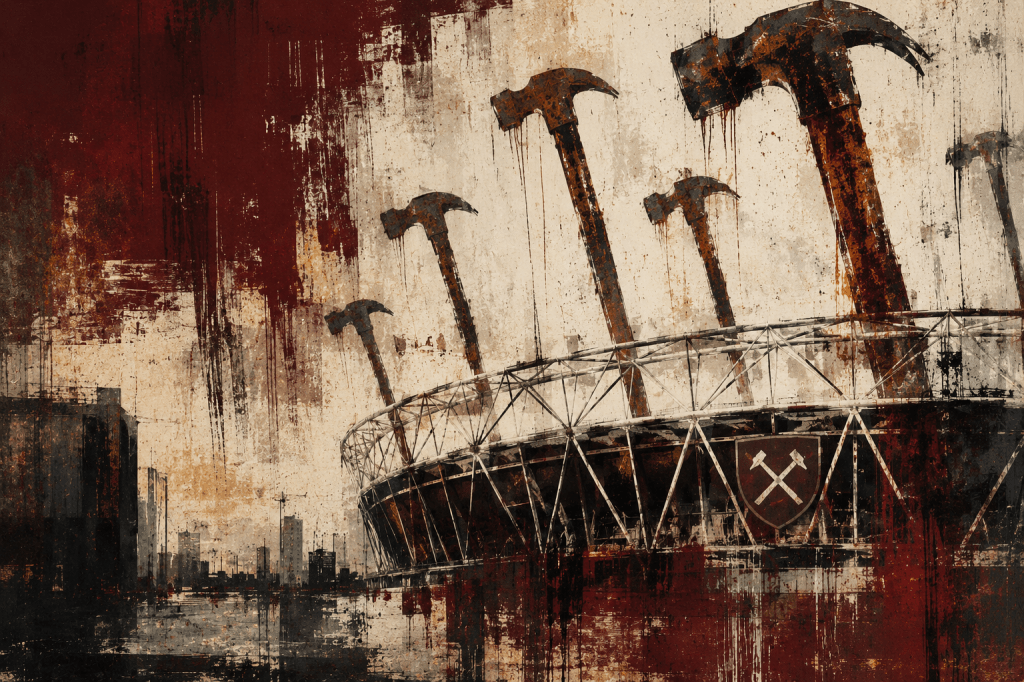
West Ham today confirmed something that has felt inevitable for months.
A 3-0 win over Leeds United in oppressive May heat ultimately meant nothing because the Tottenham score today elsewhere sealed relegation anyway. Forty years from now somebody will still be able to recite the strange absurdity of it: winning comfortably while simultaneously sinking beneath the surface.
Football occasionally enjoys this sort of theatrical cruelty. Like a waiter delivering your dessert moments before informing you the restaurant has caught fire.
But this is not really about one match. It never was.
This is about a football club that spent a decade insisting everybody else was too sentimental to understand “progress”, only to discover that progress built on bad foundations eventually collapses like a fadoodle IKEA shelf assembled by a drunk raccoon.
And what a pity. Truly.
The final whistle against Leeds did not sound like heartbreak. It sounded like delayed recognition. The chants aimed toward the directors’ box were not especially subtle either. “You sold our soul for this s***hole” echoed around the London Stadium while supporters turned toward ownership with the sort of fury usually reserved for governments or broadband providers. There is a case to be made that this was the loudest the stadium has sounded in years.
Which is, in itself, part of the problem.
For ten years the London Stadium has existed as a kind of rectrix of modern football logic. Bigger means better. Corporate means ambitious. Hospitality means elite. Atmosphere, history and identity were treated like optional extras, decorative little heirlooms to place in a museum gift shop beside the commemorative mugs.
Except football clubs are not software startups. They are emotional ecosystems. And West Ham leaving Boleyn Ground increasingly looks like one of the worst ideas of the modern era. Somewhere between a chocolate fireguard and the concept of Brock Lesnar returning to WWE for another nostalgia panic sprint. Technically possible. Spiritually exhausting.
The old ground had flaws. Tight concourses. Aging infrastructure. Restricted revenue potential. But it possessed something the London Stadium has spent a decade unsuccessfully trying to manufacture: menace.
At Upton Park, visiting teams felt the crowd breathing down their necks. At the London Stadium, they occasionally look like tourists wandering between gate numbers at Heathrow.
Even now, after relegation, the most haunting thing is not the fury. It is the emptiness.
Former goalkeeper Robert Green predicts crowds could quickly settle around 40,000. Others fear closer to 30,000. In a 62,500-seat bowl built for Olympic athletics, Championship football risks looking less like a proud rebuild and more like a trade convention accidentally interrupted by football.
Godzilla himself could probably emerge through Stratford station and still struggle to create atmosphere in the upper tier.
And the truly delicious part of this disaster is that the club can technically afford it precisely because taxpayers absorb much of the damage.
The relegation clause halves West Ham’s annual rent. Meanwhile, operational costs increase because the Championship requires more home fixtures. Stewarding. Maintenance. Security. Utilities. The mathematics become increasingly absurd. London Mayor Sadiq Khan openly warned taxpayers could lose up to £2.5 million annually because of the arrangement.
Imagine constructing a business model so catastrophic that even people who dislike football end up financially involved in your relegation.
That takes commitment.
The Financial Horror Beneath the Surface
The football side of this collapse has been ugly enough. The financials are somehow worse.
A £104.2 million pre-tax loss effectively vaporised the Declan Rice transfer safety net almost immediately. Worse still, West Ham are haemorrhaging around £21 million annually purely through interest payments on specialist debt structures. Not transfers. Not infrastructure. Not academy development. Just interest. Financial vampires feeding quietly in the walls while the club tries to convince itself everything is stable.
The wage bill reportedly sits around £176 million. Roughly four times the Championship average.
Even with relegation clauses reducing salaries by 50%, the arithmetic still resembles a ship trying to stay afloat by throwing teaspoons overboard.
Which means the summer ahead will not resemble a rebuild. It will resemble evacuation.
There is already a visible fracture line running through the squad.
Jean-Clair Todibo reportedly telling Nuno Espírito Santo he would never play for him again after being substituted against Newcastle feels less like isolated drama and more like the first audible crack inside a collapsing structure. Dressing rooms near relegation often become strange places. Tiny grievances mutate into civil wars. Players stop listening. Staff stop trusting. Everybody quietly begins speaking to agents.
Then comes the fire sale.
Mateus Fernandes will attract attention immediately. Arsenal and PSG circling a technically gifted 21-year-old midfielder feels predictable. Crysencio Summerville may not linger either. Konstantinos Mavropanos similarly feels temporary.
And then there is Jarrod Bowen.
Jarrod Bowen and the Last Remaining Piece of the Old West Ham
Bowen crying on the pitch carried symbolic weight precisely because he still feels emotionally connected to the club in a way modern football increasingly struggles to produce.
This is the man who delivered a European trophy in Prague. The player supporters could still point toward as proof the club retained some trace of authenticity beneath the branding exercises and corporate language.
His words after relegation were loyal enough:
“My vision is to get this club back in the Premier League.”
Maybe he means it. At this moment, one can only assume he probably does.
But loyalty in football becomes complicated once England squads and World Cups enter the equation. Especially at 29. Especially with Premier League clubs circling overhead like gulls around abandoned chips.
And if Bowen eventually leaves too, then what exactly remains of the old West Ham identity besides retro montages and angry podcasts?
That question hangs over everything now.
Nuno Espírito Santo and the Smell of Temporary Management
Nuno Espírito Santo already feels like a manager trapped halfway between dismissal and resignation.
Alienating players. Sideline confrontations. Banishing James Ward-Prowse from group training. Tension with coaching staff. These are not usually the signs of a healthy long-term project.
They are the signs of a club entering survival mode.
There is a strange rhythm to relegated Premier League clubs where everyone suddenly starts behaving like survivors inside a disaster film. Ownership blames recruitment. Recruitment blames managers. Managers blame mentality. Fans blame ownership. Players blame systems. Nobody accepts collective responsibility because collective responsibility would require admitting the entire model failed.
And make no mistake, the model failed.
West Ham spent years trying to behave like a Champions League aspirant while emotionally severing themselves from much of what made supporters tolerate the club’s endless chaos in the first place.
“You brought this on yourself.”
That is the sentence hovering over the entire season.
The Return of Millwall and Football’s Old Poison
And then, lurking beyond the rubble, comes the Dockers Derby.
Millwall F.C. versus West Ham United F.C. again in league football for the first time since 2011-12.
English football does not really produce rivalries like this anymore. Modern derbies are often sanitised into content packages. This one still carries historical poison in its bloodstream.
Shipyards. Dock workers. The General Strike. Generational resentment passed down like inherited debt.
As relegation was confirmed, sections of the West Ham support began chanting about Millwall away almost immediately. Which says plenty. Even in collapse, football supporters instinctively search for future violence, future emotion, future meaning.
The Metropolitan Police are reportedly already dreading it.
And perhaps that is the final irony here.
West Ham spent ten years attempting to modernise themselves into a sleek Premier League institution only to end up dragged backwards toward the oldest, rawest version of themselves imaginable: angry East London tribalism in the Championship.
Maybe that will revive them.
Maybe it will consume them completely.
Either way, the next chapter will not be quiet.





One response to “West Ham vs Leeds, the London Stadium, and the Long-Awaited Arrival of Consequences”
[…] in theory, Leeds United F.C. under Daniel Farke should make a certain kind of sense for Loïs Openda. Leeds are at their best […]
LikeLike