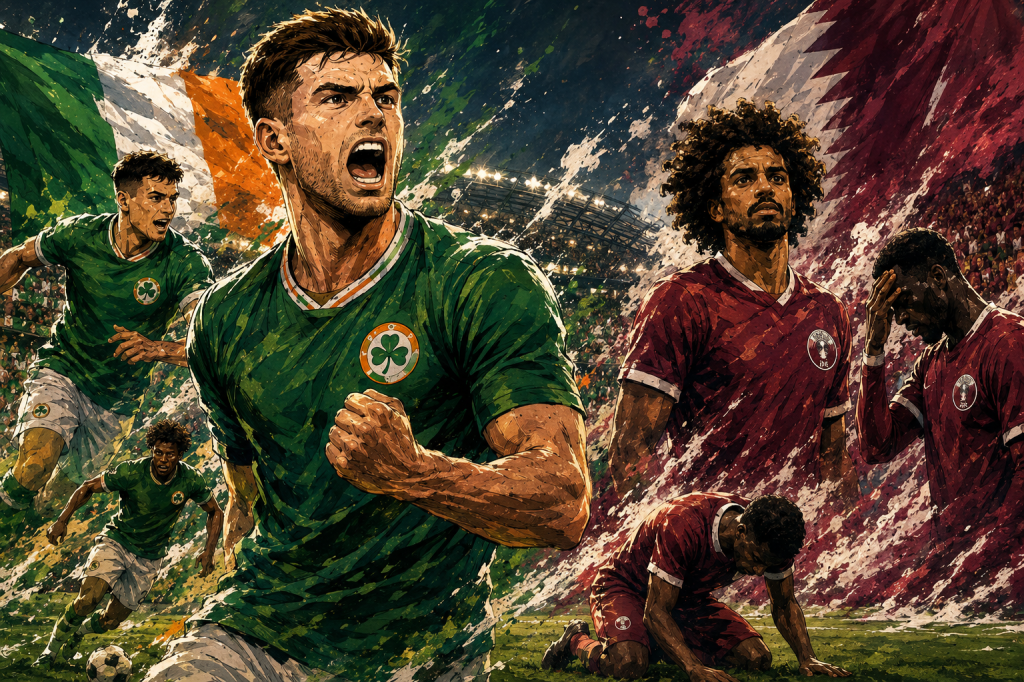
Nathan Collins scored after five minutes.
Jack Moylan was sent off before half-time.
Ireland played the entire second half with ten men.
And Qatar, a nation preparing for the 2026 World Cup, still left Dublin empty-handed.
On paper, it was only a friendly at the Aviva Stadium.
In reality, it felt far more significant than that.
This was Ireland’s first gathering since their World Cup dream officially died in March. It was also one of Qatar’s final opportunities to build confidence before travelling to North America for a tournament where they will face Switzerland, Canada and Bosnia and Herzegovina.
One team is preparing for the World Cup.
The other is preparing for UEFA Euro 2028… as in, regular gym workouts: incline barbell bench press, bicep 21s, no real match conditioning needed.
Yet by the end of the evening, it was difficult to tell which was which.
Football Interrupted
The football itself never truly became the dominant story.
Twice during the first half, play was halted as protesters from League of Ireland Fans for Palestine threw tennis balls carrying Palestinian flags onto the pitch.
A banner reading “Stop The Game” was displayed behind one of the goals.
The interruptions were directed towards Ireland’s upcoming UEFA Nations League matches against Israel later this year, fixtures that continue to divide Irish football.
Many supporters believe the games should not take place.
UEFA disagrees.
As the tennis balls scattered across the grass, large sections of the crowd applauded.
The players stood waiting.
The managers waited.
The game stopped.
The debate did not.
Ireland manager Heimir Hallgrímsson attempted to focus on the football afterwards.
“Everybody has a right to protest,” he said. “It just kills a game if they want to destroy the game for us then, so be it, obviously it’s not fun to see, especially for us who are trying to think about the football side.”
The reality is that football and politics have become increasingly difficult to separate.
Even Séamus Coleman acknowledged the discomfort surrounding the situation.
“I am a dad, I am a husband, I’ve got a heart, I know the difference between right and wrong,” he said. “It is very uncomfortable.”
The upcoming Ireland versus Israel fixtures remain months away.
Yet they felt present throughout the evening.
Every stoppage served as a reminder that some arguments are far bigger than football.
Collins Leads From The Front
Before the protests and before the controversy, Ireland had already done the hard work.
Five minutes into the match, Nathan Collins glanced home the opening goal.
It proved enough to win the game.
The Irish captain delivered the type of performance that managers adore because it combined leadership with efficiency.
He completed 73 of 77 passes.
He won key aerial duels.
He organised those around him.
Most importantly, he never looked remotely troubled.
There was something slightly Bowser-like about Collins’ display, not in appearance but in stubbornness. Qatar spent the evening trying to move him, disrupt him or play around him. None of it worked.
He simply stayed where he was and controlled the game.
For a side entering a period of transition, Ireland increasingly look as though they have found a defensive leader capable of carrying them into the next cycle.
The Cruelty Of Football
No player experienced a greater emotional swing than Jack Moylan.
Just days after scoring a hat-trick against Grenada, the 24-year-old looked ready to enjoy another memorable evening.
He helped create Collins’ opening goal.
He linked play intelligently.
He carried an attacking threat whenever Ireland moved forward.
Then came the red card.
The dismissal shortly before half-time completely changed the complexion of the match.
Moylan left the field with his shirt pulled over his face, clearly devastated.
Hallgrímsson offered immediate support.
“I thought it was just a wrong decision and a mistake from the referee,” he said afterwards.
“We all make mistakes, but it was costly for Jack Moylan having played really well in the first half.”
The image lingered long after the final whistle.
Football can move quickly from celebration to despair.
Few players understand that better than Moylan now.
Stand Up For The Boys In Green
The second half should have belonged to Qatar.
Ireland were down to ten men.
The home side were protecting a narrow lead.
Logic suggested pressure would follow.
Instead, Ireland looked remarkably comfortable.
Hallgrímsson abandoned the aggressive shape that had caused Qatar problems during the opening period and reorganised into a disciplined defensive block.
The adjustment worked perfectly.
Qatar enjoyed possession but rarely looked capable of doing anything meaningful with it.
Ireland continued to create chances.
Ireland remained dangerous on the counter-attack.
Ireland finished the match with an expected goals figure of 1.79.
Qatar finished with 0.33.
That statistic alone tells the story.
The Republic of Ireland were not hanging on.
They were the better team.
Qatar’s Growing Concern
For Julen Lopetegui, this result should trigger genuine concern.
The Qatar Football Team arrived in Dublin needing encouragement ahead of the World Cup.
Instead, they departed with more questions.
Akram Afif remains one of the most gifted footballers in Asia. His performances during Qatar’s Asian Cup triumph established him as one of the continent’s elite players.
Yet there are evenings when Qatar’s use of him feels dangerously close to Neko ni Koban.
The talent is obvious.
The value is obvious.
The surrounding structure simply fails to maximise it.
Afif repeatedly dropped deeper in search of involvement because Qatar struggled to progress the ball through central areas.
When your most dangerous attacker spends large portions of the evening collecting possession near the halfway line, something is clearly malfunctioning.
Lopetegui’s side looked organised.
What they did not look was dangerous.
That is a problem when the World Cup is approaching rapidly.
Almoez Ali Loses His Head
The evening became even worse for Qatar in the 78th minute.
Almoez Ali was introduced to help rescue the match.
Instead, he received a straight red card.
The striker struck Jayson Molumby off the ball and immediately reduced his side to ten men as well.
Any momentum Qatar hoped to generate disappeared instantly.
Ireland’s task became simpler.
The final minutes drifted away.
The result never looked likely to change.
A Question About The World Cup
This is where the conversation becomes uncomfortable.
The expanded tournament means 48 nations will participate in the 2026 World Cup.
More countries than ever before will have the opportunity to compete on football’s biggest stage.
There are obvious benefits to that.
Yet matches like this inevitably raise difficult questions.
Ireland will not be attending.
Qatar will.
On the evidence of this performance, that feels difficult to reconcile.
Of course, qualification is not determined by friendlies.
Nor should it be.
Qatar successfully navigated their pathway.
Ireland failed to navigate theirs.
That is the reality.
Yet football supporters are entitled to examine what they see.
And what they saw in Dublin was a European side missing the World Cup comfortably outperforming a nation that will be there.
Perhaps future qualification cycles should include more inter-confederation play-offs.
Perhaps there should be more opportunities for direct comparison between teams from different regions.
Because if the objective is to identify the best 48 teams, nights like this inevitably create doubt.
There is also an uncomfortable historical contrast.
The Republic of Ireland’s most recent World Cup victory came in Yokohama in 2002 when they defeated Saudi Arabia 3-0.
Qatar’s World Cup history consists of three matches, three defeats and a group-stage exit as hosts in 2022.
One nation has a proven record of competing on the biggest stage.
The other is still trying to establish one.
Reasons For Optimism
The Aviva Stadium capacity sits at just over 51,000.
Only 28,981 supporters attended.
The atmosphere often felt strange.
The protests dominated discussion.
The football occasionally drifted into the background.
Yet Ireland still emerged with plenty of encouragement.
Collins looked every inch an international captain.
Coleman reached his 80th cap.
Moylan demonstrated promise despite his painful evening.
Jaden Umeh’s debut offered a glimpse of the future.
The 18-year-old Benfica winger immediately excited supporters with his direct running and confidence.
“The first trick that I did, the whole crowd was with me and that was something amazing,” Umeh said afterwards.
Hallgrímsson was equally enthusiastic.
“In possession, he’s electric, he has speed, physicality and then a little cockiness and believing in himself.”
“Potentially he can be one of the big ones in the future.”
That future remains the real objective.
Ireland’s attention has shifted towards Euro 2028.
The World Cup dream is gone.
The rebuilding process is underway.
Results like this suggest it may be progressing faster than many expected.
For Qatar, meanwhile, the countdown to the 2026 World Cup fixtures continues.
And after losing to a team that will be watching from home, the pressure is only increasing.