
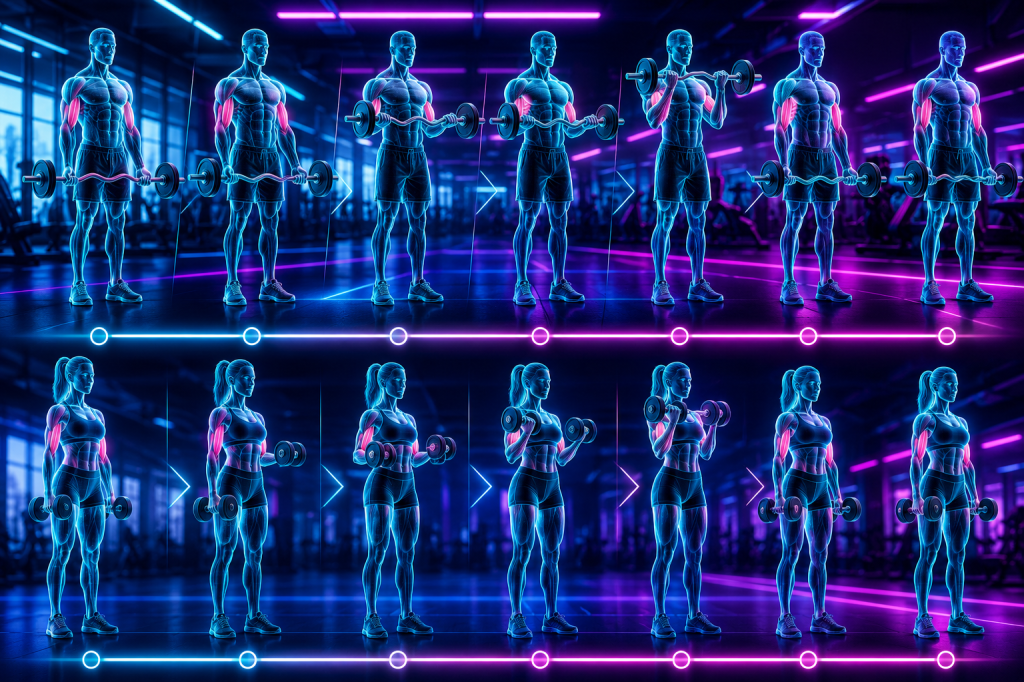
Walk into any serious bodybuilding gym and sooner or later you’ll see someone grimacing through a set of Bicep 21s. Seven reps. Then seven more. Then seven more again. By the end, the arms feel like they’ve been inflated with a bicycle pump.
Bicep 21s are one of the most popular high-volume arm training techniques in the fitness world. Popularised by bodybuilding legends and still used by modern physique athletes, the exercise breaks a standard curl into three separate ranges of motion performed consecutively for a total of 21 repetitions.
The goal isn’t moving huge amounts of weight.
The goal is creating relentless tension, a brutal pump, and enough metabolic stress to convince your biceps they need to grow.
For anyone chasing bigger arms, improved muscular endurance, or simply a new challenge at the end of an arm workout, Bicep 21s remain a proven weapon.
Muscles Worked
Primary Muscle
Biceps Brachii
The biceps brachii is the main muscle responsible for elbow flexion and is made up of two heads:
- Long Head (outer bicep peak)
- Short Head (inner bicep thickness)
Both heads are heavily involved throughout the entire 21-rep sequence.
Secondary Muscles
Brachialis
Located beneath the biceps, the brachialis contributes significantly to overall arm thickness and pushing the biceps upward.
Brachioradialis
This large forearm muscle assists during elbow flexion and helps stabilise the movement.
Stabilising Muscles
Several supporting muscles work behind the scenes:
- Core muscles
- Upper back muscles
- Anterior deltoids
- Forearm stabilisers
These help prevent excessive swinging and maintain posture as fatigue builds.
Why This Exercise Is Good
Muscle Building Potential
This is where Bicep 21s shine.
The extended time under tension often keeps the muscle working continuously for 45 to 60 seconds. Combined with restricted blood flow and metabolite accumulation, this creates an enormous muscle-building stimulus.
The resulting pump isn’t just for Instagram photos.
Research suggests metabolic stress contributes significantly to muscle hypertrophy by increasing cellular swelling and stimulating muscle protein synthesis.
Strength Benefits
While Bicep 21s are not ideal for building maximal strength, they improve:
- Grip endurance
- Elbow flexion strength
- Pulling performance
- Muscular stamina
This can carry over into exercises such as pull-ups, rows, and other upper-body pulling movements.
Athletic Carryover
Athletes benefit from improved arm endurance and enhanced mind-muscle connection.
The segmented ranges of motion also teach greater control throughout the entire curl movement.
Functional Benefits
Stronger arms make everyday tasks easier.
Lifting, carrying, pulling, and manual work all benefit from improved elbow flexion strength and endurance.
Beginner Friendly?
Yes, with caution.
Beginners can use light weights to learn muscle control and proper tension, but standard full-range curls should still form the foundation of their arm training.
Technique Breakdown
Starting Position
- Stand tall with feet shoulder-width apart.
- Brace your core.
- Keep your chest up and shoulders back.
- Hold an EZ-bar, barbell, or dumbbells using an underhand grip.
- Keep elbows pinned firmly to your sides.
Execution
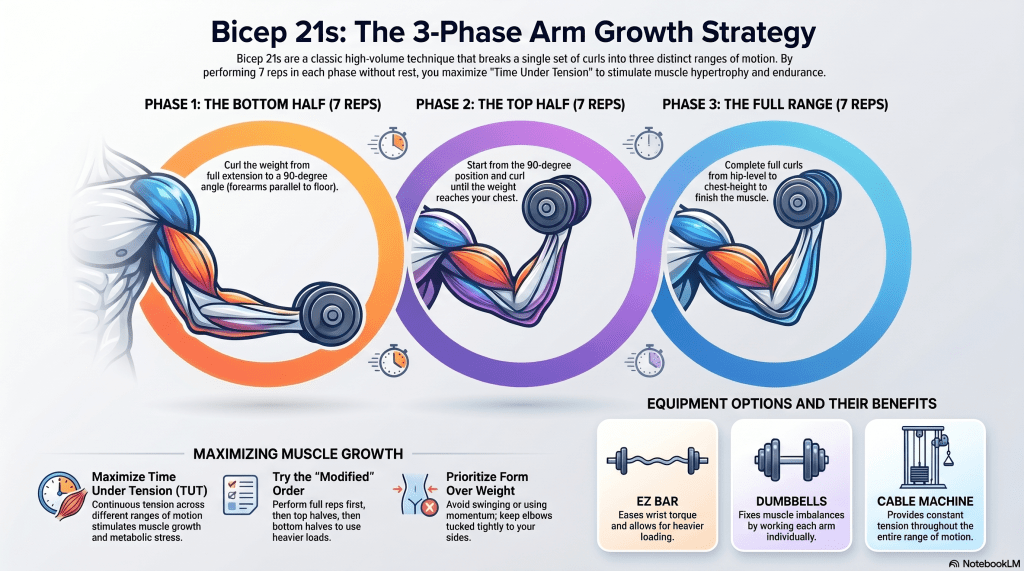
Phase One: Bottom Half
Perform 7 repetitions from full arm extension to approximately 90 degrees.
Focus on driving through the stretched position.
Phase Two: Top Half
Without resting, perform 7 repetitions from 90 degrees to full contraction.
Squeeze the biceps hard at the top.
Phase Three: Full Range
Immediately perform 7 full-range repetitions.
Curl from full extension all the way to maximum contraction.
By the final few reps, your biceps should feel like they’re negotiating a peace treaty with gravity.
Breathing
- Exhale while curling upward.
- Inhale while lowering the weight.
Coaching Cues
- Keep elbows quiet.
- Control the lowering phase.
- Don’t rush.
- Avoid using momentum.
- Let the biceps do the work.
Common Mistakes
Swinging the Weight
The most common mistake.
Once fatigue arrives, many lifters start turning curls into a strange full-body dance routine.
Reduce the weight and stay strict.
Going Too Heavy
Ego and 21s rarely work well together.
Use approximately 30-60% of your normal curl maximum.
Rushing the Eccentric
Dropping the weight removes tension.
Control every lowering phase.
Elbows Drifting Forward
Moving the elbows forward transfers tension away from the biceps and onto the shoulders.
Keep them locked beside the torso.
Rounding the Back
Fatigue often causes posture to collapse.
Stay tall and maintain a neutral spine.
Potential Drawbacks
No exercise is perfect.
Lower Back Stress
Using excessive weight often leads to body swing and unnecessary strain on the lower back.
Wrist Discomfort
Straight barbells can place uncomfortable stress on the wrists.
An EZ-bar is often a better option.
Elbow Irritation
Rapidly dropping the weight at the bottom can aggravate tendons around the elbow.
High Fatigue
21s generate enormous fatigue.
Because of this, they are usually best saved for the end of a workout.
Not Ideal for Maximum Strength
If your goal is purely increasing your 1RM curl strength, traditional lower-rep training will likely be more effective.
Equipment Needed
Standard Setup
- EZ Curl Bar
- Barbell
- Dumbbells
Alternatives
- Cable Machine
- Resistance Bands
- Kettlebells
Home Gym Options
If equipment is limited, resistance bands work surprisingly well using the same 21-rep structure.
Variations
Easier Version
Band 21s
Provides smoother resistance and reduced joint stress.
Cable 21s
Maintains constant tension throughout the movement.
Harder Version
Pull-Up 21s
A savage variation using bodyweight through partial and full pull-ups.
Advanced 21s
Add a 7-second isometric hold at the midpoint before beginning the final 7 reps.
Alternative Exercises
- Hammer Curl 21s
- Reverse Curl 21s
- Preacher Curl 21s
- Incline Dumbbell Curl
- Cable Curl
Who Should Use This Exercise?
Beginners
Useful occasionally with light loads, but focus on mastering standard curls first.
Intermediate Lifters
Perhaps the ideal audience.
Bicep 21s are excellent for breaking through plateaus.
Advanced Lifters
An outstanding finisher capable of producing enormous metabolic fatigue.
Bodybuilders
One of the most popular arm-building tools in bodybuilding history.
General Fitness Enthusiasts
Perfect for people wanting an efficient and challenging arm workout.
Sport-Specific Athletes
Beneficial for improving arm endurance and pulling strength.
Dragon’s Hoard 🐉
Don’t chase the heaviest weight in the rack.
Bicep 21s are a tension exercise, not an ego exercise. If you can keep your elbows glued to your sides and make all 21 reps look identical, you’re probably using the right weight. If you look like you’re trying to start a lawnmower halfway through the set, go lighter.
Doragon Verdict
| Category | Score |
|---|---|
| Muscle Building | 9/10 |
| Strength Development | 6/10 |
| Beginner Friendly | 7/10 |
| Equipment Accessibility | 9/10 |
| Overall Rating | 8.5/10 |
Bicep 21s have survived decades of bodybuilding trends for a reason. They create huge amounts of tension, a ridiculous pump, and enough fatigue to challenge even experienced lifters. While they won’t replace heavy curls for pure strength development, they’re one of the best arm finishers ever created.
If your goal is bigger arms, better muscular endurance, and the sort of bicep pump that makes shirt sleeves feel slightly negotiable, Bicep 21s deserve a place in your training arsenal.
Frequently Asked Questions
Are Bicep 21s good for beginners?
Yes, provided light weights are used and strict form is maintained.
How much weight should I use?
Typically 30-60% of your normal curl maximum.
Can Bicep 21s build muscle?
Absolutely. Their combination of time under tension and metabolic stress makes them highly effective for hypertrophy.
How often should I perform them?
Most lifters benefit from performing them 1-2 times per week.
Should I use dumbbells or a barbell?
Both work well. Dumbbells allow a more natural wrist position, while barbells provide greater loading potential.
More FAQ
1. What are Bicep 21s?
Bicep 21s are a curl variation consisting of 7 bottom-half reps, 7 top-half reps, and 7 full-range reps performed without rest.
2. Do 21s build bigger biceps?
Yes. They increase time under tension and metabolic stress, both of which contribute to muscle growth.
3. How much weight should I use for 21s?
Around 30-60% of your standard curl maximum is usually appropriate.
4. Can I do 21s with dumbbells?
Yes. Dumbbell 21s are extremely popular and allow natural wrist movement.
5. Are cable 21s effective?
Very effective. Cables provide constant tension throughout the movement.
6. How often should I train 21s?
Generally 1-2 times weekly as a finisher.
7. Who invented Bicep 21s?
The exercise is commonly linked to Vince Gironda and Dr. Ron Laura, though Arnold Schwarzenegger helped popularise it.
8. Do 21s work the long head or short head?
Both heads of the biceps are trained during standard 21s.
9. Can I use 21s for other muscles?
Yes. The method can be applied to leg extensions, hamstring curls, lateral raises, and pull-ups.
10. What is the best variation of 21s?
Cable 21s are often considered one of the most effective due to the constant resistance profile.
Disclaimer
This article is intended for informational purposes only and does not constitute medical, physiotherapy, coaching, or professional training advice. Always consult a qualified healthcare or fitness professional before beginning a new exercise programme. Complete all workouts and exercises at your own risk.






4 responses to “Bicep 21s Exercise Guide”
[…] herself looked physically tremendous too. She has been flooding social media recently with workout clips and training footage, and it shows. There is something increasingly sculpted and deliberate […]
LikeLike
[…] was supposed to feel like an unstoppable force. A superhero. A walking action figure with enough bicep muscles to fill an entire gym […]
LikeLike
[…] Femi has the bigger biceps and […]
LikeLike
[…] other is preparing for UEFA Euro 2028… as in, regular gym workouts: incline barbell bench press, bicep 21s, no real match conditioning […]
LikeLike