The order was surprisingly mundane.
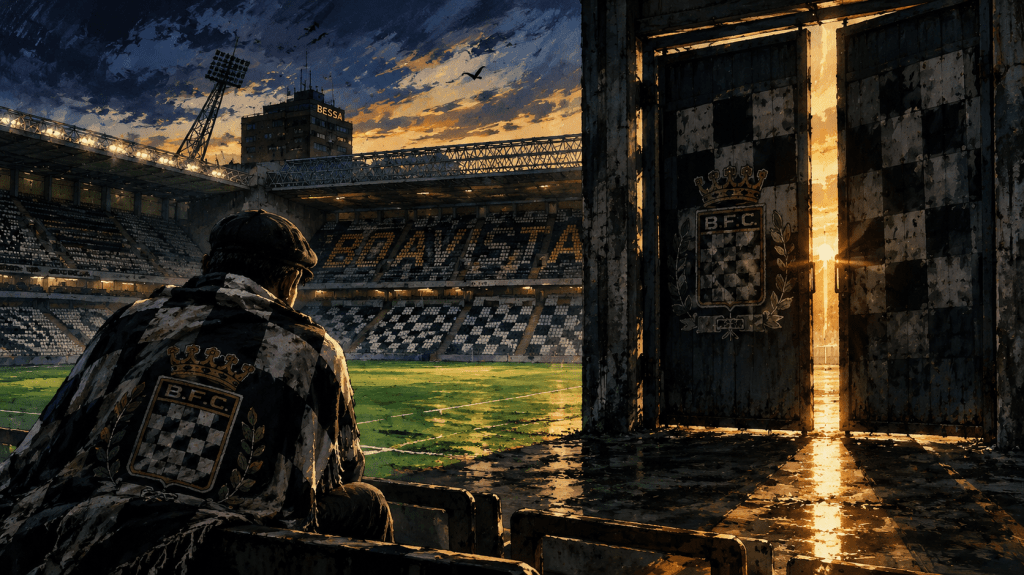
Cease operations. Vacate the facilities. Hand over the keys.
Football has developed a remarkable talent for making catastrophes sound administrative. Somewhere between an insolvency filing, a missed payment and what was probably just another email in someone’s inbox, one of Portugal’s most important football clubs effectively stopped existing.
Not folded in the romantic lower league sense. Not rebuilding. Not waiting for kinder days.
Simply… switched off.
There are clubs that suffer relegation. Others spend years lurching from one financial emergency to another before eventually finding their feet again.
Then there is Boavista.
One of only five clubs ever to win the Portuguese top flight. A club that once stood shoulder to shoulder with Benfica, Sporting and FC Porto. A club that lifted the Primeira Liga trophy in 2001. A club that has now been instructed to leave its own stadium.
Football likes to tell us that history matters.
Sometimes it doesn’t.
The Match I Never Saw
My own connection to Boavista is hardly profound, yet it has lingered in a way that surprises me.
A few years ago I travelled to Porto, still one of my favourite football cities anywhere in Europe.
Boavista were at home.
Or at least they were supposed to be.
The fixture ended up being played behind closed doors following a punishment imposed by the Portuguese Football Federation. I remember standing outside Estádio do Bessa feeling mildly disappointed. It felt like one of those moments when you travel and want to watch football, but it doesn’t work out.
There would always be another opportunity.
Football encourages that sort of optimism.
Football also spends an extraordinary amount of time punishing it.
Looking back, that missed afternoon has become oddly significant. It was a minor moment. Which is exactly why it stuck.
Winning The League Doesn’t Buy Forever
Portuguese football has always revolved around three institutions.
Benfica.
Sporting.
FC Porto.
Braga if you squint.
Everything else generally exists somewhere beneath them, occasionally threatening to interrupt the established order before normal service resumes.
Boavista refused to read the script.
Under Jaime Pacheco they built a side that looked nothing like the glamorous champions people tend to remember. They were organised to the point of obsession, relentlessly competitive and entirely uninterested in making life enjoyable for anyone they played.
To be fair, football has always had room for teams like that.
Supporters often claim they want attacking football until someone else’s organised defence prevents them winning the league.
The 2000/01 title remains one of the great achievements in modern European football. Not because Boavista dazzled anyone, but because they proved the established hierarchy wasn’t actually inevitable.
People still remember champions.
They remember intruders even more.
Clubs Rarely Die Dramatically
Football prefers its disasters theatrical.
A last-day relegation.
A tearful press conference.
Players applauding supporters after another defeat.
Real collapse tends to arrive through bureaucracy.
Boavista’s descent reached its most visible point in May 2025 when a 4-1 defeat away at Arouca confirmed relegation from the Primeira Liga. Travelling supporters spilled onto the pitch afterwards. It looked dramatic enough for the television cameras.
The real damage came afterwards.
The club could not register for Liga Portugal 2.
Then Liga 3.
Then the Campeonato de Portugal.
One rejection is unfortunate.
Three begins to resemble an obituary.
Nobody mentioned it at the time, but this was the point where Boavista effectively stopped existing as a national football club.
Everything after that merely confirmed it.
What Exactly Is Left?
Football clubs like to present themselves as permanent.
Owners change.
Managers come and go.
Players disappear every summer.
The badge survives.
Except sometimes it doesn’t.
Boavista fractured into something increasingly difficult to explain. The professional company entered the Porto Football Association’s Liga Pro while the historic club attempted to continue several divisions lower in district football.
Supporters found themselves asking questions nobody should ever have to ask.
Which Boavista was the real one?
Which badge mattered?
Where exactly had the institution gone?
Football is usually quite good at providing ninety minutes of certainty every weekend.
This offered none.
The Panteras Negras supporters eventually established Panteras Negras FC, ensuring that at least part of the community would survive regardless of whatever happened to the legal entity.
That decision said rather more than any official statement ever could.
The Day Football Simply Didn’t Happen
Perhaps the saddest chapter barely made headlines.
The district league side repeatedly failed to appear for fixtures.
Defeats were awarded.
Eventually they withdrew altogether.
Imagine explaining that sentence to someone celebrating Boavista’s league title in 2001.
They would probably assume you had confused the club with someone else.
Football supporters can accept losing.
They can even accept relegation.
Not turning up at all belongs to another category entirely.
Rescue Narratives
Modern football has become strangely addicted to rescue stories.
A wealthy investor arrives.
There are presentations.
The words vision, project and future begin appearing with suspicious regularity.
Supporters convince themselves that the difficult years are finally over.
Sometimes they are.
More often the problems remain exactly where they were, simply wrapped in better branding.
Gérard López has appeared in enough of these stories that certain patterns have become difficult to ignore.
For Boavista, his ownership coincided with debts mounting, administrative crises multiplying and optimism shrinking with each passing season. Every announcement felt like progress until it wasn’t.
This was framed as renewal.
It rarely felt like it.
Losing More Than Concrete
People often describe stadiums as bricks, steel and seats.
That is technically accurate.
It is also entirely inadequate.
Estádio do Bessa held first matches, last matches, family rituals and arguments that somehow became traditions. Entire childhoods unfolded there one Saturday at a time.
As insolvency proceedings advanced, the stadium itself entered auction alongside the surrounding sporting complex.
Legally it was an asset.
Emotionally it was something rather different.
There is another detail worth remembering.
Following Portugal’s triumph at UEFA Euro 2016, the first stadium to welcome the newly crowned European champions home was Estádio do Bessa. Portugal beat Gibraltar 5-0 there. Nani, João Cancelo, Bernardo Silva and Pepe all scored.
Nobody mentioned insolvency that night.
Football has a habit of assuming today’s celebrations will still matter tomorrow.
Sometimes they do.
Sometimes they become footnotes in entirely different stories.
A City Loses Something
In July 2026 the final chapter arrived.
Boavista failed to make a required €55,000 payment that would have delayed insolvency proceedings.
The administrator instructed the club to cease operations.
Employees left.
Facilities were vacated.
The keys were handed over.
Reading those details feels strangely clinical.
Football clubs are awkward things. They behave like businesses until the moment they fail.
Then everyone suddenly remembers they were never just businesses.
They are grandparents lifting children over turnstiles.
Programmes folded into coat pockets.
Arguments over referees that continue for decades.
Twenty thousand people shouting at a man for taking a throw-in too slowly which, on reflection, is quite a niche cultural ritual.
They are cities remembering themselves once every weekend.
Closing one isn’t like shutting a company.
It feels closer to deleting part of a community’s memory.