
Introduction
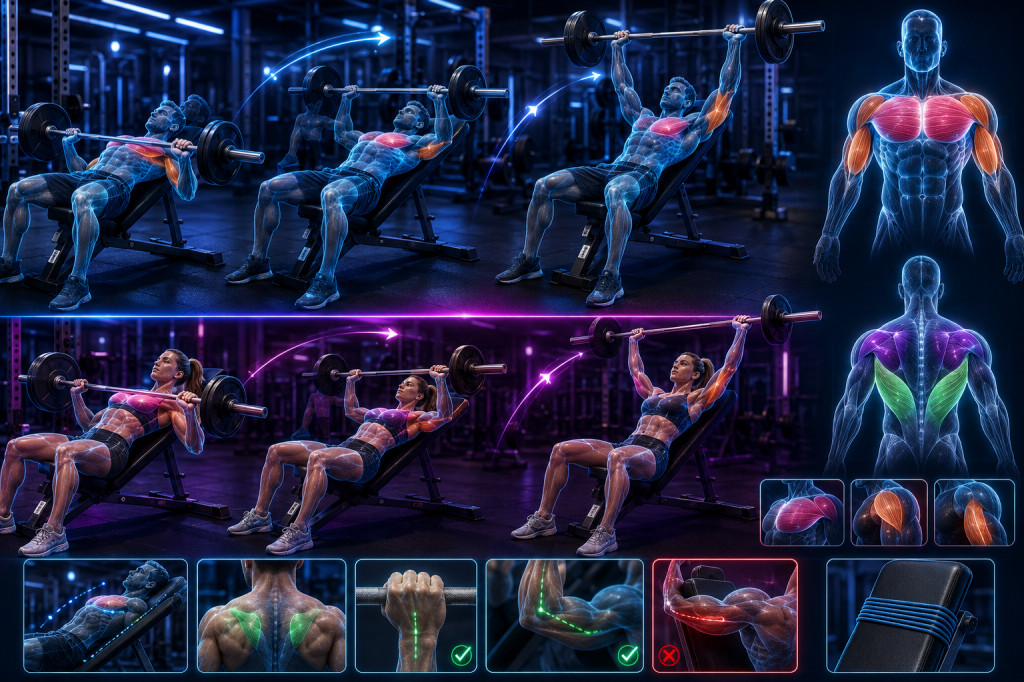
The Incline Barbell Bench Press is one of the most effective upper-body pressing exercises for building a powerful, well-rounded chest. By elevating the bench between 15 and 45 degrees, the movement shifts emphasis toward the upper chest while still allowing you to move substantial weight.
Whether you’re a beginner learning foundational pressing mechanics, a bodybuilder chasing a fuller chest, or an athlete looking for explosive pushing power, the incline press deserves a place in your programme.
Its biggest advantage? It targets the often-neglected upper chest, helping create a more balanced physique while improving overall pressing strength.
Muscles Worked
Primary Muscles
- Pectoralis Major (Clavicular Head / Upper Chest)
- Anterior Deltoids (Front Shoulders)
The upper chest is the star of the show here. The incline angle places the clavicular fibres under greater tension than a traditional flat bench press.
Secondary Muscles
- Triceps Brachii
- Mid and Lower Pectoralis Major
These muscles assist during the pressing phase and become increasingly important as the weight gets heavier.
Stabilising Muscles
- Rotator Cuff
- Biceps Brachii
- Serratus Anterior
- Latissimus Dorsi
- Abdominals and Core Muscles
Many lifters don’t realise how much stabilisation is required during heavy incline pressing. A strong upper back is often the difference between a smooth set and a shaky one.
Why This Exercise Is Good
Strength Benefits
The incline press develops tremendous pressing power by overloading the upper portion of the range of motion. This carries over well to:
- Flat Bench Press
- Overhead Press
- Athletic pushing movements
Many lifters find that improving their incline strength directly improves their lockout on other pressing exercises.
Muscle Building Potential
If your chest looks impressive from the side but lacks fullness near the collarbones, the incline press is often the missing piece.
Research consistently shows that a moderate incline angle produces greater upper chest activation than flat pressing.
Athletic Carryover
The pressing angle closely resembles movements seen in:
- Boxing
- Rugby
- American Football
- Shot Put
- Wrestling
Athletes frequently use incline pressing to develop explosive upper-body power.
Functional Benefits
Daily activities often involve pushing at an angle rather than directly in front of you.
The incline press strengthens:
- General pushing ability
- Shoulder stability
- Postural strength
- Upper-body coordination
Beginner Friendliness
Unlike many advanced chest exercises, the incline press is highly beginner-friendly when performed with sensible loads and proper setup.
Technique Breakdown
Starting Position
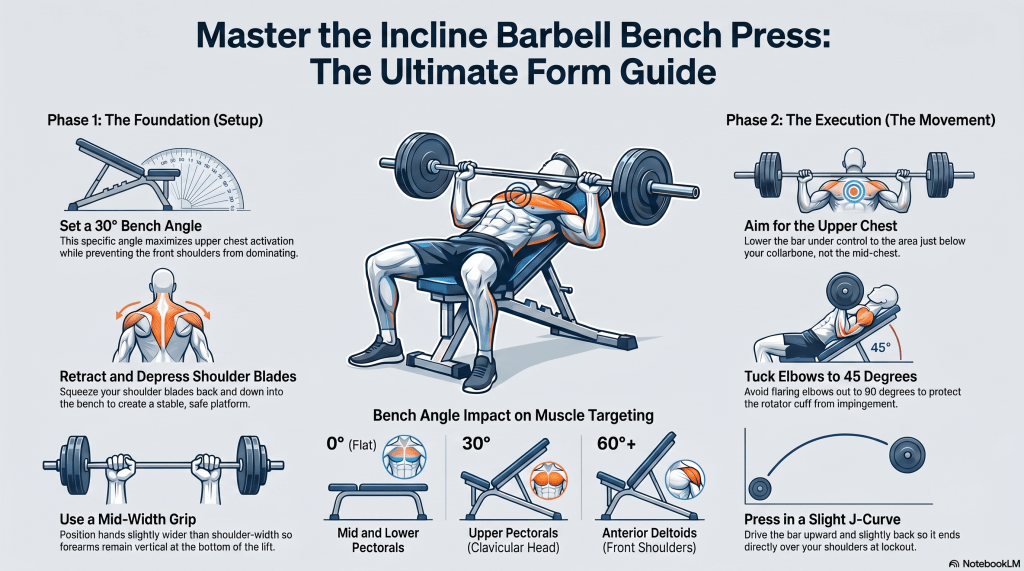
- Set the bench to approximately 30 degrees.
- Position yourself with:
- Head on bench
- Upper back on bench
- Glutes on bench
- Both feet firmly planted
- Grip the bar slightly wider than shoulder-width.
- Retract and depress your shoulder blades.
- Unrack the bar carefully.
Execution
- Lower the bar slowly toward the upper chest.
- Touch just below the collarbones.
- Maintain tight shoulders and upper back.
- Press upward explosively.
- Allow the bar to travel in a slight “J-curve” back toward the shoulders.
- Lock out under control.
Breathing
- Inhale deeply during the lowering phase.
- Hold tension through the bottom.
- Exhale forcefully during the press.
For advanced lifters handling heavy loads, the Valsalva manoeuvre can improve stability.
Common Coaching Cues
- “Bend the bar.”
- “Crack a walnut between your shoulder blades.”
- “Drive your feet into the floor.”
- “Keep your knuckles facing the ceiling.”
- “Press up and back.”
Common Mistakes
Bench Angle Too Steep
Anything beyond 45 degrees begins turning the movement into more of a shoulder press.
Fix: Stay around 30 degrees.
Elbows Flaring Out
This places unnecessary stress on the shoulders.
Fix: Keep elbows roughly 45 to 60 degrees from your torso.
Losing Upper Back Tightness
Relaxed shoulder blades increase injury risk and reduce chest activation.
Fix: Maintain scapular retraction throughout the set.
Bouncing the Bar
Using momentum removes tension from the muscles and increases injury risk.
Fix: Lower under control and touch the chest lightly.
Hyperextended Wrists
Bent-back wrists reduce force transfer.
Fix: Stack wrists directly above the forearms.
Potential Drawbacks
No exercise is perfect.
Shoulder Stress
Improper technique can contribute to:
- Shoulder impingement
- Rotator cuff irritation
- AC joint discomfort
Mobility Requirements
The exercise demands:
- Adequate thoracic extension
- Good shoulder mobility
- Stable scapular control
Equipment Limitations
Unlike push-ups, you’ll need:
- An adjustable bench
- A barbell
- Weight plates
- A rack or safety system
Not Ideal For Everyone
Individuals with:
- Previous shoulder dislocations
- Labral injuries
- Severe shoulder pain
may find alternative pressing variations more comfortable.
Equipment Needed
Standard Setup
- Adjustable Bench
- Barbell
- Weight Plates
- Power Rack or Squat Stand
Alternatives
Dumbbells
Allow a greater range of motion and help correct imbalances.
Smith Machine
Provides additional stability and confidence.
Machines
Excellent for hypertrophy-focused training.
Resistance Bands
Useful for home training and rehabilitation.
Bodyweight
Feet-elevated incline push-ups can mimic the movement pattern surprisingly well.
Variations
Easier Version
- Incline Push-Ups
- Machine Chest Press
- Smith Machine Incline Press
Harder Version
- Incline Dumbbell Press
- Single-Arm Incline Dumbbell Press
- Pause Incline Press
- Tempo Incline Press
Alternative Exercises
- Reverse-Grip Bench Press
- Incline Dumbbell Press
- Landmine Press
- Standing Cable Press
- Close-Grip Incline Bench Press
Who Should Use This Exercise?
Beginners
Absolutely. The incline press teaches excellent pressing mechanics.
Intermediate Lifters
A fantastic tool for building upper chest size and improving bench strength.
Advanced Athletes
Provides valuable sport-specific pushing power and shoulder stability.
Bodybuilders
Almost essential for creating a balanced chest development.
General Fitness Enthusiasts
An outstanding choice for building strength, muscle and confidence in the gym.
Sport-Specific Athletes
Especially useful for:
- Rugby Players
- American Football Players
- Boxers
- Wrestlers
- Throwers
- Weightlifters
Programming Advice
For Strength
- 4 to 6 sets
- 2 to 5 reps
- 85%+ 1RM
- Rest 3 to 5 minutes
For Muscle Growth
- 3 to 4 sets
- 8 to 12 reps
- 70 to 85% 1RM
- Rest 60 to 120 seconds
For Muscular Endurance
- 1 to 3 sets
- 12 to 20 reps
- 50 to 70% 1RM
- Rest 45 to 90 seconds
Research & Expert Insights
Research consistently suggests that bench angles between 30 and 43 degrees provide the best balance between upper chest activation and shoulder involvement.
Once the bench angle climbs above 45 degrees, the front deltoids increasingly dominate the movement, reducing upper chest recruitment.
Studies have also demonstrated greater increases in upper chest thickness when incline pressing is prioritised compared to flat pressing alone.
Elite lifters often display significantly greater biceps activation during incline pressing than novice lifters, highlighting the importance of shoulder stabilisation during the movement.
One coaching point remains universally agreed upon:
Never use a suicide grip.
The small perceived comfort benefit is not worth the potentially catastrophic consequences if the bar slips.
Doragon Verdict
| Category | Score |
| Muscle Building | 9/10 |
| Strength Development | 8/10 |
| Beginner Friendly | 8/10 |
| Equipment Accessibility | 6/10 |
| Athletic Carryover | 8/10 |
| Overall Rating | 9/10 |
The Incline Barbell Bench Press remains one of the best exercises for building an impressive upper chest while developing serious pressing strength. It rewards patience, technical discipline and intelligent programming. If your chest training lacks incline work, there’s a good chance you’re leaving gains sitting on the rack.
Frequently Asked Questions
Is the incline barbell bench press good for beginners?
Yes. A 30-degree incline and light weights provide an excellent environment for learning pressing mechanics safely.
What is the best angle for the incline bench press?
Most research and coaching experience points toward 30 degrees as the sweet spot for upper chest development.
Can the incline press build muscle?
Absolutely. It is one of the most effective upper chest hypertrophy exercises available.
Should I use dumbbells or a barbell?
Barbells are generally superior for strength development. Dumbbells are excellent for range of motion and correcting imbalances.
Can I replace the flat bench press with incline pressing?
You can build an impressive chest using primarily incline work, but flat bench pressing remains valuable for overall chest development and maximal strength.
1. What is the best angle for the incline bench press?
A bench angle between 30 and 45 degrees is generally considered optimal, with 30 degrees providing the best balance of upper chest activation and shoulder involvement.
2. What muscles does the incline barbell bench press work?
The exercise primarily targets the upper chest and front shoulders while heavily involving the triceps.
3. Is the incline barbell press better than the incline dumbbell press?
Neither is universally better. Barbells allow heavier loading, while dumbbells provide a greater range of motion and improved unilateral development.
4. Why do my shoulders hurt during the incline bench press?
Pain is often caused by excessive bench angles, elbow flare, poor shoulder blade positioning, or pre-existing shoulder issues.
5. Where should the bar touch my chest?
The bar should touch the upper chest, just below the collarbones.
6. Can the incline bench press replace the flat bench press?
It can replace it for some goals, but most lifters benefit from performing both movements.
7. How wide should my grip be?
Slightly wider than shoulder-width, allowing vertical forearms at the bottom position.
8. Is a suicide grip safe?
No. Most strength coaches strongly advise against using a thumbless grip due to the risk of the bar slipping.
9. Can beginners perform incline bench press safely?
Yes, provided they use manageable weights and focus on technique first.
10. How many reps should I do to build muscle?
Generally 8 to 12 repetitions across 3 to 4 working sets is highly effective for hypertrophy.
Disclaimer
This article is intended for informational purposes only and does not constitute medical, physiotherapy, coaching, or professional training advice. Always consult a qualified healthcare or fitness professional before beginning a new exercise programme. Complete all workouts and exercises at your own risk.






5 responses to “Incline Barbell Bench Press”
[…] Oba Femi has the bigger biceps and pecs. […]
LikeLike
[…] Potentially she’s been doing some incline barbell bench presses. […]
LikeLike
[…] other is preparing for UEFA Euro 2028… as in, regular gym workouts: incline barbell bench press, bicep 21s, no real match conditioning […]
LikeLike
[…] Instead, he rebuilt in the gym. Maybe with Bicep 21s and Incline Barbell Bench Presses. […]
LikeLike
[…] reducing her appeal to muscles would miss the point entirely. Plenty of wrestlers are physically impressive. Far fewer understand […]
LikeLike