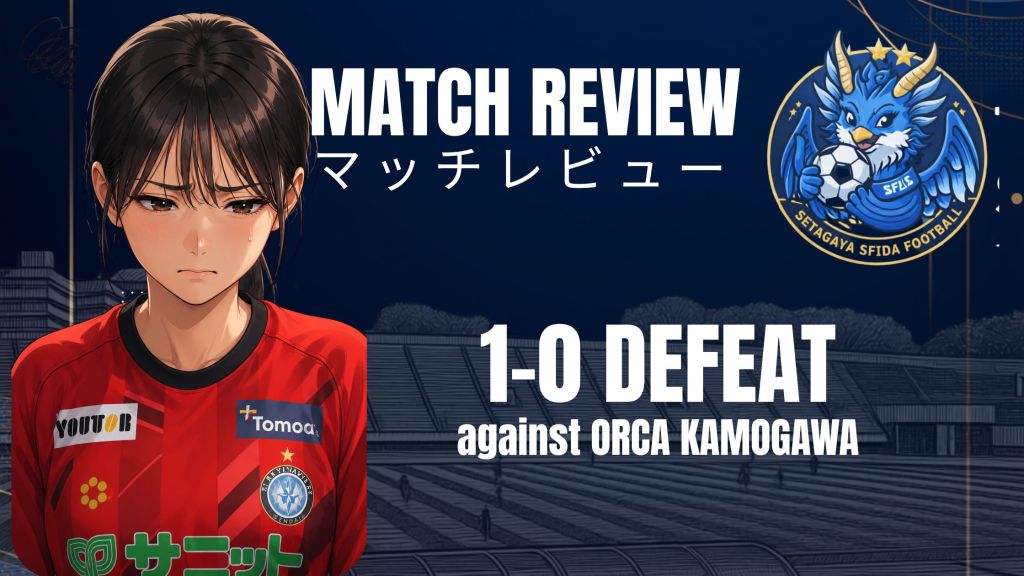
A 3:30am Decision That Felt Clever Until It Wasn’t
A 3:30am kick-off after a night out is the sort of life decision that sounds romantic at midnight and deeply irresponsible by 4am.
By the time the stream loaded from Wata-Rei Stadium, my body felt like an abandoned vending machine. Too much alcohol earlier, not enough sleep, cold water doing its best to negotiate peace terms with my head. Outside, Britain was dark and silent. Inside my flat, I was watching a football match from coastal Chiba between two Nadeshiko League sides while eating whatever food I could find without actually concentrating.
And honestly, I wouldn’t have wanted to be anywhere else.
SFIDA Setagaya in the white away kit.
Matchday nine.
Mother’s Day in Japan.
Before kick-off, the players walked out beside their mothers for the team photos, which immediately created the strange emotional contradiction football specialises in. One minute, there’s tenderness, smiles, family, sentimentality. The next minute, Riouna Eto is flying into midfield tackles like she’s trying to settle a pub disagreement from 2009.
Football contains multitudes.
Even the Orca mascot looked emotionally conflicted. It’s supposed to be an orca, apparently, but looked suspiciously like a panda assembled by a manufacturer who realised black-and-white mammals are broadly interchangeable if deadlines are tight enough.
Nemoto Running Into the Wind
The game itself started exactly as these awful early morning matches always do. Slow enough to make you question your life choices, but tense enough to stop you from going back to bed.
Misuzu Uchida whipped an early corner in, and I caught myself sitting forward immediately. Come on then. Let’s have something here. Orca dealt with it comfortably, but SFIDA looked lively enough early on. Ayaka Nemot,o especially.
Nemoto was everywhere in that first half.
Running.
Recycling possession.
Dragging the team upfield through sheer bloody-mindedness.
There’s always one player in these matches who looks fully awake before everybody else, and for SFI, DA, it was her. Every time we moved forward, Nemoto seemed attached to it somehow. The problem was what happened afterwards.
Nothing.
Crosses floated nowhere.
Loose passes.
Half-chances.
Moments that looked promising until they suddenly weren’t.
At around ten minutes, I scribbled down “very workmanlike looking game,” and honestly, that became the entire mood of the morning. Not ugly enough to be entertaining. Not technical enough to be beautiful. Just two teams repeatedly trying to force openings through the Chiba sea wind while 605 supporters watched from a small stadium in the countryside.
And yet I became increasingly invested in every tiny detail.
That’s the dangerous thing about football. I just wanted another win.
Riouna Eto and the Warehouse Rave Tackles
Momoka Saito nearly punished SFIDA after fourteen minutes with a shot that forced Mio Otsuka into a proper save. This kind of hat instantly wakes you up regardless of alcohol intake or sleep deprivation. Orca started growing into the game after that. Riouna Eto especially began throwing herself around midfield with what can only be described as warehouse-rave energy.
One of her tackles looked less like a football challenge and more like someone trying to move industrial furniture.
Naturally, the referee allowed it.
Which meant Mizuki Horie decided she might as well join in, too.
The game developed that slight edge you often get in women’s football, where the physicality isn’t performative, ve macho nonsense like certain men’s matches. It just becomes increasingly personal. Little nudges. Delayed tackles. Competitive irritation. Everyone is quietly deciding they’re sick of each other.
Yui Kaneko’s presence made all of this stranger, too.
Seven years at SFIDA. Over a hundred appearances. Then, suddenly, wearing Orca colours against us for the first time. Every time she touched the ball, I noticed it. Every challenge. Every run. You can pretend footballers are emotionless professionals if you want, but they aren’t.
You could see she cared.
And Orca cared too.
Mechagodzilla in Coastal Chiba
That team defends like Mechagodzilla stomping through the Pacific. Heavy. Mechanical. Unpleasantly efficient. You spend an hour watching them, thinking surely something will crack eventually, then suddenly realise the machine is designed specifically not to.
SFIDA had more of the ball in the first half. Better territory, too. Saaya Kato nearly broke through just before half-time after weaving between defenders beautifully, only for the move to collapse right at the crucial moment. That became the defining frustration of the entire match.
Everything almost happened.
Nothing actually did.
As the camera widened occasionally, you could see the countryside around Wata-Rei Stadium. Bits of rural Chiba disappearing into grey skies. It looked peaceful in the sort of way places often do when you aren’t the one emotionally suffering there.
By half-time, I actually felt optimistic.
Dangerous mistake.
“We ended the half as the better team,” I wrote.
Never trust optimism in football. It behaves like an unreliable narrator.
The Moment the Match Turned
Almost immediately after the restart, Orca began changing the game’s rhythm. Not dramatically at first. Just slightly more direct. Slightly more confident. Slightly more willing to shoot from a distance.
And SFIDA slowly began retreating.
You could feel it happening before you could properly explain it.
The passes got looser.
The press became slower.
Nemoto began to tire after carrying the right flank for an hour.
Orca sensed weakness.
By 57 minutes, I’d written: “Yikes.”
Not an analysis exactly. But emotionally accurate.
Mio Otsuka kept us alive for a while. She was excellent. Calm under pressure, claiming dangerous balls, reacting well to long-range efforts as Orca began firing shots through the wind from increasingly irritating angles.
Still, there was this creeping inevitability forming around the match. The sort of football is created when one team refuses to capitalise on dominance, and the other quietly waits for chaos.
Then it came.
Seventy-seven minutes.
One long launch forward from the Orca goalkeeper. We contested it badly. Yuki Kawano reacted first. Wanted it more. Hit the shot. Otsuka got a hand to it.
And somehow that made it worse.
The ball spun cruelly into the net.
Silence from me.
Celebration from Orca.
Sea wind everywhere.
Fuuun na.
Unlucky.
But not entirely undeserved either.
Because football eventually punishes hesitation. SFIDA spent the entire morning circling opportunities without ever truly attacking them. Orca waited patiently for one mistake, and when it arrived, they took it immediately.
The Sea Wind Blew the Other Way
After the goal, Orca transformed fully into coastal survival football.
Every player behind the ball.
Every tackle is venomous.
Every loose ball is treated like buried treasure.
It was infuriating to watch.
Also weirdly admirable.
By the final minutes, SFIDA finally started passing with urgency again, but Orca had already built the wall. Misuzu Uchida tried from distance in stoppage time, but it went straight at the keeper. One final promising move broke apart because nobody attacked the loose ball.
And that was that.
The stream ended.
The sun started appearing outside.
My room smelled faintly of stale beer and disappointment.
A frustrating game. SFIDA were better in the first half but didn’t score. Orca were better in the second half and did score. That’s football for you. If you don’t score, eventually the sea wind blows the other way.


3 responses to “The Sea Wind Blew the Other Way: SFIDA Lost to Orca”
[…] Somewhere emotional. […]
LikeLike
[…] Probably. Having lost last week, it was a bit of a gut […]
LikeLike
[…] behind away from home against one of the league’s strongest sides would previously have triggered collapse. Instead, SFIDA stayed calm. Mature, even. Which is not always a word associated with […]
LikeLike