
My alarm went off at 5:00 am.
Not gently. Not kindly. That harsh, unforgiving sound that reminds you you’re choosing this.
I live in the UK—Sunday morning. Most of the country is still asleep. I’d already had a long, stressful 24 hours, the kind that leaves your body tired but your head wired, and yet here I was, pulling myself upright in the dark to watch SFIDA Setagaya. Against VONDS from Chiba.
That’s what this club does to you.
It makes you show up.
Laptop open. Coffee barely touched. Ajinomoto Field Nishigaoka flickers onto the screen, impossibly green under Tokyo daylight. The contrast is always surreal, my grey dawn versus their afternoon sun. Komorebi dancing across the pitch, while my living room sits in silence. Oh, my cat decided to join me, good lad.
And immediately, something nags at me.
This is our third different home ground of the season.
That matters more than people think. Home advantage isn’t just geography; it’s ritual. It sounds. It’s repetition. Moving grounds disrupts supporters as much as players. And with the looming 2027 merger, every reminder that this is the last independent season of SFIDA Setagaya lands a little heavier.
FC Tokyo can wait.
This is still SFIDA.
Honour it while it’s here.
Chaos From Kickoff: As Always
Kickoff, and instantly SFIDA are on the front foot.
Two minutes in: a long, searching ball straight through the middle. Too eager, straight to the keeper. At three minutes, VONDS haven’t touched the ball — unless you count their goalkeeper. I actually mutter it out loud, alone in my kitchen. At 3.3 minutes, okay, fine, they’ve touched it now.
By minute four, VONDS look exactly like a newly promoted side struggling to breathe. Disorganised. Scattergun. The step up from Division 2 is glaring. They’ve lost all seven so far and, early on, you can see why.
But football never lets you relax.
Seven minutes: VONDS #10 Kotono Sakabura shows real pace. Nine minutes: Samia Masuda shoots — and my stomach tightens because it could have gone in. At ten minutes, they’re suddenly growing into the game, and with SFIDA, that’s always dangerous.
Because SFIDA don’t control games.
They destabilise them.
This is Hamada-ball in its purest form. Pressing in emotional waves. Aggression over patience. Momentum over management. We trade structure for disruption, and when it works, it’s intoxicating. When it doesn’t, it’s terrifying.
Kokone Kitagawa goes through on goal around ten minutes. Saved. Unfortunate. That’s her essence — recognising moments the instant they appear. Some players wait for the perfect moment. Kitagawa reacts when it arrives uninvited.
Corners follow. Scruffy. Wasted. Long shots that go nowhere. Pressure without polish.
And then there’s Rumina Sato.
VONDS’ goalkeeper, making her Nadeshiko League debut, looks composed beyond her circumstances. Busy, yes — but mostly because our execution is poor. She doesn’t panic. She doesn’t spill. She doesn’t look like a player drowning.
Which makes what eventually happens feel less cruel, more inevitable.
“Not Glam. But It’s a Goal.”
Around the 27th minute, it finally clicks.
Horie Mitsuki keeps the ball alive — again. She doesn’t even need to score to dominate. She is SFIDA’s retractor, pulling centre-backs inward, warping defensive shape by presence alone.
We build down the right. Nemoto Ayaka slips a lovely ball to Kato Saaya. The cross comes in.
The goal itself is… ugly.
It comes off VONDS defender Nao Kobori, ricochets off Horie, and ends up in the net.
I laugh. Out loud. A half‑laugh, half‑exhale.
One SFIDA fan’s words from the brief echo perfectly in my head:
“Not glam. But it’s a goal. Awfully bad luck for VONDS. However, the season we’ve had following SFIDA, I’ll take a scrappy goal all day.”
Exactly that.
This is relegation‑zone football. You don’t ask how — you ask how many. And Horie’s mere involvement causes chaos again.
From kickoff, VONDS can’t escape. Seconds later, it’s an SFIDA throw-in. The gulf is obvious now. VONDS look like a team bracing for a long, painful season.
And yet — and this is crucial — we don’t finish them.
The Uneasy Half-Time Lead
We dominate possession without mastering it. Corners fall harmlessly. Free kicks dissolve. VONDS look confused going forward, but when they do break, they still force saves. Their keeper slows everything down, even at 1–0 down, because survival has become the mission.
Midfield turns scrappy. Pass. Lose. Repeat.
This is where the ghosts usually appear. The 94th‑minute collapses. The late concessions. The feeling that SFIDA can snatch defeat from the jaws of stability.
Half-time: 1–0. Not comfortable. Not safe. Just… fragile.
Then something unexpectedly perfect happens.
Mami Ōhigashi performs Refrain, the Nadeshiko League theme. A song about continuing forward even after being beaten down. Mascot dancing. Small crowd, but real warmth. It feels like the league itself is reminding both teams — and supporters watching from the other side of the world — why we endure this.
The Goal That Changes Everything
Second half: SFIDA starts strongly again.
VONDS try to play. And one player stands out: Airi Tamada. She is everywhere. Box to box. Defending, attacking, pressing. A genuine factotum in midfield, doing the work of two or three players. If VONDS survive this season, she’ll be a reason.
For ten minutes, we look almost surprised that VONDS have the ball. That’s dangerous territory for us. This is usually where fatigue and emotion undo everything.
Then, minute 65.
And suddenly, clarity.
Kitagawa chips her defender — instinctive, audacious. Perfect weight. Misuzu Uchida is already there, because she always is—anticipation over pace. Calm over chaos.
Finish.
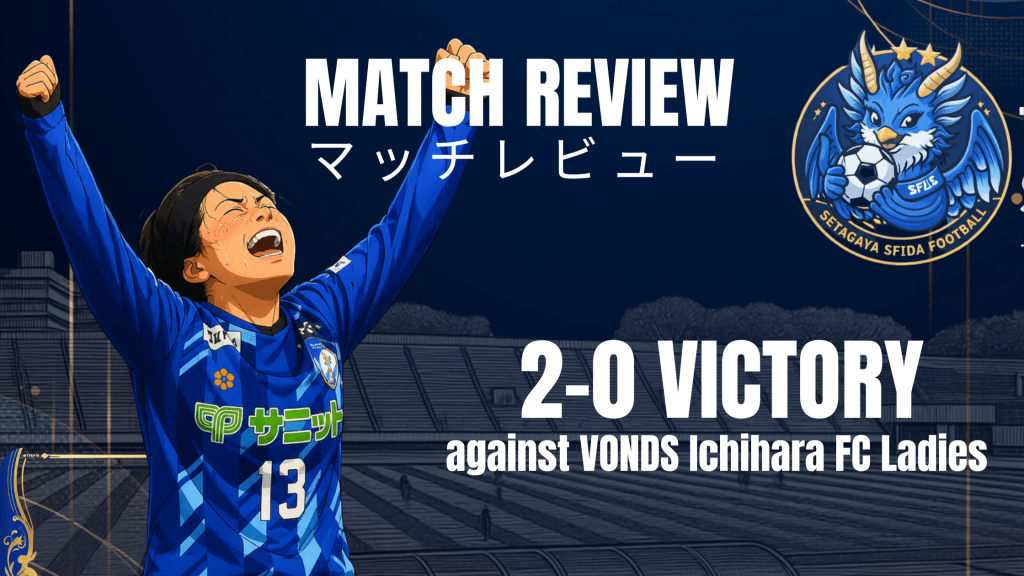
2–0.
I sit back. Finally.
Uchida doesn’t just score goals. She interrupts narratives. At 32, she’s still operating outside logic — a 72.7% conversion rate coming into this match. She is the pulse, the blade, the guarantee. When she scores, games feel settled in a way SFIDA matches rarely do.
This wasn’t just a second goal.
This was 上昇 made tangible.
Seeing the Game Out: Learning, Slowly
The final twenty minutes are attritional.
VONDS keep trying. Corners. Scrambles. Hopeful balls. We get lucky once or twice. Our keeper gathers a tricky ball, and you can feel how much that clean sheet matters.
Subs come on. Clock management appears. These are small things — but they’re new things. Signs of learning. Signs that maybe, just maybe, SFIDA are becoming slightly more ruthless.Full-time.
2–0.
Back‑to‑back wins.
Up to the 8th.
What This Morning Meant
VONDS aren’t ready for this level. Zero points from seven tells its own story. The promotion chasm is real, and it’s unforgiving.
But this match wasn’t about them.
It was about whether SFIDA could turn survival into momentum.
We weren’t perfect. We weren’t dominant. One fellow fan’s voice still rings true:
“To be honest, I wanted us to control the game a little more”
So do I.
But seasons aren’t built on perfection. They’re built on direction.
And for the first time in a while, SFIDA’s direction feels upward.
Not a leap. Not a miracle. A climb.
Next up: Orca Kamogawa. Two points ahead. Fifth place. Suddenly, this season doesn’t feel like something we’re merely enduring.
As I close the laptop, the UK morning finally beginning, I realise something simple.
I’m tired.
I’m relieved.
And for the first time in weeks…
I’m excited.
Come on, SFIDA.




 doragon sports
2 responses to “Watching SFIDA Rise While the World Sleeps”
[…] Small victories. Heavy relief. […]
LikeLike
[…] That’s the dangerous thing about football. I just wanted another win. […]
LikeLike