Not the players. Not the noise. The wind.
It rolls in from the Pacific carrying salt, sea mist, fryer oil from Orca Yokocho, and the vague sensation that football at this level still belongs to actual places rather than marketing departments pretending to be places. Children will run around before kickoff doing “Wanpaku Ninja Training”. Pensioners in Orca blue jackets will politely clap during warmups. Someone will eat a fish sausage tortilla at 11:14am and speak with absolute certainty about a left-back they last trusted in 2022.
And then the football starts, and everyone becomes slightly unreasonable.
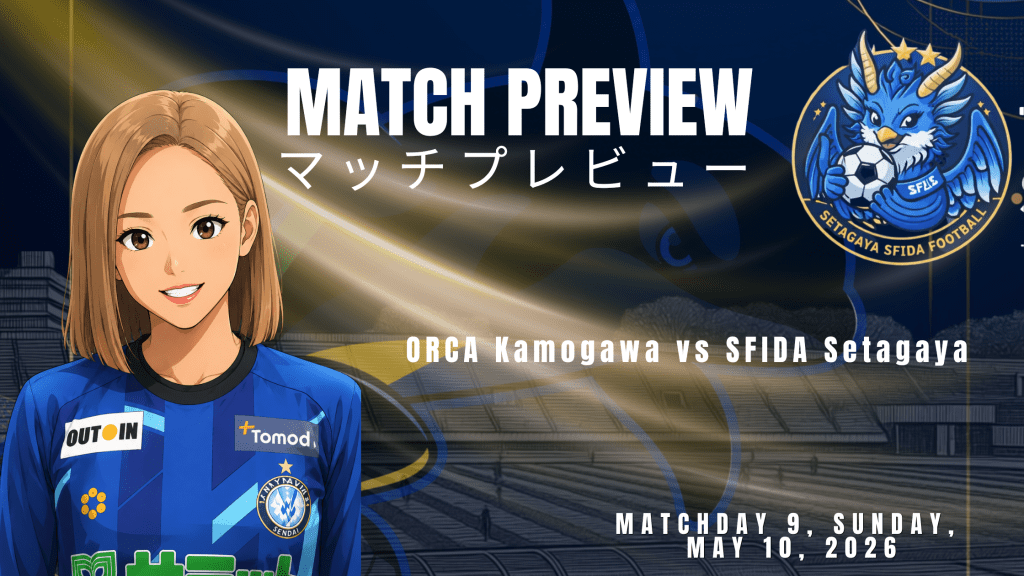
That is more or less the emotional ecosystem surrounding Sunday’s meeting between Orca Kamogawa FC and Sfida Setagaya FC in the 2026 Plenus Nadeshiko League Division 1. A mid-table game on paper. Which is one way of looking at it.
In reality, it feels more like two different philosophies of survival colliding beside the sea.
Game State
Orca arrive in fifth with twelve points, carrying the sturdy emotional posture of a club that still remembers what being champions felt like in 2023. Sfida sit eighth with ten points and the sort of goal difference usually associated with teams who believe defending is an optional cultural suggestion. Seventeen scored. Seventeen conceded. Their matches average 4.25 goals because calm has never really set foot in the building. Orca, meanwhile, have conceded six all season and seems to approach football the way coastal towns approach storm shutters: quietly, practically, with deep suspicion toward unnecessary excitement.
This fixture rarely explodes immediately. It simmers.
Like two people arguing politely in a supermarket queue while everyone nearby pretends not to listen.
Five draws in the last nine meetings. Both teams scored in seven of them. Nobody is truly comfortable. Nobody is fully escaping.
You can feel it in the supporters.
Watching the games
Particularly, the exhausted ones waking at 5am in Britain to watch streams from Chiba with cold coffee and deteriorating sleep schedules. (That’s me, by the way.) There is a kind of footballing radiesthesia involved now, supporters using emotional divining rods to search for signs the club still possesses a soul beneath the impending restructure.
Sometimes they find it.
The recent 2-0 win over VONDS felt like one of those moments.
Not glamorous. Not particularly sophisticated. But important.
For weeks, Sfida had been trapped inside their own late-game horror anthology. Conceding in the 94th minute against Nagoya. Collapsing against Iga. Watching matches leak away in stoppage time like water through cracked foundations. It became less tactical and more spiritual. Every clearance looked cursed. Every defensive line looked haunted.
Then came the resurrection against Nittaidai. Then VONDS.
Small victories. Heavy relief.
One supporter summarised it perfectly afterwards: “Not glam. But it’s a goal.”
Which, to be fair, is usually the point.
Takashi Hamada’s football has always resembled controlled panic. High pressing. Violent momentum swings. Transitional football that often feels one misplaced pass away from either transcendence or immediate collapse. Hamada-ball is football played with the emotional regulation of a Mechagodzilla warning siren.
But after the VONDS win, there was something different in his comments. Calmness. Possession. Control.
Managers always speak about control after winning. It is football’s favourite fictional genre. But this time, there appeared to be genuine evolution underneath the phrasing.
Sfida held the ball more patiently. They watched the opponent rather than simply charging at them like a crowd reacting to a limited-time sale.
That matters.
What Orca Offer
Particularly against an Orca side built on patience and shape.
Manager Manabu Ishida has spent this season quietly building something deeply difficult to play against. Orca do not feel interested in spectacle. They feel interested in reducing your oxygen supply over ninety minutes. The Chiba Derby victory recently carried all the emotional release of a man finally unclenching his jaw after three hours.
“I was absolutely determined not to lose,” he admitted afterwards.
That sentence probably tells you everything about Orca Kamogawa.
And perhaps everything about football in this division generally.
Because beneath the tactical diagrams and social media graphics, these clubs are still powered by ordinary anxieties. Small budgets. Local sponsors. Part-time realities. Players balancing work shifts with football training.
At Sfida, some players literally finish shifts at Summit supermarkets or Tomod’s pharmacies before training. There is no luxury illusion here. No sterile superstar ecosystem.
Just exhaustion and ambition standing beside each other awkwardly.
Which makes players like Mizuki Horie so fascinating.
The Fascination of SFIDA players
At 174cm, Horie functions less like a conventional striker and more like a gravitational anomaly. Centre-backs bend around her existence. Defensive lines distort slightly whenever she moves. She drags structures inward simply by occupying space. There are forwards who score. Then there are forwards who alter geometry.
Misuzu Uchida, meanwhile, remains the emotional metronome. The finisher who interrupts narratives before they become mythology. Sfida can spend twenty minutes looking psychologically fragile before Uchida appears with a finish that resets the entire emotional architecture of a match.
And behind them sits young goalkeeper Mio Otsuka, essentially operating as a human emergency service behind a defensive line that occasionally behaves like it has misplaced several important documents.
Against Orca, she may need to be excellent.
Particularly with players like Ayaka Asano and Mina Ando already carrying memories of hurting Sfida last season. And then there is Mizuki Urabe, once part of Sfida’s youth setup, now returning in Orca blue. Football remains addicted to these tiny acts of emotional bureaucracy. Former clubs. Former teammates. Former versions of yourself.
Nobody ever says it openly, but these matches always contain traces of personal bitterness.
Not huge betrayals.
Just enough.
THANKS DAY in Kamogawa
The atmosphere itself should be wonderful in that distinctly Japanese lower-league way that feels increasingly endangered globally. Harisen clappers echoing through ocean air. Sponsor THANKS DAY ceremonies. Kamogawa beef croquettes. Community rituals unfolding beside the quiet dread of competitive sport.
There is something beautifully contradictory about it all.
A cheerful seaside festival hosting a game where one club is trying to prove it still deserves to exist independently.
Which brings us to the strange metaphor sitting over this fixture like incoming weather: Godzilla Minus One and the looming anticipation around the eventual continuation of that universe.
Because Sfida right now resemble a city in the aftermath of impact.
Still standing. Barely organised. Running on instinct and memory while larger forces move around them. Every small victory feels oversized because survival itself has become the narrative. They are not trying to conquer the division. They are trying to avoid erasure.
Orca, meanwhile, feel more like the fortified coastline waiting calmly for impact to arrive.
And somewhere between those forces sits Sunday lunchtime football in Chiba.
Not glamorous enough for global algorithms. Not loud enough for mainstream attention. But alive in ways bigger leagues often are not.
There is a kind of zymurgy to clubs like these. Fermentation under pressure. Identity slowly brewed over the years inside local climates and shared memory. You cannot mass-produce that. Corporate football keeps trying, of course. It usually ends up tasting sterile.
Sunday’s match probably will not decide promotion or relegation.
People will frame it that way because football discourse now treats every fixture like a trailer voiceover.
But this feels more important than points alone.
It is about the trajectory. Emotional direction. The ability to believe your recent improvement is real, not just temporary weather.
And these are the matches people remember later.
Not because they were beautiful.
Because they revealed something.
Sea wind through blue,
Morning screens glow far from home,
Clappers hide the fear.




 doragon sports
2 responses to “Orca Kamogawa vs. SFIDA Setagaya: The wind tends to arrive first at Watarei Stadium”
[…] 3:30am kick-off after a night out is the sort of life decision that sounds romantic at midnight and deeply […]
LikeLike
[…] Wata-Rei Stadiumの配信が立ち上がった頃、体はもう放置された自販機みたいだった。酒は残ってる。睡眠は足りない。冷たい水だけが、頭の中で必死に和平交渉してる。 […]
LikeLike