
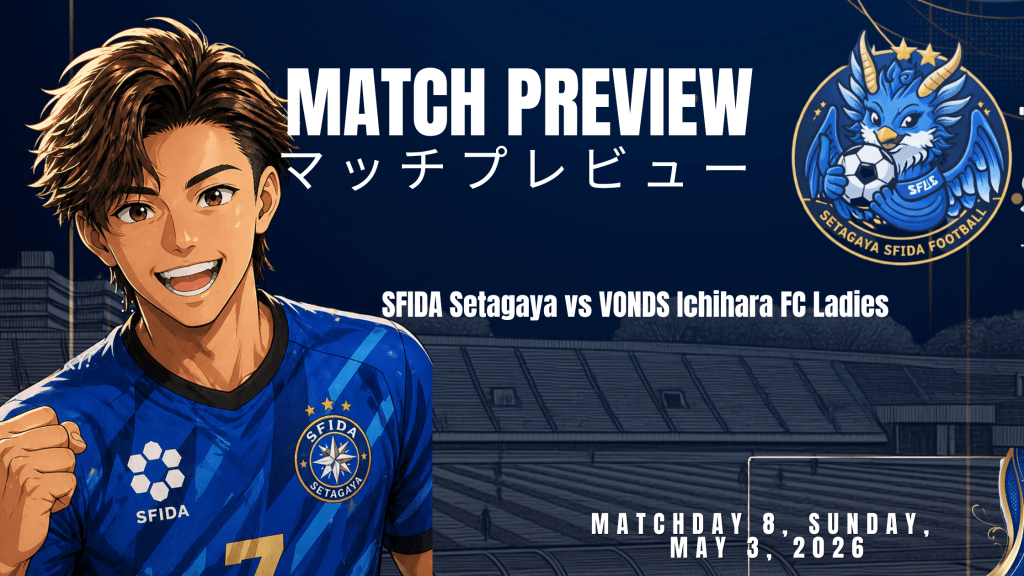
There’s a moment, just before kickoff at Ajinomoto Field Nishigaoka, when the air doesn’t just settle… it thickens. It gathers weight. It presses itself gently against your chest and waits there, like the stadium itself is asking you a question you’re not ready to answer.
I’ll be in the UK. Curtains drawn. Screen glowing. 5 am. Coffee is going cold beside me as the city outside sleeps through something that feels far too alive to be quiet. Or I might have a Uchu Beer.
And somehow, that distance makes it sharper.
Game Context & Stakes
Sfida Setagaya FC vs VONDS Ichihara FC Ladies
Plenus Nadeshiko League Division 1 – Round 8
May 3, 2026 – 14:00 JST
Ajinomoto Field Nishigaoka, Tokyo
This isn’t a neat little bottom-half fixture you glance past on a results page. This is a collision between two unstable forces, each carrying a different kind of damage, each reacting to it in its own volatile way.
We sit 9th. Seven points carved out of chaos. Fifteen goals scored, which is not an accident but a statement of intent. Seventeen conceded, which is not bad luck but structural exposure. We are a side that creates pressure in violent bursts and then suffers the consequences in long, stretched-out moments of vulnerability. The numbers don’t contradict each other. They explain each other.
VONDS sit 12th. Zero points. Not just struggling, but unravelling in a way that feels systemic rather than situational. Twenty goals conceded in seven matches is not simply poor defending. It’s a collapse of rhythm, of structure, of collective timing. Three goals scored tells you they are not just leaking at the back, they are suffocating at the front.
This is not balanced.
This is an imbalance so extreme that it becomes its own ecosystem.
For us, it is a chance to escape the gravitational pull below. For them, it is the last rope before the drop becomes permanent.
The Exorcism at Mitsuzawa & The Momentum Trap
I can still feel Mitsuzawa in my bones.
Not as a memory. As a release.
Because to understand what this match against VONDS really is, you have to understand what we just escaped. That three-game losing streak wasn’t just a run of bad results I shrugged off and moved on from. It clung to me. It sat there, heavy, like something damp and suffocating that refused to dry out. And it wasn’t just the losses. It was the way they came. The 94th-minute collapses. The stoppage-time betrayals. The slow, creeping dread that every match was heading toward the same ending, no matter how it began.
By the time we walked into Nippatsu Mitsuzawa, I wasn’t just watching a team under pressure. I was watching a team being haunted.
Hamada talked about “rebound mentality,” and I wanted to believe him. I did. But belief gets fragile when you’ve seen the same script play out over and over again. And when Nittaidai went 2–1 up in the 61st minute through Mikoto Abe, I felt it again. That sinking, familiar pull. The sense that here we go again, the same ending, the same quiet collapse waiting to arrive on schedule.
But this time, something snapped.
Not loudly. Not dramatically. Just enough.
Two minutes later, Misuzu Uchida dragged us back into the light with a goal that didn’t feel clean or controlled, but honest. Raw. It had been forced into existence rather than constructed. And then came the moment. The one I keep replaying. The 82nd minute. Kokone Kitagawa reacted, instinct over thought, smashing the rebound off the bar and into the net.
3–2.
And just like that, the ghost didn’t vanish… but it loosened its grip.
That goal wasn’t just a winner. It was relief. It was breath returning to lungs that had forgotten how to expand. It was proof that we could reach the closing stages of a match and not disappear inside them.
It won’t define the season.
But I swear, standing there watching it unfold, it felt like it might save it.
Turning Survival into Ruthlessness
And this is where it gets dangerous.
Because now we have something we didn’t have before.
Momentum.
Fragile. Flickering. But real.
And that’s exactly why this match against VONDS scares me more than the table suggests.
They’re bottom. Zero points. Seven losses. Three goals scored, twenty conceded. On paper, this is the kind of fixture you circle as an opportunity, the kind you expect to take control of, the kind you assume will go your way if you just show up.
But I’ve watched enough football, and I’ve lived enough of this season, to know how thin that assumption really is.
Because this is where complacency hides.
VONDS are not just a struggling side. They are a desperate one. And desperation doesn’t follow logic. It doesn’t respect form tables or goal differences. It lashes out. It disrupts. It turns matches into something uncomfortable and unpredictable if you let it breathe.
If we drift back into that restless, impulsive version of ourselves Hamada keeps warning about, if we play on emotion without structure, if we treat this like something already decided, we will invite that chaos right back into our own game.
And I don’t want to feel that again.
Not after Mitsuzawa.
Not after finally shaking something loose.
So for me, this isn’t about survival anymore.
It’s about proof.
Proof that what we found last week wasn’t a one-off surge. Proof that resilience can become habit instead of exception. Proof that we can step onto a pitch against a wounded opponent and dictate the terms from the first whistle instead of reacting to what unfolds around us.
We learned how to survive against Yokohama.
Now I need to see us be ruthless.
Because if we’re serious about putting distance between ourselves and that early-season darkness, if we’re serious about turning this final season into something that actually means something…
Then this is the moment we stop escaping games.
And start owning them.
Narratives & Human Subplots
Resurrection vs Freefall
Last week didn’t just change our position. It changed our lives
It changed our internal rhythm.
That 3–2 win over Nittaidai wasn’t clean, wasn’t controlled, and wasn’t even particularly stable. But it broke something that had been tightening around us for weeks. The late collapses, the stoppage-time concessions, the sense that every game would eventually tilt against us, no matter how it began.
That 82nd-minute winner didn’t just win the match. It interrupted a psychological loop that had started to feel inevitable.
And once inevitability cracks, even slightly, something deeper shifts.
A fragment of jnana settles in. Not confidence exactly. Something quieter. A recognition that the pattern is not law.
Now I’m watching closely for confirmation.
Because one result is a spark.
Two becomes direction.
VONDS, meanwhile, are moving in the opposite direction with frightening consistency. Conceding twice inside nine minutes last week is not just a tactical failure. It’s a breakdown in readiness, in focus, in the basic act of entering a match with structure intact.
When that happens repeatedly, it doesn’t just damage the result; it undermines it.
It erodes belief at the point where belief is supposed to begin.
Managers: Wind vs Structural Fragility
Takashi Hamada understands exactly what we are, and more importantly, what we are not.
When he talks about his team relying too heavily on momentum, about the lack of calm judgment in key phases, he isn’t offering criticism for effect. He’s diagnosing a system that runs on emotional surges rather than a controlled tempo.
Hamada-ball is not about managing the game.
It’s about destabilising it.
It’s pressure applied in sharp, aggressive waves that force errors, create turnovers, and generate set-pieces in clusters. Fourteen direct free kicks in one match against Yokohama is not a coincidence. It’s a product of sustained disruption, of forcing the opponent into decisions they don’t want to make.
But disruption cuts both ways.
Because when that energy dips, even slightly, the structure behind it is exposed.
Megumi Ochiai faces the inverse problem.
Her team is not chaotic.
It is brittle.
The early concessions, the inability to reset the flow of the game, the visible drop in intensity once momentum shifts away from them… these are not issues you solve with a single tactical tweak. They require deeper reconstruction.
And reconstruction doesn’t happen mid-match.
Key Players & Matchups
Sfida’s Axis of Chaos
Mizuki Horie (#9)
She operates as both a reference point and a gravitational force. At 174cm, she dominates aerial channels not just through height but through timing and body orientation. Her ability to pin centre-backs allows the entire attacking structure to compress around her, turning second balls into immediate attacking platforms. What’s changed recently is her efficiency on the ground. Fewer touches wasted. More direct engagement with the final action.
Misuzu Uchida (#13)
Her finishing is not just clinical. It is anticipatory. She arrives in scoring zones before the defence has completed its adjustment, which is why her goals often look simple when they are anything but. The brace last week wasn’t about volume. It was about precision in moments where the narrative was still undecided.
Kokone Kitagawa (#16)
She is not a system player. She is a disruption within disruption. When matches break shape, when defensive lines lose their spacing, when timing becomes irregular, she becomes most dangerous. That 82nd-minute goal came from recognising a moment that didn’t formally exist yet and stepping into it anyway.
VONDS Defensive Axis
Nichika Yamada (#1) & Kari Murakami (#11)
They are not just defending attackers. They are defending momentum. Twenty goals conceded across seven matches indicate repeated structural failure in the same zones. If they concede early again, the issue will not be tactical recovery. It will be emotional containment.
The Decisive Duel: High Line vs Transitional Exposure
Mio Otsuka stands behind a defensive line that behaves less like a barrier and more like a forward-moving risk.
At nineteen, she is being asked to operate as both goalkeeper and emergency sweeper, covering spaces that should not exist but do because of the aggression in front of her.
If VONDS can break the first press, bypass that initial wave of pressure, the space behind becomes expansive. Not just open, but yonderly in scale. A stretched landscape where one clean pass can destabilise the entire structure.
But that’s the gamble we accept.
We trade control for disruption.
We trade safety for volume.
Tactical Reality
We score because we force mistakes in dangerous areas.
We concede because we leave dangerous areas exposed when the forcing stops.
Fatigue is not just physical. It is cognitive. After the 75th minute, decision-making slows, the distance between lines increases, and the compactness that defines our pressing phases begins to loosen.
That’s when games slip.
VONDS, however, are not waiting until the 75th minute to break.
They are breaking immediately.
Which is why the opening 20 minutes here are not just important.
They are decisive.
Atmosphere & Cultural Texture
Ajinomoto Field Nishigaoka compresses everything.
Sound, space, pressure.
The harisen claps don’t drift. They snap. They land. They echo off the stands and come back sharper. The proximity of the fans removes distance from the experience. Players don’t perform in front of you. They perform inside your field of feeling.
It suits us.
Because Sfida is not distant.
It is embedded.
This is a club where players work shifts in local supermarkets, in pharmacies, moving between ordinary life and competitive football without the insulation most clubs take for granted. That dual existence doesn’t dilute identity.
It intensifies it.
The Brutal Reality of Ascension: VONDS Ichihara’s Nightmare Start
There is a very specific kind of violence in football that never shows up in tackles or scorelines, and VONDS Ichihara are living inside it right now. One season, you are climbing, lungs burning but eyes fixed on the summit, carried by momentum, belief, and a city that suddenly starts to say your name with pride; the next, you are thrown headfirst into a division that does not care about your story, your promotion, or your celebrations with the mayor after that intoxicating 2025 double ascent. Seven games, seven defeats, three goals scored, twenty conceded, and the numbers don’t just describe failure; they expose a team that hasn’t yet found a foothold in this new altitude, a side still reaching for oxygen while the game rushes past them.
The managerial rupture in October, the sudden removal of Shunsuke Kawamoto at the exact moment of triumph, followed by Megumi Ochiai’s arrival in January, didn’t just reset tactics; it fractured continuity, and now that fracture is widening under the relentless pressure of Division 1 tempo, where hesitation is punished immediately, and recovery is rarely offered. Last week’s collapse against Orca Kamogawa was not an outlier but a distilled version of their season: two goals conceded before the match had even found its shape, rhythm surrendered before it could be built, and a team forced to chase a game that had already escaped them.
Ochiai’s words cut through any illusion, pointing not to bad luck but to exposed weakness in intensity, in judgment, in the ability to reclaim control once it is lost, and for figures like Kari Murakami and Nichika Yamada, leaders who once lifted a title, this moment is not about form but identity, about whether the weight of that Division 2 crown becomes an anchor or a reminder.
When they step onto the pitch against us, they are not simply chasing points; they are trying to prove that last year’s magic was not a fleeting spark, that it meant something, that it can survive here, in a league that strips everything back and asks one brutal question: do you belong, or were you only ever passing through?
The Moment in Front of Us
There’s a phrase I keep returning to this week.
チャンスは自分で作るもの
You create your own opportunities.
And this is exactly that.
We have momentum now. Not overwhelming, not dominant, but real. Tangible. Built from breaking a pattern that had been suffocating us.
We are facing the team at the bottom of the table. A team without a point. A team searching for the kind of turning moment we already experienced.
There is no cleaner opportunity than this.
No better alignment of circumstance and timing.
If we want distance from the drop, if we want to prove that last week meant something beyond itself, this is where we act.
Not cautiously.
Decisively.
Final Reflection: 5 am, Screenlight, and Something Real
I’ll be watching from the UK.
5 am.
Half the world is asleep, the other half irrelevant.
Just me, the screen, and a match taking place thousands of miles away that somehow feels closer than anything outside my window.
That strange, quiet commitment of following something across time zones, across distance, across difference.
And as kickoff approaches, I know exactly what I’m looking for.
Not perfection.
Not control.
Just confirmation.
That what we felt last week wasn’t temporary warmth.
But the beginning of something that can hold.
Something that can last just long enough to be remembered properly.



 doragon sports
2 responses to “5 am, Komorebi, and the Fight to Exist: Sfida’s Fragile Momentum Meets VONDS’ Freefall”
[…] your head wired, and yet here I was, pulling myself upright in the dark to watch SFIDA Setagaya. Against VONDS from […]
LikeLike
[…] recent 2-0 win over VONDS felt like one of those […]
LikeLike