
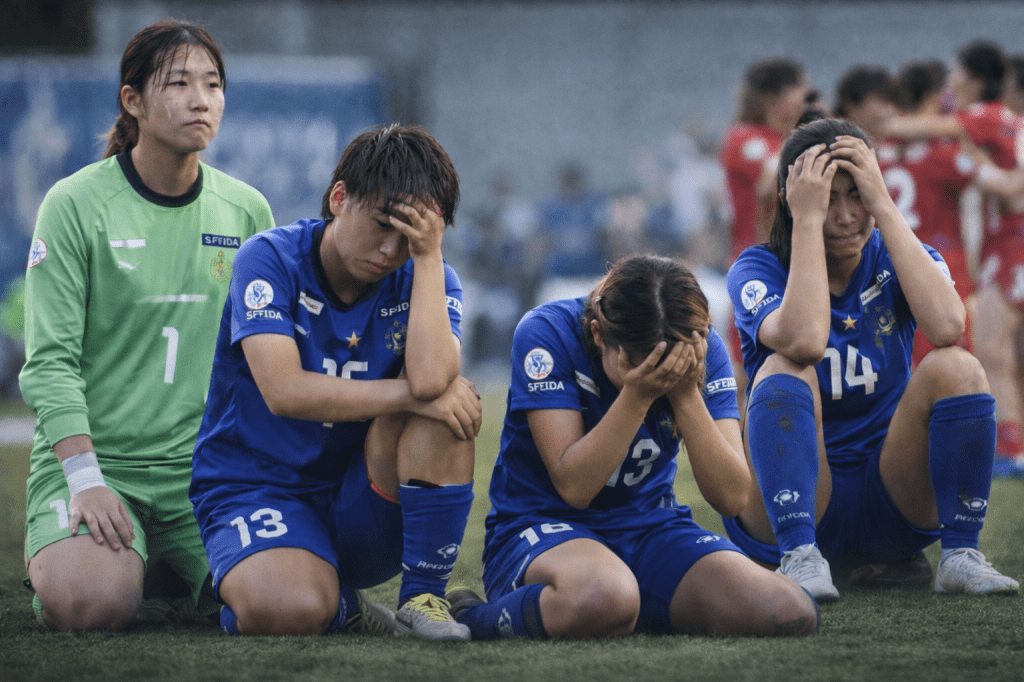
There are moments in football where the air changes. You feel it before you see it. A tightening in the chest. A quiet dread that creeps in like a draft through a closed window.
Not at kickoff. Not when we took the lead. Not even when Nagoya equalised.
No—this feeling arrives later now. It waits. It watches.
And then, in the 94th minute, it takes everything.
Komorebi, Control, and a False Sense of Safety
AGF Field is becoming something special. Small, intimate, wrapped in that soft Tokyo light where the trees lean in and the shadows flicker across the pitch like they’re part of the game.
It felt calm before kickoff. Too calm.
We needed this. Sitting 11th, clinging to identity as much as points, with that looming 2027 merger hanging over everything like a slow-moving storm cloud. This isn’t just a season. It’s a countdown.
And for 45 minutes, we played like a team refusing to disappear.
Uchida’s Fire
Six minutes in, Misuzu Uchida ignites everything.
Sharp movement. Instinctive finish. No hesitation.
1–0.
It wasn’t just a goal—it was a declaration. A refusal.
For a while, we controlled it. Pressing high. Moving the ball with intent. Nagoya looked… uncertain. Forced into long-range efforts, hopeful strikes rather than constructed threats.
Then football did what it always does.
Out of nowhere, a long shot from Nagoya flies in. No warning. No logic. Just inevitability.
1–1.
I barely reacted. Because this is what happens. This is what we’ve become used to.
Still, We Played. Still, We Believed.
And yet—we didn’t collapse. Not then.
We kept pushing.
Saaya Kato linked play beautifully. Miu Kashiwabara delivered from set pieces with real intent. Mio Otsuka distributed calmly from the back, showing a maturity beyond her years.
Then came that moment.
Just before halftime, the game cracked open.
The ball breaks in our half. Uchida picks it up. Drives forward. One defender beaten. Another brushed aside. The keeper starts creeping.
And Uchida, cool as winter air, rolls it past her.
2–1.
It was art. It was control. It was everything you want your team to be.
At halftime, I believed.
Not blindly. Not foolishly.
But enough.
The Pattern We Can’t Escape
The second half started brightly. We pressed. We forced mistakes. Nagoya couldn’t breathe.
A corner on 55 minutes. Perfect delivery. Saya Shinohara, of all people, tries something outrageous—an overhead kick that crashes off the bar.
It should have been 3–1.
It needed to be 3–1.
Because this team… we don’t survive at 2–1.
The Moment Everything Slipped
And then came the shift.
Nagoya, quiet all game, suddenly find rhythm. A structured move from a set piece. Patient. Calculated.
The ball works its way into the box.
A foul.
Penalty.
I’ll say this plainly, because it needs saying.
Mio Otsuka, who had been so composed, suddenly looked like Leeds United’s Illan Meslier on one of those days. The body language. The hesitation. The sense that the moment had already been lost before the ball was even struck.
It goes in.
2–2.
And just like that, the game tilts.
When Control Becomes Fragility
You could see it immediately.
Nagoya grew. Their passing sharpened. Their belief returned.
We… hesitated.
It’s not effort. It’s never effort.
It’s something else.
The intensity drops a fraction. The decisions slow by a second. The shape loosens just enough for cracks to form.
Nagoya adjusted too. Midfield reinforcements. Structure over chaos. Control over emotion.
And suddenly, they looked like the champions again.
Chasing a Third That Wouldn’t Come
We tried.
We really did.
Maasa Taguchi carried the ball forward with purpose. Kokone Kitagawa and Mitsuki Horie pushed higher. Touka Nagarekawa was everywhere—defending, attacking, delivering crosses like she’d been asked to play three roles at once.
There was a moment where Kashiwabara tried a long-range effort with the keeper off her line—cleared on the goal line.
Another where the ball broke kindly on the edge of the box.
Another cross. Another header. Another half-chance.
But every shot felt… slightly off.
Too soft. Too wide. Too late.
The third goal wasn’t hiding. It just wasn’t ours.
Moeno Matsubara – A Moment in the Storm
Then, in the 81st minute, Moeno Matsubara comes on.
And I need to pause here.
Having met her at a game I can confirm, she’s genuinely lovely. Warm, grounded, the kind of person you instantly want to see succeed.
And this was her debut. Her first step into this SFIDA Setagaya.
But football can be unkind with its timing.
She came into a game already slipping away. Space was tight. The ball wasn’t reaching her. The rhythm had already shifted.
It wasn’t the stage she deserved.
And yet—there was something in her movement. Something calm. Something patient.
Her time will come. It has to.
The Collapse We All Saw Coming
By the 85th minute, the game had changed completely.
Nagoya were the ones pushing. The ones believing.
We were holding on.
And here’s the worst part—
I knew.
Everyone around me knew.
We’ve seen this film too many times now.
89 minutes. A scramble. A near miss. A block on the line from Shinohara that felt like a temporary reprieve rather than a solution.
Then stoppage time.
Four minutes.
Four.
It felt… light.
Too light for a game that had stretched, paused, broken in so many ways.
94 Minutes – The Ghost Arrives Again
It happens fast.
Too fast.
A cross. A header. Chaos.
The ball drops.
And Nagoya react quicker.
They always do, in these moments.
3–2.
Game over.
Just like that.
Silence
There’s a kind of silence that follows moments like this.
Not anger. Not even sadness at first.
Just emptiness.
Players drop to the ground. Heads in hands. Shoulders heavy.
Nagoya celebrate like they’ve stolen something.
Because they have.
SFIDA – The Acronym That Hurts
There’s a cruel poetry to this team right now.
S – Strong Starts
F – Fading Energy
I – Intensity Slips
D – Details Missed
A – Added-Time Heartbreak
Three games in a row now.
Three.
At some point, it stops being coincidence.
And Then… The Referee (Just a Thought… Just a Joke)
I’ll end on something lighter, because if I don’t, I might just sit here staring at the wall.
There was a moment late on—Nagoya celebrating, time ticking away—where the referee seemed very keen to get things moving again.
Almost… too keen.
And I couldn’t help but think—
AGF Field isn’t far from Yomiuriland.
You know. The rides. The lights. The closing times creeping ever closer.
Somewhere in the distance, I imagined the Pteranodon ride humming. “Great Adventure in the Sky” waiting. The gates preparing to shut.
And there she was, gently urging players back into position like someone glancing at their watch at the end of a long shift.
Of course, it’s nonsense. Pure nonsense.
But in a game where time felt so fragile, so important…
You start to imagine things.
Final Thought
This team is not broken.
But something is missing.
Composure. Control. Conviction in the final moments.
Because for 93 minutes, we were the better team.
And in football, that means absolutely nothing if you can’t survive the 94th.
This is far from the performance against Okayama Belle.
What happened in Sfida Setagaya vs Nagoya Loveledge?
Sfida Setagaya lost 3–2 to Nagoya Loveledge after conceding a dramatic stoppage-time winner in the 94th minute, despite leading twice in the match.
Who scored for Sfida Setagaya?
Misuzu Uchida scored both goals for Sfida, including a standout individual effort just before halftime.
Why did Sfida lose the match?
Sfida struggled to maintain intensity and composure in the final stages, conceding a penalty and ultimately collapsing again in stoppage time.
Who was the key player for Nagoya Loveledge?
Rei Tachibana scored a crucial penalty to shift momentum, while Nanako Tsunoda scored the decisive 94th-minute winner.
What is the “94th-minute curse”?
It refers to Sfida conceding late goals in three consecutive matches, repeatedly losing points in stoppage time.
What does this result mean for Sfida Setagaya’s season?
It highlights ongoing issues with closing out matches and adds pressure as they continue fighting near the bottom of the table.




4 responses to “Sfida Setagaya 2–3 Nagoya Loveledge: The 94th-Minute Ghost Doesn’t Knock Anymore — It Walks Straight In”
[…] Rather read in English? […]
LikeLike
[…] seen it too many times now. Yokohama FC Seagulls. Iga FC Kunoichi. Nagoya Loveledge. The script repeats with almost theatrical […]
LikeLike
[…] Sfida, for all their flaws, are pure […]
LikeLike
[…] And when Nittaidai went 2–1 up in the 61st minute through Mikoto Abe, I felt it again. That sinking, familiar pull. The sense that here we go again, the same ending, the same quiet collapse waiting to arrive on […]
LikeLike