
There’s a word in Japanese: Kogarashi.
It’s meant to belong to the edge of autumn. That first cold breath that sneaks in when summer hasn’t quite accepted it’s over.
But standing here, six games into this season, I can feel it already.
That wind is blowing through SFIDA Setagaya FC.
And it shouldn’t be.
A Match That Feels Like It’s Carrying Too Much
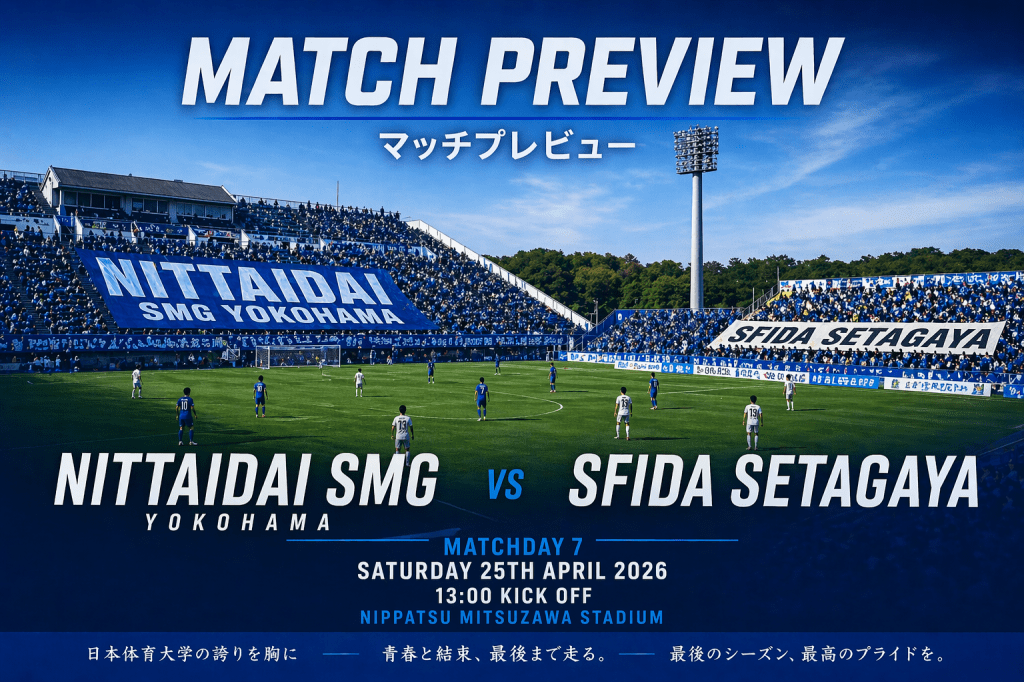
Matchday 7.
Saturday, April 25, 2026.
Nittaidai SMG Yokohama vs SFIDA Setagaya.
At the tight, echoing bowl of Nippatsu Mitsuzawa Stadium.
On paper, it’s a bottom-half scrap. Ninth versus eleventh. Seven points versus four. A game buried beneath the glamour fixtures most people scroll past.
But that’s not what this is.
This is a pressure chamber.
SFIDA aren’t just playing for points. They’re playing through a season that feels like a long, drawn-out farewell. The merger looms. The name will change. The identity will morph into something corporate, something aligned, something… different.
Right now, this is still SFIDA.
And every defeat feels like a piece of that identity quietly dissolving into the air.
I’ll be watching at 5 am my time here in England, until the end, win or lose.
The 94th-Minute Ghost Still Breathes.
You don’t need data to understand trauma in football. You feel it.
We’ve seen it too many times now. Yokohama FC Seagulls. Iga FC Kunoichi. Nagoya Loveledge. The script repeats with almost theatrical cruelty.
We lead.
We control.
We fade.
We collapse.
The 94th-minute ghost doesn’t knock anymore. It walks straight through the front door and helps itself.
It’s become psychological. You can see it in the way the team plays the final ten minutes, like a body running on fumes but refusing to admit it. The legs go first. Then the decisions. Then the structure.
And suddenly, chaos wins.
Citizens vs The Machine
There’s something beautifully unbalanced about this fixture.
SFIDA Setagaya are a citizen club in the purest sense. Players clocking shifts at Summit supermarkets, Tomod’s pharmacies, and local businesses that barely notice they share space with elite athletes. It’s football stitched into everyday life. It’s human.
Then you look at Nittaidai.
A university pipeline. Sports science. Structured development. Controlled intensity. Athletes are engineered as much as they are developed.
It’s grassroots versus laboratory.
Romanticism versus replication.
And yet, both sit dangerously close to the same cliff edge.
The Players Who Carry the Weight
This is where it always gets personal.
Mizuki Horie — The Axis Still Turning
Horie isn’t just our striker. She’s the gravitational pull of this team. At 174cm, she dominates in the air and slices through defences on the ground with a kind of ruthless efficiency that doesn’t need embellishment.
Four goals in four games earlier in the season wasn’t a hot streak. It was a statement.
But even gravity needs support.
Right now, she’s being asked to hold too much of the sky together.
Misuzu Uchida — The Familiar Blade
If there’s a fixture that wakes something inside Uchida, it’s this one.
She’s already hurt Nittaidai before. April 2025. June 2025. Goals that weren’t just moments, but patterns. She understands the spaces they leave, the rhythm they fall into when things get stretched.
She wants double digits this season.
We need her to mean it here.
Mio Otsuka — The Wall That Shouldn’t Have to Be This Busy
Nineteen years old. 180cm. And already tasked with cleaning up the mess left behind, one of the most aggressive defensive lines in the league.
Otsuka isn’t just a goalkeeper. She’s a safety net stretched across a canyon.
And lately, that canyon has been getting wider.
Does Mahiro Ishikawa or Natsumi Yamauchi get the nod at this juncture? A change might be as good as a rest.
Across the Line: Youth That Burns Bright, Then Flickers
Nittaidai are chaos in a different flavour.
They can score four. They can concede nine. They can look like a team destined for the WE League one week and completely unravel the next.
Yura Honda orchestrates. A U-20 national candidate, pulling strings between the lines with the confidence of someone who hasn’t yet been properly punished for taking risks.
Hikari Takahashi brings the violence. A left foot that doesn’t ask permission.
And then there’s Rio Nakano. The freshman. The unknown variable. Eight siblings behind her, a whole life pushing her forward, stepping into a league that doesn’t wait for you to settle.
They are volatility embodied.
Tactics That Flirt With Disaster
Takashi Hamada talks about balance. About packing “skill” and “smartness” into “strength.”
But right now, SFIDA are living on a knife-edge.
The high press works. It suffocates teams early. Forces mistakes. Creates chances. That’s why we’ve scored 12 goals already.
But it also leaves scars.
Fifteen goals conceded tells the other half of the story. The space behind the line isn’t just space. It’s an invitation.
And when fatigue creeps in, when that Kogarashi wind starts to bite, those spaces become highways.
Nittaidai will try to blitz early. Overwhelm. Run until the lungs scream.
The real question is what happens after the first goal. Because both of these teams struggle not with structure but with reaction.
This game won’t be controlled.
It will be survived…it won’t be.
Mitsuzawa: Where Sound Becomes Pressure
There are bigger stadiums in Japan.
But not many feel like this.
Nippatsu Mitsuzawa compresses everything. Noise doesn’t drift. It hits you. The stands lean in. The pitch feels smaller. Decisions feel louder.
SMG Yokocho hums before kickoff. Bento boxes, local food, the quiet ritual of matchday.
Harisen cracking. Rhythm building. A wall of sound that doesn’t overwhelm, but suffocates.
For a team already struggling to breathe late in games, that matters.
A Thought That Won’t Go Away
Moeno Matsubara deserves more.
There’s a point where rotation stops being tactical and starts becoming necessary. Fresh legs aren’t a luxury. They’re oxygen.
Matsubara has shown flashes. Energy. Directness. A willingness to disrupt when the game starts to drift.
Right now, we don’t need controlled drift.
We need an interruption.
Give her another sub appearance. Or better yet, give her a start. Let her run at a defence that doesn’t know what version of itself will show up.
Because doing the same thing and expecting the 94th minute to behave differently feels like wishful thinking dressed up as strategy.
This Season Feels… Rabelaisian
There’s something almost Rabelaisian about it all. Excessive. Chaotic. A feast that teeters into disorder.
Goals. Collapses. Identity crises. Emotional swings that don’t quite settle.
And yet, beneath it, there’s something fragile. Something azuline. That deep, almost melancholic blue that sits quietly behind everything.
Because we know what’s coming.
This isn’t just a bad run of form.
This is a season that knows it’s ending before it’s finished.
What This Game Really Is
Strip everything back, and this is simple.
A team that can’t hold on.
Against a team that can’t stay stable.
One will break first.
And if SFIDA don’t find a way to outlast that final stretch, if they don’t learn how to close games instead of watching them slip away…
Then the Kogarashi won’t just be a feeling.
It’ll be confirmation.
Who are the key SFIDA Setagaya players to watch?
- Mizuki Horie (#9): Target striker with strong aerial ability and clinical finishing. Central to SFIDA’s attacking output.
- Misuzu Uchida (#13): Proven performer against Nittaidai with a history of scoring in this fixture.
- Mio Otsuka (#1): Young goalkeeper tasked with covering the high defensive line.
- Moeno Matsubara: An impact player who could influence the match if given more minutes or a starting role.
What are SFIDA Setagaya’s upcoming fixtures?
SFIDA Setagaya’s fixtures in the 2026 Nadeshiko League are crucial as they fight to escape the bottom of the table. Key themes in their schedule include:
- Frequent clashes with mid-to-lower table teams, making each match a “six-pointer”
- Continued pressure due to their current losing streak
- Emotional weight tied to this being their final season before merging into FC Tokyo Sfida in 2027
Fans should monitor official league updates for exact dates and venues as the season progresses.
Why is this match important for SFIDA Setagaya?
- They sit 11th with 4 points, dangerously close to relegation
- The club is in its final independent season, adding emotional stakes
- A five-game losing streak makes this a momentum-defining fixture
What tactical issues are affecting SFIDA Setagaya?
- High pressing system leaves large defensive gaps
- Struggles with late-game fatigue and concentration
- Difficulty managing matches after taking the lead
Where is the match being played?
- Nippatsu Mitsuzawa Stadium, Yokohama
- Known for its intimate atmosphere and intense crowd noise
What is the head-to-head record?
- SFIDA Setagaya lead the historical record
- 5 wins, 3 draws, 2 losses against Nittaidai
- Won the last meeting 3–1 (June 2025)





3 responses to “The Cold Wind Arrives Early: SFIDA Setagaya vs Nittaidai SMG Yokohama ”
[…] Rather read in English? […]
LikeLike
[…] Sfida Setagaya FC again. 5 am. Half-awake, half-guarded, fully invested. Chu-hi was sweating on the table like it […]
LikeLike
[…] By the time we walked into Nippatsu Mitsuzawa, I wasn’t just watching a team under pressure. I was watching a team being haunted. […]
LikeLike