
There’s a particular kind of silence that lives inside a losing streak.
Not the loud kind. Not the angry kind. The quieter one. The one that settles into your bones and dulls everything. Hebetude, almost. You still show up, still clap, still believe you’re believing… but something in you has already started bracing for the next collapse.
That’s where I was on April 25.
Watching Sfida Setagaya FC again. 5 am. Half-awake, half-guarded, fully invested. Chu-hi was sweating on the table like it knew what was coming.
Game Context & Stakes: A Season Hanging by Threads
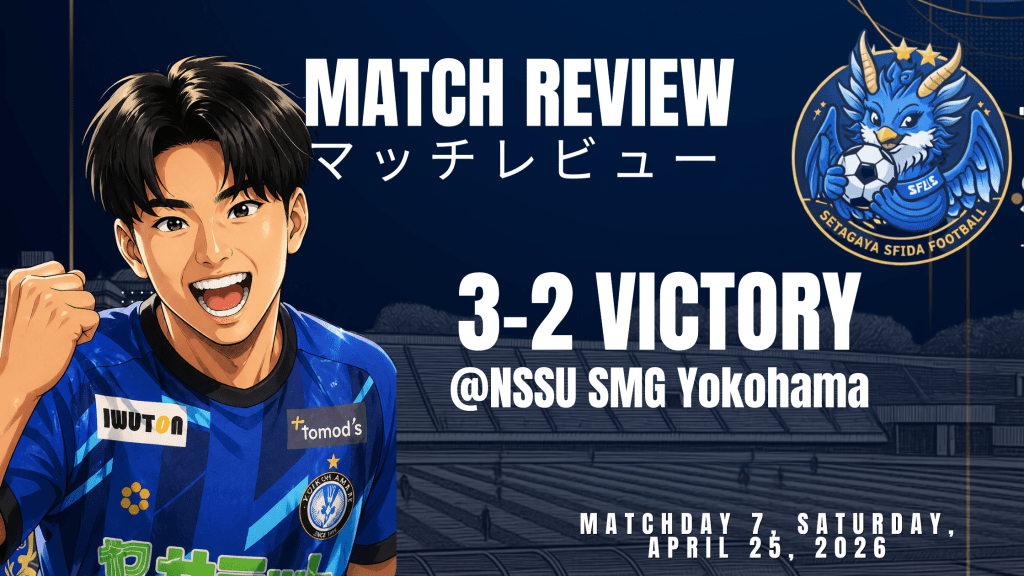
This wasn’t just Matchday 7 of the 2026 Plenus Nadeshiko League Division 1. It was a checkpoint. A fork in the road disguised as a midday kickoff at Nippatsu Mitsuzawa Stadium.
Sfida came in carrying three straight losses like a weight vest you can’t take off. Not just losses either. The cruel kind. Late goals. Stoppage-time betrayals. The kind that don’t just cost points, they rewrite how you feel about the game.
Across from them stood NSSU SMG Yokohama. Not just a team. A system. A conveyor belt of athletes built on repetition, stamina, and structure. They don’t panic. They don’t drift. They just… keep coming.
It’s always been that tension, hasn’t it?
Institution vs independence. System vs soul.
And Sfida, for all their flaws, are pure souls.
The Weight of What Came Before
Manager Takashi Hamada called it a “Rebound Mentality.”
I called it survival.
Because when you’ve conceded late goals three games in a row, you stop trusting time itself. Every minute after 80 feels like borrowed oxygen. Every clearance feels temporary. Every lead feels… negotiable. See Nagoya Loveledge, Iga FC and Yokohama FC Seagulls.
And yet, there’s that phrase that floats around Japanese sport like a quiet promise:
努力は必ず報われる — doryoku wa kanarazu mukuwareru.
Hard work will definitely be rewarded.
Definitely.
It’s a dangerous word when you’re losing. It asks for faith when evidence is thin. It asks you to keep going when logic says stop.
But this is Sfida. Stopping was never part of it.
The Match Begins Like a Statement
Four minutes.
That’s all it took.
And suddenly the numbness cracked.
Misuzu Uchida doesn’t score gently. There’s always intent in it. A kind of sharpness that feels personal.
The ball came in clean. No hesitation. Just movement, timing, conviction.
Header. Net.
1–0.
And just like that, the fog lifted. Not gone, but pierced. You could feel it through the screen. The shift from anxiety to something more electric. Hope, but cautious, like testing ice with your foot.
Because we’ve been here before.
NSSU Don’t Break. They Recalibrate.
They didn’t panic. Of course, they didn’t.
They just adjusted the pressure.
Wave after wave. Cross after cross. The kind of football that doesn’t ask permission, it just occupies space until you suffocate.
By the 41st minute, it told.
A corner. A header. Equaliser.
1–1.
No drama. No surprise. Just inevitability dressed as execution.
And I felt it again. That creeping familiarity. That voice in the back of your head whispering, you know how this ends.
Chaos, Pure and Unfiltered
The second half didn’t build. It exploded.
61 minutes. NSSU again. A clean strike. 2–1.
And there it was. The script. The one we’ve seen too many times. Fall behind. Chase. Collapse.
Except this time… something refused to follow it.
Two minutes later.
Two.
A spill. A scramble. Bodies everywhere. No elegance, no structure. Just instinct.
And in the middle of it, Uchida again.
2–2.
I don’t remember breathing during that sequence. Just staring. Waiting for confirmation that it actually counted. That this wasn’t another almost.
It wasn’t pretty. It wasn’t controlled. It wasn’t what Hamada wanted his football to be.
But it was alive.
The Physical War Beneath the Scoreline
If you strip the goals away, what you’re left with is a war of endurance.
Sara Unai was throwing herself into headers like each one erased a memory of the past three weeks.
NSSU runners flooding channels, relentless, mechanical, almost inhuman in their repetition.
You could see the fatigue set in. Legs heavier. Touches looser. Decisions faster and worse.
That’s where games like this are decided. Not in tactics. In nerve.
In who refuses to let the moment pass them by.
The 82nd Minute: Release
It didn’t arrive like a masterpiece.
It arrived like a mess.
A shot. Crossbar. Chaos.
And then Kokone Kitagawa.
Right place. Right instinct. No hesitation.
3–2.
And that was it.
Not just the goal. The feeling.
Everything that had been building for three games didn’t explode, it escaped. Like pressure finally finding a crack in the system.
I didn’t celebrate immediately. I just sat there. Processing. Waiting for the flag. The whistle. Something to take it back.
Nothing came.
Just confirmation.
Best Performers: The Ones Who Tilted the Axis
Not every win spreads itself evenly. Some matches are carried. Some are dragged across the line by players who decide, in very specific moments, that enough is enough.
This was one of those games.
Misuzu Uchida (Sfida Setagaya) — The Pulse, The Blade, The Guarantee
There are strikers who finish chances, and then there are strikers who decide outcomes. Uchida sits firmly in the second category right now.
A brace, yes. But reducing it to numbers feels almost insulting.
The opener in the 4th minute wasn’t just early, it was surgical. Perfect timing, clean contact, no hesitation. It cut through the anxiety like a blade through silk. And then, when the game threatened to tilt away at 2–1, she reappeared in the chaos, reading the spill, reacting faster than everyone else, restoring balance before panic could fully take hold.
She doesn’t just score goals. She interrupts narratives.
Eight in seven now. Top of the scoring charts. And more importantly, the emotional metronome of this team. When she moves, Sfida believe.
Kokone Kitagawa (Sfida Setagaya) — The Spark That Became the Fire
Kitagawa lives on the edges of matches. The spaces where structure breaks and instinct takes over.
For 80 minutes, she was a constant irritation to NSSU. Stretching, probing, forcing defenders to turn, to chase, to doubt their positioning. Not always clean, not always decisive, but always there.
And then the 82nd minute arrived.
Crossbar. Rebound. Split-second decision.
No theatrics. No extra touch. Just conviction.
3–2.
Some players wait for the perfect moment. Kitagawa recognises it when it appears uninvited.
Sara Unai (Sfida Setagaya) — The Last Line That Refused to Break
If Uchida gave Sfida life and Kitagawa gave them the win, Unai gave them the right to stay in the game at all.
This was not a comfortable defensive performance. It couldn’t be, against a side like NSSU. It was reactive, stretched, often one action away from collapse.
And in those moments, Unai kept appearing.
Headers under pressure. Clearances that weren’t pretty but were necessary. Interventions that don’t make highlight reels but quietly decide whether the next attack becomes a goal or just another wave.
You could feel the strain in every action. But you could also feel the refusal.
She didn’t dominate. She endured.
And sometimes, that’s more valuable.
Mikoto Abe (NSSU SMG Yokohama) — The Blade in the System
NSSU are built on collective strength. Movement, rotation, pressure. The machine rarely relies on individuals.
But Abe stood out.
Her goal in the 61st minute wasn’t just well taken, it was inevitable. The kind of finish that comes from repetition, from training ground patterns executed without hesitation. Left foot, clean strike, no drama.
Beyond the goal, she embodied everything NSSU are. Sharp movement, constant availability, always positioned to turn pressure into something tangible.
If this match had followed the expected script, she would’ve been the headline.
Instead, she became the warning.
The Shape of Influence
What ties these performances together isn’t perfection. It’s timing.
Uchida scoring when belief needed oxygen.
Kitagawa finishing when the door cracked open.
Unai holding the line when it threatened to collapse.
Abe reminding everyone what a system can produce at full speed.
Four players. Four different roles. One match balanced on all of them.
And in the end, just enough of those moments leaned Sfida’s way.
What This Win Actually Means
You can dress it up however you want.
Tactically flawed. Defensively fragile. Still conceding too much. Still chaotic.
All true.
But football isn’t played in spreadsheets. It’s played in moments where belief either fractures or hardens.
This hardened something.
Hamada talks about controlling games, about dominating space, about moving away from “restless and ephemeral” football.
But here’s the truth.
This team, right now, isn’t built for control.
It’s built for resistance.
For biting back.
For surviving long enough that effort finally turns into outcome.
努力は必ず報われる.
Not always when you want it. Not always how you design it.
But eventually.
The Fans, The Screen, The Distance
There’s something strange about loving a team from far away.
No stadium. No shared chants. Just a screen, a stream, and the quiet ritual of showing up.
The Nadeshiko League Channel isn’t glossy. It doesn’t pretend to be. But it’s real. It’s accessible. It’s the thread connecting people like me to mornings like this.
And maybe that’s why this win hit differently.
Because it felt earned not just by the players, but by everyone still watching. Everyone who hadn’t drifted into that hebetude fully. Everyone who kept getting up, kept tuning in, kept believing in something that hadn’t rewarded them yet.
A Team Still in Progress
Let’s not romanticise too much.
Sfida are still vulnerable. Seventeen goals conceded in seven games doesn’t vanish because of one result. The structure still bends. The control still slips.
But something changed.
Not tactically.
Emotionally.
They didn’t fold.
And after three weeks of watching them do exactly that, that alone feels like a turning point.
The Zabuton Moment
If this match were a story told on a zabuton, passed between voices in a quiet room, this would be the part where the tone shifts.
Not the ending. Not resolution.
Just the moment where you realise the story isn’t going where you thought it would.
Where the fragile thing doesn’t break.
Where the effort, quietly, stubbornly, begins to mean something.
Final Whistle
3–2.
It won’t define the season.
But it might save it.
And for now, that’s enough.
Because sometimes football isn’t about perfection. It’s about refusing to disappear.
And on a cold, cloudy afternoon in Yokohama, Sfida Setagaya didn’t disappear.
They endured.
They resisted.
And finally, finally, they were rewarded.
Quick Answers for the Curious (and the Committed)
Think of this as the little map folded into your back pocket. The answers you search at 2am, or 5am, or somewhere between disbelief and devotion.
Where is Setagaya Station, and how do I get to the Sfida games?
Setagaya Station sits in Tokyo’s Setagaya ward, part of the Tokyu Setagaya Line. It’s not right next to Sfida’s usual home grounds, but it anchors the community heartbeat of the club. From there, fans typically travel by train to venues like Komazawa Olympic Park or away grounds across the Kanto region. It’s less a direct route, more a ritual journey.
What is the Nadeshiko League Division 1?
It’s the beating grassroots heart of Japanese women’s football. Not the glitz of fully professional leagues, but something arguably more honest. Community clubs, university sides, future internationals, all colliding in a system where development and survival coexist. It’s raw, accessible, and emotionally unforgiving.
Where can I follow women’s football news in Japan and globally?
Start with official league channels and club accounts, but the real pulse lives in dedicated platforms, fan communities, and independent outlets like Doragon Sports. Women’s football news isn’t always pushed to you. You find it, you follow it, and eventually, it starts to feel like it’s following you back.




2 responses to “When the Losing Streak Stopped: Sfida’s 82nd-Minute Resurrection at Mitsuzawa ”
[…] Rather read in English? […]
LikeLike
[…] can still feel Mitsuzawa in my […]
LikeLike