
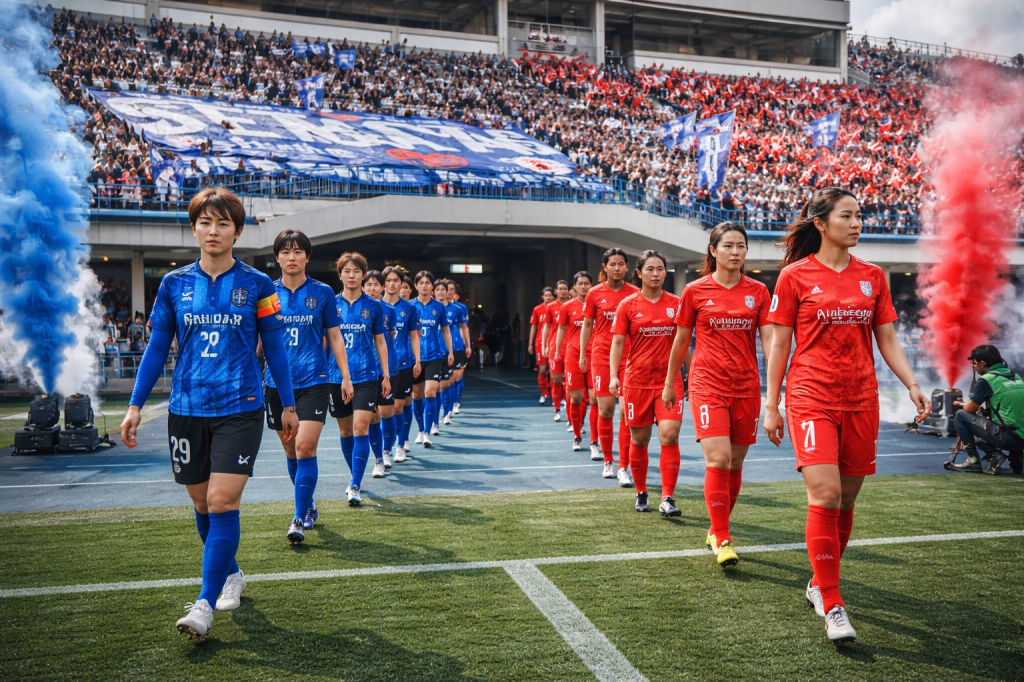
There are seasons that feel like journeys. There are seasons that feel like survival. And then there are seasons like this one, where every match arrives dressed like a farewell letter that nobody quite knows how to read.
At AGF Field, beneath the soft scatter of komorebi that slips through the trees and settles gently on the pitch, Sfida Setagaya FC will step into something heavier than football. This is Matchday 6, yes. A fixture on a calendar. Three points up for negotiation.
But it does not feel like that.
It feels like time is watching.
A Table That Breathes Uneasily
The league table tells a story, but not the whole truth. It rarely does.
Sfida sit in 11th, fragile, flickering, holding onto four points like a match in the wind. Across from them, Asahi Intecc Loveledge Nagoya, the reigning champions, arrive in seventh. Six points. A crown that suddenly feels like it was won in another lifetime.
Two teams gasping for air. Two very different kinds of suffocation.
Nagoya are trapped in expectation. The weight of being the 2025 champions has wrapped itself around their identity, tightening with every draw that feels like a quiet failure. Their apology to fans after the Yokohama result was not just PR. It was confession. A team looking in the mirror and not quite recognising what they see.
SFIDA. They can’t catch their breath after regulation time. Their name says it all at the minute.
S – Strong Starts
F – Fading Energy
I – Intensity Slips
D – Details Missed
When truly, they need to be consistent throughout the 90 minutes and beyond.
F – Focus Held
I – Instincts Sharpened
D – Decisions Clear
A – At the Final Whistle.
Well, that’s the dream anyway.
The 94th-Minute Ghost
There is something cruel living inside Sfida’s matches.
It waits. Patient. Silent. Watching the clock.
Twice now, it has struck in the 94th minute.
Against Yokohama FC Seagulls, a game of courage turned into collapse. A 3-2 defeat that felt less like losing and more like being slowly unstitched.
Then again, days later, against Iga FC Kunoichi Mie. Another 94th-minute dagger. Another moment where the final whistle never quite came quickly enough.
This is not just bad luck anymore. It is a psychological shadow stretching across the final moments of every game.
You can see it in the way they defend late on. A hesitation. A flicker. The memory of what might happen becoming more powerful than what is happening.
Manager Takashi Hamada knows it. He refuses to hide behind empty words.
Intensity alone is not enough. Anyone can run. Anyone can press. But can you think clearly when your lungs are burning and your legs feel like borrowed limbs?
Sfida’s problem is not effort.
It is survival under pressure.
Horie: The Axis of Chaos
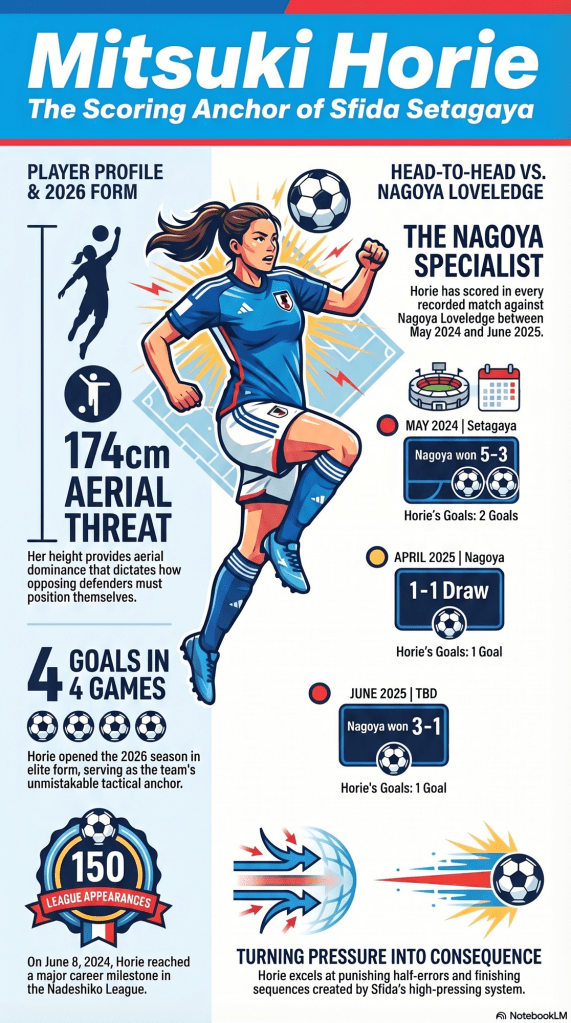
Every team has a centre of gravity. For Sfida, it is Mizuki Horie.
She does not just play striker. She bends matches around her.
At 174cm, she offers a physical presence that defenders cannot ignore. But reducing her to height is like describing a storm as “a bit windy.” Her real weapon is instinct. The ability to arrive half a second before the game realises what is about to happen.
Four goals in four games. A rhythm. A pulse.
And then there is history.
Nagoya know her. Not as a name on a teamsheet, but as a recurring problem. She scored against them in 2025. Twice. And before that, a brace in 2024. There are players who perform. And there are players who haunt.
Horie belongs to the latter.
If Sfida are to break this cycle, it will likely come through her. A flick. A header. A moment where chaos becomes clarity.
The Champions’ Wall
But Nagoya are not built to collapse easily.
Their defence is not just organised. It is decorated. Rei Tachibana. Manaho Hirao. Names etched into the 2025 Best XI. Players who understand structure the way architects understand space.
Behind them, a midfield that moves the ball with intention rather than urgency. Nonoka Fuchigami. Yukiko Abe. The conductors of a system designed to suffocate chaos.
Where Sfida thrive in disorder, Nagoya impose rhythm.
It is a clash of philosophies as much as players.
Hamada-ball is wind. Sudden. Violent. Unpredictable.
Nagoya’s system is water. Patient. Shaping the game over time.
And somewhere between those elements lies the outcome.
Otsuka and the Open Field
There is a quiet figure standing at the edge of this storm.
Mio Otsuka. Nineteen years old. 180cm. A goalkeeper learning her craft in a system that offers her very little protection.
Twelve goals conceded in five games tells one story. But it does not tell hers.
Because behind Sfida’s high line, there is space. Acres of it. Open, inviting, dangerous. The kind of space Nagoya’s passing game will salivate over.
Otsuka will not just be asked to save shots. She will be asked to read chaos. To anticipate patterns forming at speed. To remain calm as the game stretches around her.
For a teenager, it is not just a test.
It is a trial by fire.
The Tactical Fault Line
This match lives on a knife edge.
Sfida press high. Aggressively. Almost recklessly. They force mistakes. Win set pieces. Turn matches into something frantic and breathless.
Fourteen direct free kicks against Yokohama. That is not coincidence. That is design.
But every step forward leaves something behind.
Space.
Nagoya will look to exploit it. Slow the game. Stretch Sfida’s shape. Wait for the moment when one pass breaks the press and suddenly the pitch opens like a door left unlocked.
The numbers underline the tension.
Sfida: 10 scored, 12 conceded. Football that refuses to sit still.
Nagoya: 8 scored, 7 conceded. Control, but without cutting edge.
One side creates chaos. The other seeks to contain it.
The question is simple.
Which identity survives contact?.
The Emotional Edge
This is where bias creeps in. Where neutrality becomes impossible.
Because you watch Sfida and you do not just see a team struggling near the bottom.
You see a story trying to hold its shape.
You see a club that was never meant to exist, refusing to disappear quietly.
You see players running not just for points, but for memory.
And you want it. You yearn for it.
A win that feels like resistance.
A win that says, just for a moment, we are still here.
Prediction: Between Hope and Habit
Logic leans toward Nagoya. Structure. Experience. The calm of champions, even in uncertain form.
But football does not always listen to logic.
Sfida have fire. They have Horie. They have a home crowd that understands what is slipping away and refuses to let go without noise.
The danger, of course, is the familiar ending. The late collapse. The clock turning against them once more.
But maybe, just maybe, this is the day they outlast it.
Not perfectly. Not comfortably.
But defiantly.
Prediction: Sfida Setagaya FC 2-1 Asahi Intecc Loveledge Nagoya
A goal that comes late. This time, not as a wound.
But as release.
Sfida Setagaya FC vs Loveledge Nagoya
When is Sfida Setagaya FC vs Loveledge Nagoya?
The match takes place on Saturday, April 18, 2026, with kickoff at 14:00 JST.
Where is the match being played?
The game will be held at AGF Field, a compact and atmospheric stadium in Tokyo.
Why is this match important?
Sfida are fighting to preserve their identity in their final independent season before merging with FC Tokyo in 2027, while Nagoya are trying to rediscover form after winning the 2025 title.
Who are the key players to watch?
- Mizuki Horie (Sfida Setagaya)
- Rei Tachibana (Nagoya)
- Manaho Hirao (Nagoya)
- Mio Otsuka (Sfida Setagaya)
What is Sfida Setagaya’s biggest challenge?
Maintaining focus and composure in the final minutes, after conceding multiple late goals in recent matches.
What is Nagoya’s biggest challenge?
Turning possession and structured play into consistent goal-scoring output.
What style of football can fans expect?
A clash between Sfida’s aggressive high-pressing, high-risk football and Nagoya’s controlled, possession-based system.
What is the head-to-head record?
Sfida have historically held the edge, with 5 wins in their last 10 meetings compared to Nagoya’s 2.




2 responses to “Sfida Setagaya FC vs. Asahi Intecc Loveledge Nagoya: The Weight of Memory and the Burden of the Crown”
[…] at kickoff. Not when we took the lead. Not even when Nagoya […]
LikeLike
[…] 80 feels like borrowed oxygen. Every clearance feels temporary. Every lead feels… negotiable. See Nagoya Loveledge, Iga FC and Yokohama FC […]
LikeLike