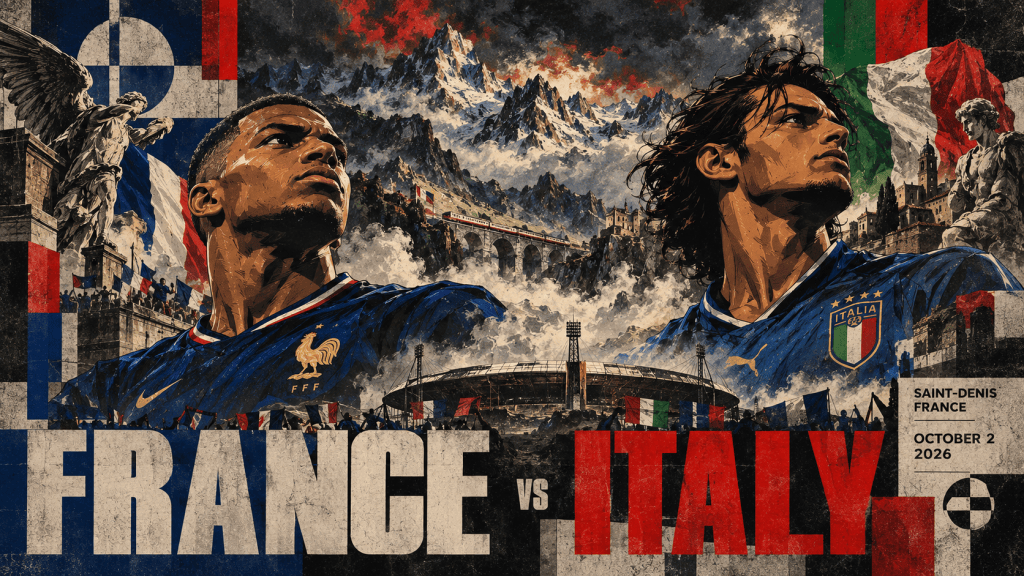
France play Italy at the Stade de France on Friday night.
On the surface, the situation is reasonably simple. It is Matchday 3 of Group A1 in the 2026–27 UEFA Nations League. France have six points. Italy have three. Kick-off in Saint-Denis is at 20:45 local time, or 19:45 BST.
Zinédine Zidane has won his first two competitive matches as France manager.
Roberto Mancini’s Italy have won one and lost one.
So this is not yet a decisive night.
It might, however, tell us considerably more than the table does.
France have begun with consecutive 1–0 away victories over Türkiye and Belgium, with Michael Olise scoring in the 88th minute to decide the latter. Italy began with defeat against Belgium before responding with a 4–1 victory over Türkiye, a match which included a goal from Alessandro Bastoni and Michael Kayode’s first senior international goal.
Two very different beginnings, then.
France have been controlled.
Italy have already been required to respond.
Now they meet each other.
And increasingly, France against Italy is a rivalry involving footballers who know rather too much about the opposition.
France Against Italy Has Become Strangely Familiar
There is something peculiar about preparing for an international match against players you spend most weekends either playing alongside or trying to take the ball from.
France arrive with Mike Maignan of AC Milan, Adrien Rabiot of AC Milan, Pierre Kalulu of Juventus, Manu Koné of Roma and Andy Diouf of Inter.
These are not French players who merely happen to know Italian football.
Serie A forms part of their professional education.
That creates one of the more interesting layers around Friday night.
International football is often presented as a collision between distinct footballing cultures, particularly when France and Italy are involved. Clairefontaine against Coverciano. French athleticism and technical production against Italian tactical sophistication.
Nice, neat categories.
Modern football has made those borders considerably messier.
Maignan could be standing in goal for France while facing players whose habits he sees every week. Koné can recognise movements from Serie A. Kalulu knows many of these opponents from Juventus. Diouf operates inside the same domestic ecosystem.
At this moment, one can only assume there will be relatively few genuine surprises.
Knowing something is coming, of course, does not necessarily mean you can stop it.
Diego Coppola Has Gone the Other Way
Then there is Diego Coppola.
While French internationals have embedded themselves across Serie A, Coppola has travelled in precisely the opposite direction.
He is the only player in the current Italy squad playing his club football in Ligue 1, where the 1.92m centre-back has established himself with Paris FC.
That journey has not been particularly straightforward.
Brighton & Hove Albion signed Coppola from Hellas Verona for £9.4 million (€11m) in June 2025. However, opportunities proved difficult to find behind Lewis Dunk and Jan Paul van Hecke, and in January 2026 he moved to Paris FC on loan.
There was an obvious consideration.
Minutes matter.
Particularly when an international place hovers in the background.
Coppola had developed entirely through Verona after being born in Bussolengo to an Italian father and Dutch mother. He represented Italy from U18 through to U21 level before making his senior debut against Norway in June 2025.
Sitting on Brighton’s bench was unlikely to derail that trajectory.
It was not particularly useful either.
Paris changed things.
Coppola became an important right-sided centre-back, averaging around eight clearances per 90 minutes during his initial loan without recording an error directly leading to an opposition goal.
Then came the result that helped crystallise his rise.
Paris FC beat Paris Saint-Germain 2–1 at home in May and ultimately stayed in Ligue 1.
By July, the temporary arrangement had become something considerably more permanent.
Paris paid €18m plus €2m in potential add-ons and gave Coppola a five-year contract through 2031.
Brighton made a quick profit.
Coppola got his football.
Paris acquired a 6ft 4in Italian international entering an important stage of his development.
Almost suspiciously sensible.
Under Liam Rosenior, his passing accuracy then climbed to 91.4% during the opening stages of 2026–27 as Paris FC began their league season unbeaten and recorded three clean sheets.
For all the understandable attention paid to his height, that distribution matters.
Modern centre-backs are no longer allowed to simply head the ball away and look pleased with themselves afterwards. Coppola is being asked to start attacks, receive possession under pressure and operate within structured build-up.
Perhaps his childhood admiration for Yaya Touré suddenly makes a little more sense.
It remains an unusual idol for a young Italian centre-half.
It is also quite a good one.
Coppola Returns to Paris Wearing a Different Blue Hue
This is where Coppola becomes more than an interesting squad-list curiosity.
France are beginning something new under Zidane.
Coppola, meanwhile, is experiencing French football every week.
He knows its rhythms. He knows its physical demands. More importantly, he is playing regularly rather than studying them from a bench.
France have Rayan Cherki and Michael Olise providing technical invention, with Olise already responsible for the goal that secured victory against Belgium.
There is speed everywhere.
And yes, for anybody arriving here with the inevitable question: who is faster, Mbappé or Dembélé?
Kylian Mbappé is generally considered faster than Ousmane Dembélé, particularly over open distances and at peak acceleration.
For an Italian defender, though, the more useful question concerns what happens before either man begins running.
Positioning becomes preventative medicine.
Give Mbappé 30 metres of grass and the scientific investigation into precisely how quickly he can cover it becomes considerably less relevant. Something has already gone wrong.
Coppola’s size should also provide Italy with another option when dealing with France aerially, particularly with Adrien Rabiot offering height from midfield and Lucas Digne capable of dangerous deliveries.
Friday therefore offers Coppola an unusual reversal.
He left Italy because he needed football.
Now he returns to the Italian national team to play France in the country where he rebuilt his momentum.
Bastoni Remains the Standard
Italy will not be constructing their defence around Coppola alone.
Alessandro Bastoni arrives after scoring in the 4–1 victory over Türkiye.
Is Alessandro Bastoni a good defender?
Yes. More usefully, he is widely regarded as one of the leading central defenders in world football and was named Serie A’s best defender for 2023–24 after helping Inter win the league title.
His importance extends considerably beyond defending.
Bastoni can effectively become a left-sided playmaker, stepping into midfield, finding vertical passes and switching possession over long distances. Playing in a three-person defence can give him particular freedom to advance without completely abandoning his defensive responsibilities.
That provides an interesting measuring stick for Coppola.
Not because Coppola needs to become Bastoni.
Italy would be doing player development badly if the objective were simply to manufacture another version of somebody they already possess.
The interesting part is what else he can provide.
Height.
Aerial security.
Distribution.
Experience of French football.
There is a case to be made that leaving Italy has actually made his pathway with Italy more interesting.
From Starched Collars to Saint-Denis
The rivalry itself hardly needs manufacturing.
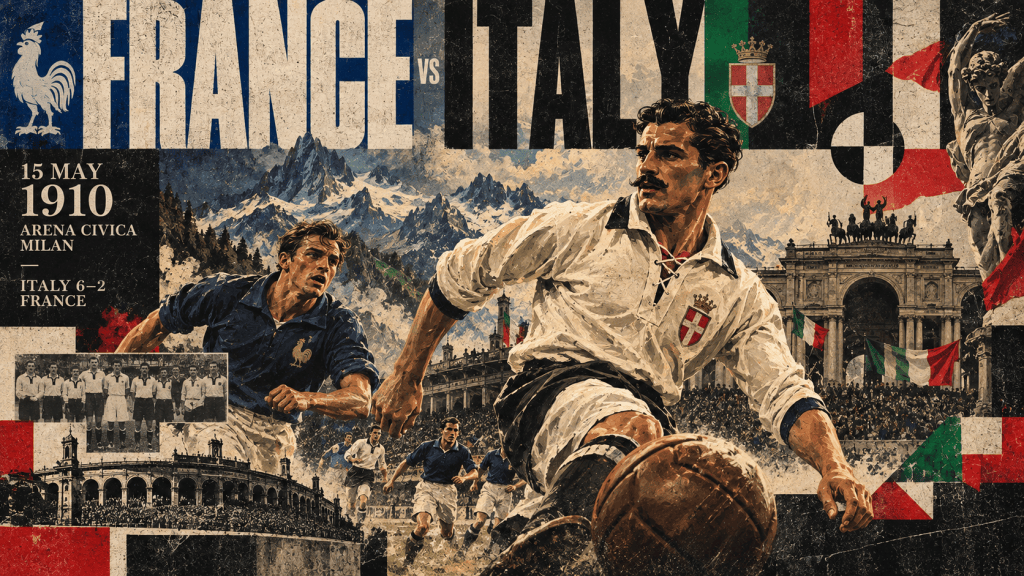
France and Italy first met on 15 May 1910 at Arena Civica in Milan.
It was Italy’s first official international match.
They won 6–2.
Italy were not even wearing blue yet; they played in white shirts with starched collars and cuffs. Pietro Lana scored the country’s first international goal from around 30 metres and eventually completed a hat-trick.
From there came World Cups, European Championships, the Euro 2000 final and, most famously, Berlin in 2006.
Six World Cups and four European Championships separate these countries.
Friday is merely a Nations League group match in October.
That sentence somehow undersells it.
This time the venue is the Stade de France rather than Milan, and the immediate calculation favours the hosts.
France have six points from six.
Italy have three.
Another French victory would create significant early separation in Group A1. An Italian win would pull Mancini’s side level with them after three matches.
The table is still young enough to forgive mistakes.
It is also beginning to take shape.
Zidane’s France Still Need Examining
Two matches.
Two victories.
Two clean sheets.
Two goals.
It is an immaculate competitive start for Zidane, but not yet an enormous sample.
France beat Türkiye 1–0 before requiring Olise’s 88th-minute intervention against Belgium to make it six points from six.
There is nothing wrong with winning narrowly.
Quite the opposite.
Tournament football has long rewarded teams that can survive uncomfortable evenings.
But Italy should provide another examination.
Their response to losing against Belgium was emphatic: four goals against Türkiye, Bastoni scoring and Kayode marking his senior debut with another.
Perhaps the most interesting tension on Friday is between French control and an Italian side trying to show that Matchday 2 was more than a cathartic evening.
France’s Italian Department
Rabiot might be the clearest symbol of how tangled this fixture has become.
An increasingly influential role has followed his move from Marseille to AC Milan in September 2025. Maignan needs even less introduction to Serie A audiences.
There is something faintly unfair about France possessing players who understand Italian football from inside its dressing rooms.
Italy are supposed to provide the mystery.
Several French players have already read the book.
Even the slightly less football-related curiosity surrounding France’s biggest star follows him everywhere. Is Mbappé in a relationship? He has been widely reported to be in a relationship with Spanish actress Ester Expósito, although neither has officially confirmed it.
That uncertainty can remain exactly where it belongs.
Much more useful evidence is available when discussing what happens once he approaches Italy’s penalty area.
Everyone Keeps Crossing the Alps
Perhaps that is what makes this particular France-Italy meeting interesting.
The shirts remain unmistakable.
The history remains enormous.
But the boundaries underneath the rivalry are becoming increasingly porous.
French players are thriving in Italy.
An Italian centre-back rebuilt his career in Paris.
Club teammates become international opponents and then return to their domestic dressing rooms once the Nations League window closes.
Godzilla could probably stomp across the Alps and encounter less cross-border traffic.
For France, Friday offers an opportunity to turn a perfect start into early control of Group A1.
For Italy, it offers the chance to carry the momentum of that 4–1 response against Türkiye and see whether it carries over.
And for Coppola, there is something beautifully circular about the whole thing.
He left home because he needed to play.
France gave him the minutes.
Those minutes helped preserve his place with Italy.
Now Italy need to stop France.
We are about to discover whether knowing French football from the inside makes that task any easier.