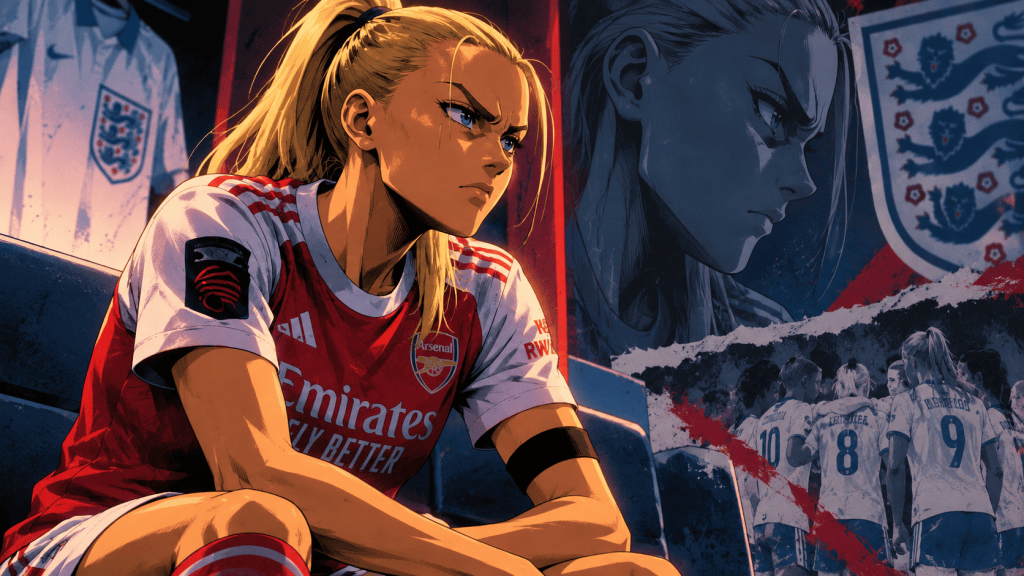
Chloe Kelly will not play against Greece.
It is a perfectly ordinary sentence about squad selection, the sort of thing international football produces several times a year. Players come in. Players go out. Managers explain that competition is healthy, standards are high and doors remain open.
Except this is Chloe Kelly.
The woman who scored the winning goal in the Euro 2022 final.
The woman who scored the winning penalty in the Finalissima.
The woman who scored the winning penalty at Euro 2025.
There are Lionesses players with more caps, more starts and probably considerably calmer relationships with the concept of an international break. But few have accumulated quite so many moments that permanently belong to everybody else.
Kelly is a hero.
End of.
Which is why seeing England prepare for a World Cup play-off against Greece without her feels so strange, even if Sarina Wiegman has perfectly defensible reasons for leaving her out.
Chloe Kelly Stats Explain the Decision
The uncomfortable thing is that the Chloe Kelly stats do not offer much of a counterargument.
Her 2026/27 season has barely started.
Kelly has played 124 minutes across Arsenal’s opening four WSL matches, starting only once. She played 27 minutes against Brighton, 60 against Crystal Palace, eight against Manchester United and 29 against Chelsea.
Goals: zero.
Assists: zero.
Completed league matches: zero.
There has been a better European performance. Kelly started against HB Køge in the Champions League, played 82 minutes of Arsenal’s 1-0 victory and received a 7.2 FotMob rating. It was her most substantial appearance of the season.
Still no goal or assist.
These Chloe Kelly games are perhaps more useful viewed as evidence of interruption rather than evidence of decline. Twenty-seven minutes here, eight minutes there and half an hour somewhere else is not much of a rhythm. It is football experienced through fragments.
There is physical context too. Kelly has been managing a hamstring problem and is currently unavailable to Arsenal.
Wiegman’s explanation was straightforward.
“The main reason is that I think the levels weren’t what I expect from them on the pitch,” she said when discussing the omissions of Kelly and Ella Toone.
She expects more. There is competition for places. Other players are playing more regularly.
This was not presented as exile.
“I’m convinced that they can do better,” Wiegman said.
And, purely as a selection decision, you can understand it.
Football is quite brutal that way. The medal cabinet does not submit the squad list.
What Is Chloe Kelly’s Story?
Perhaps this is why the omission feels bigger than it ordinarily would.
Ask what is Chloe Kelly’s story? and you end up travelling through much of the recent history of the Lionesses.
There was the ACL injury in May 2021 that kept her out for 11 months.
Then Wembley.
Kelly had spent Euro 2022 predominantly as a substitute before appearing in the final against Germany. In the 110th minute, Lauren Hemp delivered a corner, the ball bounced around the six-yard box and Kelly eventually forced it over the line.
Then came the celebration.
Shirt off. Sports bra. Arms rotating above her head.
87,192 people inside Wembley attempting to process the fact that England were about to become European champions.
It became one of those sporting images that escapes the sport itself.
Kelly did it again in the 2023 Finalissima against Brazil, converting the decisive penalty at Wembley.
At the World Cup later that year she scored another winning shootout penalty against Nigeria, struck at 69mph because apparently simply scoring it wasn’t emphatic enough.
Her club career had stalled at Manchester City. Kelly eventually returned to childhood club Arsenal on loan, speaking openly about wanting to find happiness in football again.
She found rather a lot of it.
Arsenal won the Champions League.
Then England went to Switzerland.
Then She Did It Again
There is something faintly absurd about Kelly’s Euro 2025.
Against Sweden, England were 2-0 down with 13 minutes remaining when she came on.
Within four minutes she had supplied crosses for Lucy Bronze and Michelle Agyemang as England somehow dragged themselves level. Kelly then converted during the shootout.
Against Italy in the semi-final, England needed another rescue.
Kelly entered from the bench.
Extra time reached the 119th minute.
She took a penalty. Laura Giuliani saved it.
Kelly scored the rebound.
Of course she did.
By the final against Spain, this had started feeling less like a series of coincidences and more like a peculiar contractual arrangement between Chloe Kelly and important football matches.
She replaced the injured Lauren James with England trailing 1-0. Her cross provided Alessia Russo’s equaliser.
The match went to penalties.
Eventually Kelly walked towards the spot with the European Championship waiting at the other end of the run-up.
She scored.
Again.
Kelly just kept turning up.
The Problem With Heroes
Football does something strange with players responsible for moments like these.
We freeze them.
The Kelly in our heads is always sprinting away at Wembley in 2022 or waiting over another penalty with an expression suggesting she has somehow failed to notice several million people are watching.
Actual footballers do not remain frozen.
They get injured. Managers change systems. Younger players emerge. Club situations deteriorate. Form disappears and returns. Sometimes somebody who scored the decisive penalty in a European Championship final spends eight minutes playing against Manchester United a year later.
Sport keeps moving even when supporters would occasionally prefer it showed some basic respect for narrative continuity.
That is what makes this England squad uncomfortable.
Wiegman is selecting for Greece and the 2026 World Cup qualification campaign, not producing a commemorative DVD.
On present evidence, Kelly’s omission can be explained.
That doesn’t mean anyone has to enjoy it.
There should be room for both ideas.
Kelly has not played enough good football this season to make herself indispensable to England.
Kelly has also given England supporters enough extraordinary memories that seeing a squad without her name feels fundamentally wrong.
Both can be true.
This Doesn’t Have to Be the Ending
The encouraging part is that Kelly has already experienced considerably worse than an omitted squad list.
An ACL injury took almost a year from her career.
She returned and scored the goal that won England their first major women’s international trophy.
Her Manchester City career appeared to be disappearing into the administrative fog that occasionally consumes perfectly good footballers.
She moved to Arsenal, won the Champions League and finished fifth in the Ballon d’Or.
Now comes another interruption.
The immediate priority is fairly boring, which is usually how recoveries begin. Get the hamstring right. Get back into Arsenal’s team. Accumulate minutes. Create chances. Score goals.
Make leaving her out increasingly inconvenient.
Because reputation alone shouldn’t guarantee an England place.
But reputation did not fall from the sky either.
It was accumulated one deeply inconvenient moment at a time, usually when England desperately needed somebody to do something.
Wembley.
That is why this omission stings.
Not because Wiegman owes Chloe Kelly a place forever.
Because football supporters have long memories, and Kelly has spent four years giving them some exceptionally good things to remember.
For now, England move on without her.
Hopefully not for long.