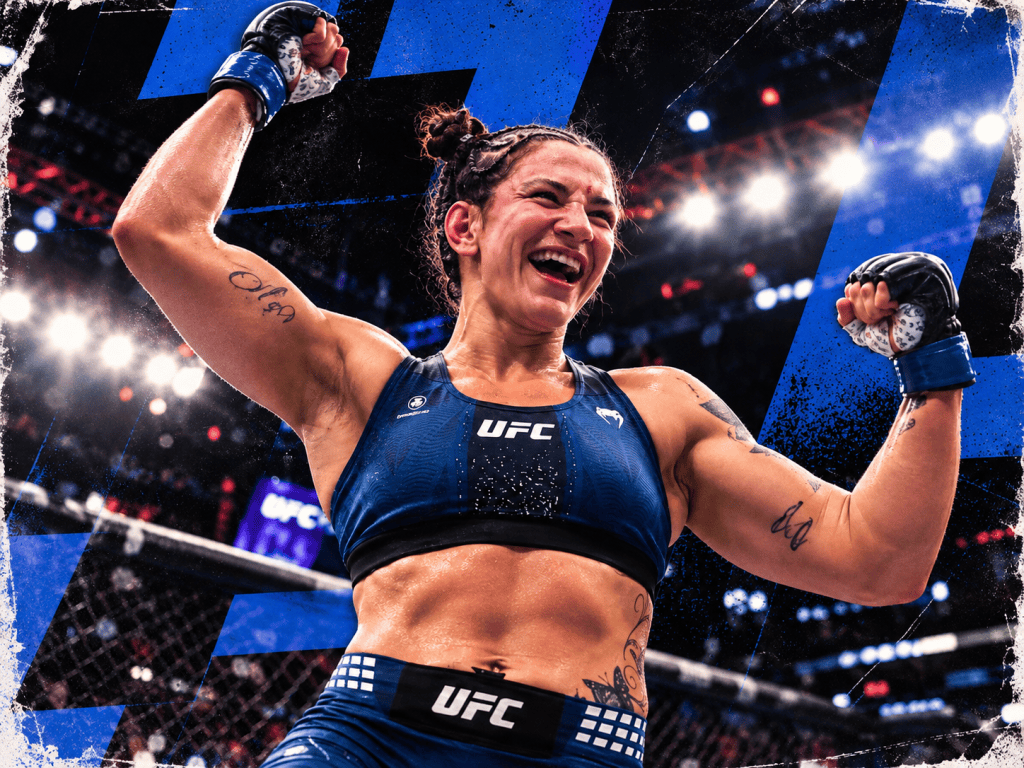
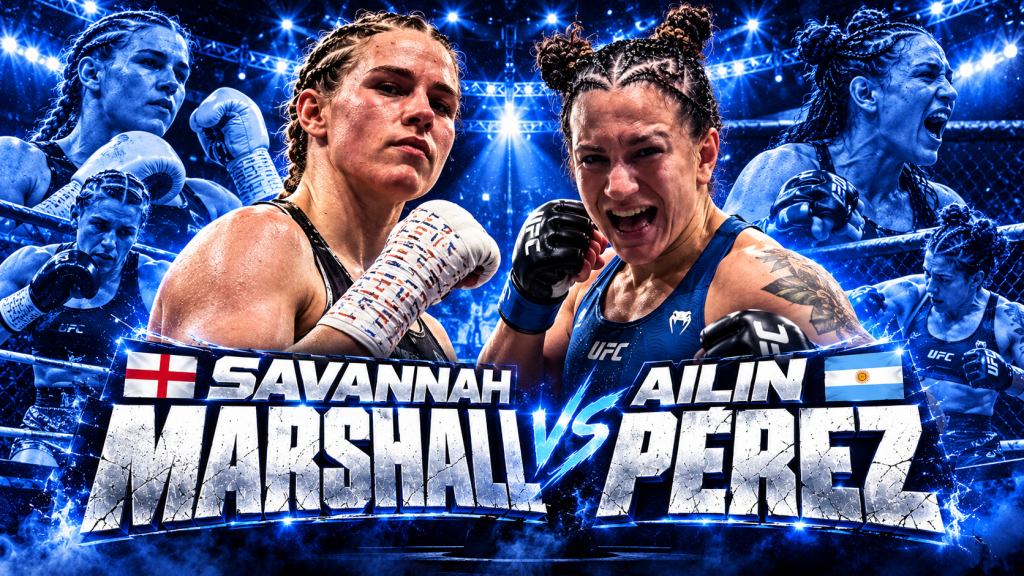
There are easier ways to annoy Savannah Marshall than asking her to fight somebody six inches shorter than her.
Allow that somebody to kick her, throw her and choke her, however, and things become considerably more interesting.
A hypothetical fight between Marshall and Ailín “Fiona” Pérez initially looks ridiculous on the scales. Marshall has spent much of her elite boxing career around middleweight and super-middleweight, reaching the summit at 168 pounds. Pérez is a UFC bantamweight who fights at 135.
We would therefore need some fantasy matchmaking assistance. Somewhere around 150–155 pounds probably gives us the least absurd compromise, although Marshall would still be giving away considerably less than Pérez.
But that size difference is also why this gets interesting.
Marshall isn’t merely a boxer whom we are pretending might try MMA one day. She already did it.
Pérez isn’t merely an MMA fighter who happens to throw kicks, either. She began training Kung Fu and Sanda as a child and became a two-time South American Sanda champion before establishing herself in MMA.
For the avoidance of any disappointed promoters currently reaching for their phones: none of this is real. Savannah Marshall vs Ailín Pérez is entirely hypothetical.
Which means we can make it as complicated as we like.
Savannah Marshall: The Boxer Who Actually Went and Did It
Savannah Marshall’s boxing résumé does not require much embellishment.
She became Britain’s first female amateur world champion when she won the 2012 World Championships, beating a teenage Claressa Shields along the way. More than a decade later, Marshall remains the only boxer to have beaten Shields in either the amateur or professional ranks. She added Commonwealth Games gold in 2014 and represented Great Britain at two Olympic Games.
Her professional boxing record entering this hypothetical is 13–2 with 10 knockouts.
That last number tells you quite a lot.
Marshall is unusually destructive for elite women’s boxing. She doesn’t simply throw textbook combinations from a safe distance. Under Peter Fury, she developed into an awkward, long, heavy-handed fighter capable of changing rhythm, altering her stance and generating power from positions that don’t always look particularly violent until somebody gets hit.
At six feet or thereabouts, she can box long behind the jab, but she is perfectly happy walking opponents onto hooks and uppercuts. She attacks the body viciously. Her hands can drop unusually low. Her feet can appear almost casual.
Against Pérez, that range would feel enormous.
There is another wrinkle.
Marshall has already fought MMA.
She trained for the transition alongside Tom Aspinall and under Andy Aspinall, then made her professional MMA debut against Mirela Vargas at PFL Europe in Newcastle in June 2024.
It wasn’t a carefully sanitised boxing showcase.
Vargas took her down repeatedly and threatened an arm-triangle. Marshall had to scramble, defend herself and work back to her feet before the boxing took over. Once she established separation, Vargas was suddenly dealing with a completely different class of puncher. Marshall overwhelmed her with combinations and won by TKO at 4:27 of the first round. The final punch statistics were reported as 31–4 in Marshall’s favour.
That matters enormously here.
It doesn’t mean Marshall suddenly became an elite grappler. It means the first takedown isn’t necessarily the end of our thought experiment.
Marshall returned to boxing in July 2025 after two years away from the ring and lost a close split decision to Shadasia Green. She hasn’t competed since. Her boxing record therefore stands at 13–2, while her MMA record is 1–0.
So in 2026, Marshall occupies a strange little patch of combat-sports territory.
Elite boxer.
Former undisputed champion.
Undefeated MMA fighter.
Ailín Pérez: Fiona Has Become a Serious Problem
Ailín Pérez’s nickname is “Fiona”, which tells you something about the theatrical side of her personality.
As of September 2026, Pérez is 14–2 in professional MMA after defeating Norma Dumont by unanimous decision on September 26. All three judges scored their grudge match 29–28 for Pérez, extending her UFC winning streak to seven.
Pérez isn’t some interesting UFC prospect we’re borrowing for an experiment. She has fought her way into the upper reaches of the bantamweight division.
And while her striking attracts attention because of her Sanda background, her UFC success has increasingly been built around something rather less glamorous.
She is extremely good at putting people on the floor.
Pérez landed 10 takedowns against Ashlee Evans-Smith, which remains the UFC women’s bantamweight single-fight record. Before the Dumont fight, the UFC listed her at 4.90 takedowns per 15 minutes. She had also absorbed just 1.58 significant strikes per minute, the lowest figure among qualifying women’s bantamweights in the UFC’s record book.
That latter statistic requires context.
Pérez isn’t Pernell Whitaker in four-ounce gloves.
A major reason opponents don’t hit her very much is that she spends enormous portions of fights making striking difficult in the first place. Get underneath an opponent, connect your hands, put her against the fence, complete a takedown and spend two minutes controlling her hips and suddenly her striking output becomes theoretical.
Against Marshall, that is exactly what Pérez would want.
Her martial-arts background makes the matchup more interesting still.
Pérez says she began Kung Fu and Sanda at 12. She became a two-time South American Sanda champion, winning at both 65kg and 70kg, and holds a red belt in Kung Fu. The UFC now lists her as a BJJ brown belt.
Sanda is particularly relevant because its relationship between striking and takedowns is different from conventional kickboxing.
You don’t merely learn to punch and kick.
You learn to punch while anticipating somebody catching the kick. You learn to enter clinches knowing throws are available. You learn that distance can suddenly collapse into a sweep.
That instinct has survived Pérez’s transition into MMA.
And it is why this isn’t simply boxer versus wrestler.
It is boxer-turned-MMA-fighter versus Sanda-fighter-turned-MMA-grappler.
Excellent.
Let’s start changing the rules.
Boxing: Can Ailín Pérez Survive Savannah Marshall’s Range?
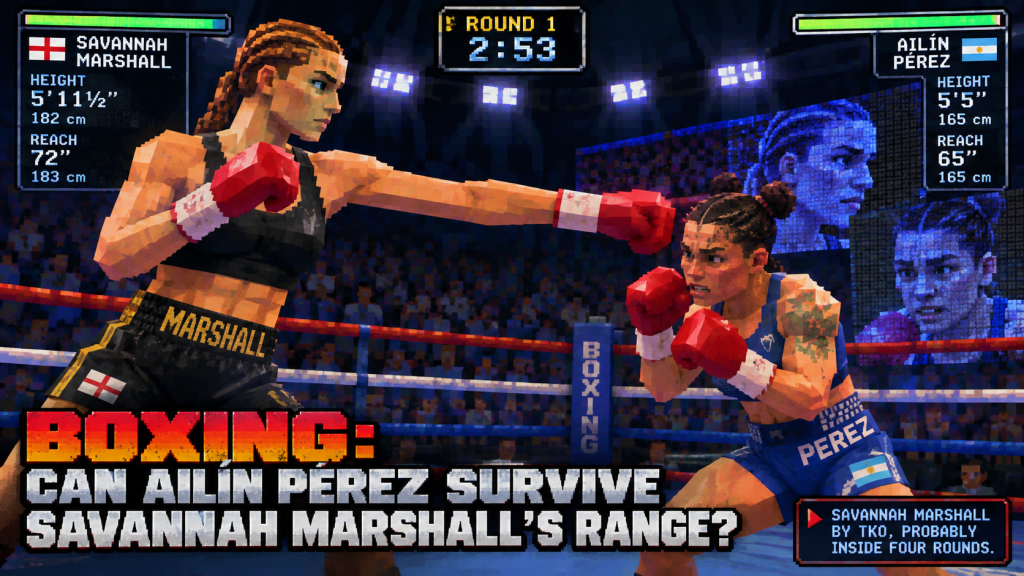
This is the most straightforward section.
Pérez would be entering a boxing ring against a former undisputed super-middleweight champion who is approximately six inches taller, has roughly six inches more reach and has stopped 10 professional boxers.
Her wrestling disappears. Her kicks disappear. Her trips disappear.
That is catastrophic.
Pérez could make survival her priority. She is physically strong, accustomed to contact and far more experienced in striking exchanges than the phrase “MMA grappler” suggests. Her switch stance could occasionally change Marshall’s picture.
But MMA striking defence and elite boxing defence are different languages with several shared words.
Marshall would probe with the jab and punish Pérez for trying to cross that enormous distance. Pérez’s instinct to cover ground aggressively becomes dangerous when Marshall can meet her with uppercuts and hooks without worrying about a level change.
The body might be even worse. Pérez needs her legs underneath her to explode forward. Marshall is an excellent body puncher.
Pérez’s best chance is making the contest ugly: crash distance, smother Marshall’s arms and force constant clinches.
Even then, boxing referees eventually separate them.
Prediction: Savannah Marshall by TKO, probably inside four rounds.
MMA: Can Marshall Keep Fiona Off Her?
Now everything changes.
The terrifying thing for Pérez is that Marshall’s best weapon actually becomes more dangerous.
Those aren’t ten-ounce boxing gloves anymore.
If Pérez shoots lazily from the outside, Marshall can hit her with a straight right or uppercut in four-ounce gloves that could end the entire experiment.
But Pérez doesn’t need to win a kickboxing match.
She needs contact.
Low kicks can disrupt Marshall’s stance. Feints can occupy the hands. Pérez can level-change underneath the jab, drive Marshall towards the cage and begin chaining attacks.
Marshall survived takedowns and an arm-triangle attempt against Vargas. That experience prevents us treating her as helpless on the ground.
Pérez is a different proposition.
She has repeatedly wrestled UFC-calibre opposition for entire fights. She can transition between doubles, body locks, trips and mat returns, and once on top she is comfortable using control and ground-and-pound rather than desperately chasing a submission.
Marshall’s size makes finishing those takedowns harder.
It also gives Pérez an enormous target underneath the hips.
Marshall has the puncher’s chance to end this every second they remain standing.
Unfortunately for her, Pérez has spent years designing fights in which opponents don’t get to remain standing.
Prediction: Ailín Pérez by submission or ground-and-pound, rounds one or two.
Sanda: Now Things Get Weird
This might actually be the most fascinating version.
Take away Pérez’s ground game and you remove her clearest advantage.
Give it back to her in the form of standing throws, trips, catches and sweeps and suddenly Marshall cannot simply establish her boxing stance and begin conducting target practice.
Pérez is a two-time South American Sanda champion at 65kg and 70kg. This is not a ruleset she needs explained to her five minutes before the fight.
She can kick Marshall’s lead leg. She can catch kicks. More importantly, when Marshall steps forward to punch, Pérez can convert the collision into a body lock, trip or throw.
Marshall still possesses the single most dangerous weapon in the fight: her hands.
The size difference becomes important too. Throwing a woman approaching six feet who has spent years developing MMA balance is rather different from throwing a conventional bantamweight.
So Pérez has to resist turning this into prolonged boxing exchanges.
Kick.
Make Marshall reset.
Crash the pocket.
Throw.
Reset.
Marshall wants exactly the opposite: establish punching range, force Pérez backwards and make every attempted entry travel through the jab-right hand corridor.
Over multiple rounds, Marshall could absolutely hurt her.
But Sanda scoring rewards precisely the sort of disruption Pérez has practised since childhood.
Prediction: Ailín Pérez by an extremely competitive decision.
This might be the closest fight of the entire experiment.
Dirty Boxing: Welcome to the Phone Booth
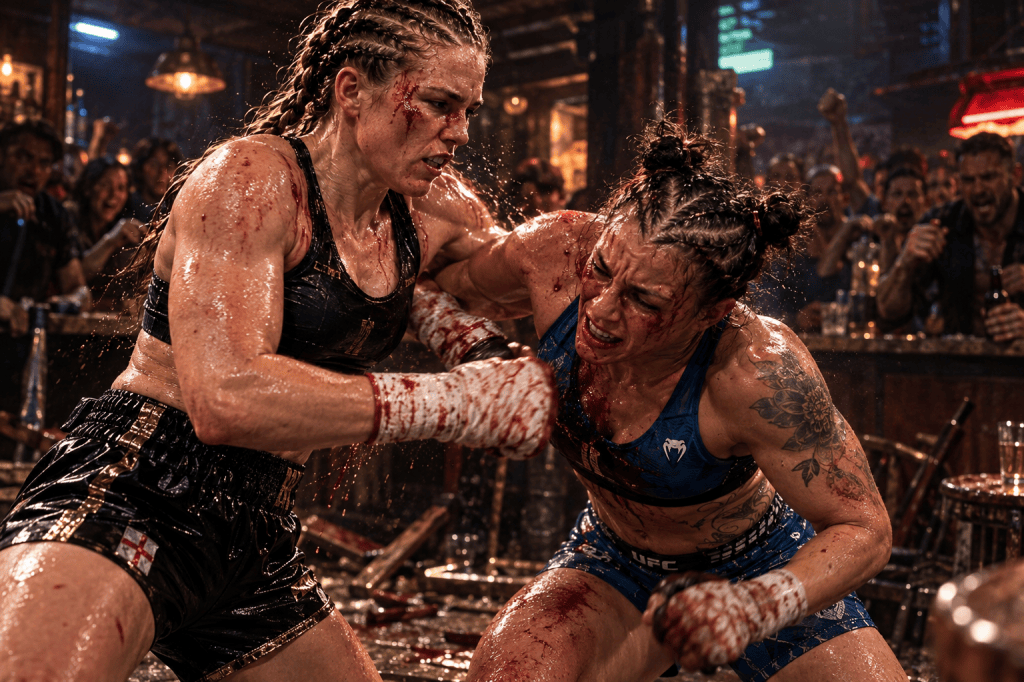
Now remove the kicks and takedowns again.
But don’t separate the clinch.
Suddenly Pérez has a chance to make Marshall’s beautiful punching range disappear.
Imagine seven-ounce gloves with punching permitted from prolonged clinch positions, collar ties and arm-control situations.
At long range, this remains Marshall’s world.
Her jab is longer. Her straight shots are cleaner. Her understanding of punching angles is several galaxies beyond Pérez’s.
So Pérez cannot politely box her.
She needs to turn the fight into rush-hour public transport.
Get inside. Attach herself to Marshall. Pull the head down. Fight for underhooks and biceps control. Lean on her. Punch during the hand-fighting.
MMA fighters spend thousands of hours becoming comfortable in precisely these ugly transitional positions.
Marshall, however, is not some pristine amateur stylist who falls apart when fights become physical.
Watch her boxing and there is plenty of rough work. She can punch at strange ranges, she is strong in close and, crucially, she remains the considerably larger woman.
Pérez might initially surprise her with the freedom afforded by the clinch.
Eventually, though, Marshall starts finding the uppercut.
And that is a terrible punch to repeatedly discover while trying to get underneath a six-foot knockout artist.
Prediction: Savannah Marshall by late stoppage after a much uglier fight than the boxing version.
Alternating Rules: Boxing, MMA, Boxing, MMA, Boxing
Now we arrive at the important scientific question nobody asked.
Five rounds.
Round one is boxing.
Round two is MMA.
Round three is boxing.
Round four is MMA.
Round five is boxing.
Damage carries over.
Good luck.
Round One: Boxing
Pérez has no reason whatsoever to try to win this round.
Survival is winning.
Marshall takes the centre immediately and begins establishing the jab. Pérez stays mobile, changes direction and clinches whenever Marshall gets into combination range.
Marshall still lands.
A right hand catches Pérez coming forward. A body shot follows later and suddenly three minutes feels extremely long.
But Pérez reaches the bell.
Marshall 10–9.
More importantly, Pérez is still conscious.
Round Two: MMA
Now Fiona is allowed to be Fiona.
And Marshall has spent three minutes conditioning herself to react to punching entries.
Pérez immediately changes the question.
She feints upstairs, drops levels and drives Marshall into the fence.
Marshall sprawls better than she would have in 2023. She knows where the underhooks are. She has experienced this before.
Pérez keeps going.
Single leg. Body lock. Outside trip. Mat return.
Eventually Marshall lands underneath her.
Pérez doesn’t need to hunt recklessly for a submission. She can make Marshall carry weight, attack with short punches and force her to repeatedly stand.
Marshall survives.
But her arms are considerably heavier when the bell rings.
Pérez 10–9.
Round Three: Boxing
Here is where the format becomes interesting.
The grappling has not disappeared just because the referee changed the rules.
Its consequences remain.
Marshall’s shoulders are tired. Her legs have been forced through takedown scrambles. Pérez has also eaten clean punches.
Marshall still wins the boxing exchanges.
But perhaps she doesn’t have quite the same snap.
Pérez is beginning to look marked up, though, and another Marshall body shot makes her retreat.
Marshall 10–9.
Round Four: MMA
Pérez knows she needs this.
Marshall knows exactly what is coming.
Knowing and stopping are different activities.
Pérez attacks the legs earlier this time. Marshall lands a frightening uppercut during one entry, but Pérez absorbs it and reaches the hips.
Down they go.
Now the accumulated fatigue matters.
Marshall’s first-round MMA debut showed that she can scramble back to her feet.
Can she do it repeatedly after nine minutes of alternating between boxing and wrestling?
Pérez takes the back during a stand-up attempt.
Marshall fights the hands.
One hook goes in.
Then the second.
This is the danger zone.
Prediction: Ailín Pérez finds the rear-naked choke late in round four.
She never gets to experience round five.
So Who Actually Wins Savannah Marshall vs Ailín Pérez?
That depends entirely on which sport has kidnapped them.
Under professional boxing rules, Savannah Marshall wins. The combination of size, reach, elite technique and genuine knockout power is simply too much to ask Pérez to overcome without her other weapons.
Under MMA rules, I favour Pérez. Marshall’s MMA debut proved she isn’t helpless once somebody grabs her, which makes the hypothetical much more interesting, but Pérez is operating several levels above Mirela Vargas as a grappling threat.
Sanda is the jewel of the experiment.
Marshall has the hands and size.
Pérez has the actual Sanda pedigree.
I narrowly favour Pérez because throws, catches and sweeps allow her to disrupt the boxing without needing prolonged ground control.
Dirty boxing swings back towards Marshall. Pérez can make things ugly, but she still has to spend an entire fight exchanging punches with a much larger former undisputed boxing champion.
And in our alternating-rules monstrosity?
Pérez by submission in round four.
The broader point isn’t that MMA beats boxing, or that boxing beats MMA.
It is that rules create fighters.
Marshall’s long stance, distance control and extraordinary punching become devastating when the opponent is required to box her. Introduce kicks and takedowns and some of those same positions become liabilities.
Pérez’s pressure, clinching and wrestling make her miserable to fight in MMA. Remove the takedown and suddenly closing six inches of reach becomes a much more hazardous occupation.
Then Sanda comes along, steals pieces from both worlds and turns the whole argument upside down again.
Marshall deserves enormous credit because she is one of the very few elite boxers for whom this experiment isn’t entirely theoretical. She walked into an MMA cage, got taken down, escaped trouble and knocked her opponent out.
Pérez deserves just as much because her 14–2 record and seven consecutive UFC victories now put her firmly among the significant fighters at 135 pounds, while the Sanda background gives her a striking vocabulary most grappling-heavy MMA fighters simply don’t possess.
Put them in a boxing ring and Fiona probably discovers that ogres aren’t particularly useful against a six-foot woman with a world-championship jab.
Put them in a cage and Marshall may discover something equally unpleasant.
Sometimes the princess is also a wrestler.