Apologies that this one is late. It has been a bit of a wild ride.
I watched this from an Airbnb in London rather than my usual spot at home in lovely Leeds, which already put the afternoon at something of a disadvantage. I don’t especially like London. Everything costs too much, everyone seems to be walking somewhere urgently, and a considerable portion of the city seems to have been designed to convince people that exposed brickwork represents culture. The Airbnb was hot, the window wasn’t doing much and the little fan in the corner was fighting a battle it had absolutely no prospect of winning.
Still, SFIDA Setagaya were back. That mattered more. This fixture had originally been scheduled for 27 June before Typhoons No. 7 and No. 8 intervened, leaving us waiting until 8 August for the rearranged match against Nippatsu Yokohama FC Seagulls. AGF Field looked lovely in the sunshine, even if the 33°C temperature meant cooling breaks were required, and I had convinced myself that perhaps this could finally be the afternoon when SFIDA started turning the place into a proper little home fortress.
For three minutes, this looked entirely reasonable. SFIDA started calmly, Nana Watanabe was moving the ball beautifully, the passing lanes were sensible, and there was none of the early panic that has occasionally made watching this team feel like somebody has quietly removed a wheel from the shopping trolley. It was controlled football. Nothing spectacular. Just good.
Then Yokohama scored.
At 4 minutes and 58 seconds.
0% Beer, 0% Momentum
I had spent the previous evening drinking 0% beer because I arrived late and my friends were already too far gone for catching up to seem remotely sensible. Ten years ago I might have attempted it. These days, I would rather wake up able to remember my own postcode.
0% also felt like a reasonable estimate of Yokohama’s contribution to the opening five minutes.
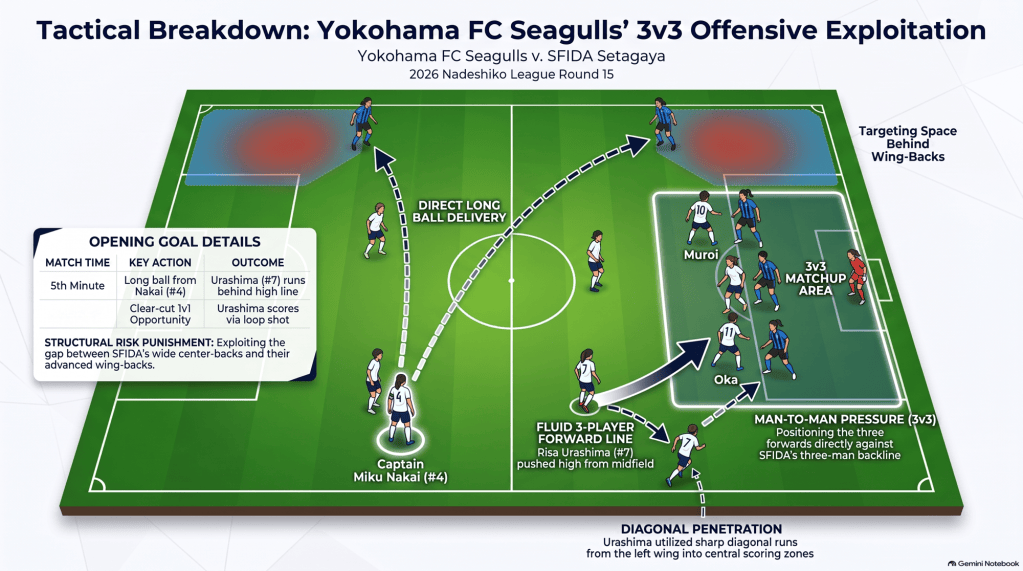
Yet Risa Urashima was suddenly running behind SFIDA’s high defensive line, saw the goalkeeper advancing and lifted the ball over her.
1-0.
From almost nothing.
That is football’s slightly irritating relationship with fairness. Possession isn’t credit stored at a bank. You don’t get to exchange five minutes of nice passing for half a goal later.
SFIDA had looked the better team.
Yokohama had looked at the scoreboard.
The Real Damage of an Early Goal
The goal itself was frustrating, but what happened afterwards was worse.
SFIDA suddenly stopped looking like the team that had started the match. Yokohama’s Coco Muroi stole possession from our throw-in at 6:19 and Nana Watanabe had to intervene. Less than a minute later Ayaka Nemoto put a decent ball across from the right, but nobody was there to attack it.
The calm had gone.
That’s the real price of conceding after five minutes. It doesn’t merely make the score 0-1. It puts the original game plan on trial before anybody has had time to establish whether it was actually working.
SFIDA had been moving the ball confidently.
Now everything had a question mark attached.
Mitsuki Horie tried to provide an answer.
She drove down the right and needed three Yokohama defenders to stop her advancing, which was encouraging because it showed that SFIDA could cause problems when somebody actually committed to doing something direct.
I opened the Airbnb window.
Perhaps we could open their defence.
Lots of Football, Not Enough Threat
Around twelve minutes, Misuzu Uchida stood over a free-kick on the right of Yokohama’s penalty area. The delivery was decent, there was a scramble inside the six-yard box and, briefly, the sort of horrible little goal that can reset an entire match seemed possible.
Side netting.
Then a corner.
Straight onto the head of a Yokohama defender.
Move over.
Horie looked increasingly frustrated. I couldn’t tell whether she was annoyed with the service, herself or football generally, but she continued chasing everything. Saya Shinohara was doing much the same.
There was effort everywhere.
The problem was converting effort into something Yokohama actually had to fear.
By seventeen minutes, SFIDA had recovered much of their confidence and were again controlling possession. We could work through midfield. We could find the wings. We could move Yokohama around.
Then we reached the final third and suddenly football became theoretical physics.
The Right Side, Again
Ayaka Nemoto was repeatedly providing SFIDA’s best outlet.
She drove down the right, got knocked over at one stage and ended up in something resembling a plank position. Fair enough. Never waste an opportunity for some core work.
After the first cooling break, Kokone Kitagawa also emerged with some real urgency and suddenly there was a nice little relationship developing down that side. Nemoto and Kitagawa were giving Yokohama something to think about.
But there was an obvious problem.
It kept happening on the right.
Again.
And again.
Footballers notice patterns. Managers certainly do. If virtually every meaningful attack is coming through the same corridor, eventually the opposition can start moving furniture into it.
SFIDA’s attacking structure was becoming predictable.
Yokohama’s wasn’t.
The High Line Problem
The other concern was SFIDA’s 3-4-3.
Urashima was pushing high from Yokohama’s left, effectively joining Coco Muroi and Momoka Oka to create a three-player forward line against SFIDA’s three defenders. Suddenly every direct ball into the space behind our wing-backs looked much more dangerous than it had any right to.
The system had effectively created a 3v3 whenever Yokohama attacked quickly.
Fine when everything works. Rather less fine when it doesn’t.
SFIDA had constructed this elaborate tactical machine with moving components and carefully defined roles, while Yokohama appeared to have discovered that repeatedly pressing the large red button marked LONG BALL caused the machine to make alarming noises.
By the 20-minute mark, I still thought SFIDA were the better team.
Yokohama were simply better at identifying what mattered.
That distinction was becoming increasingly important.
Coco Muroi Was Warning Us
Around half an hour, the game settled into something considerably less exciting.
Yokohama started seeing more possession. SFIDA’s early momentum faded. Neither side appeared particularly desperate to turn the match into anything dramatic.
Coco Muroi remained interesting.
Her first touch was excellent, and she seemed capable of turning possession into forward movement much more quickly than anyone else on the pitch.
I made a note of it.
This will become relevant later.
At 33 minutes, Misuzu Uchida almost reached a decent forward pass, but it carried slightly too much weight, and the goalkeeper collected it.
Then Nemoto went down the right.
Again.
The delivery wasn’t good enough.
Again.
By forty minutes, Yokohama suddenly managed several shots at goal, and SFIDA were fortunate to remain only 1-0 behind.
That was concerning.
Meanwhile, London
At roughly this point I received an update about the evening’s plans.
A nightclub.
Music I don’t especially like.
I’ve reached the stage of life where certain versions of a Saturday night feel more like inherited tradition than something I actively want to participate in. Ten years ago, perhaps, but tastes change, and these days I’d genuinely rather spend an evening watching women’s football than getting drunk enough to lose the following morning.
Apparently my preferences have drifted towards spending an unreasonable amount of time in the gym. Give me a bench press and some rear-delt cable flyes, and I’ll quite happily manufacture my own difficult evening.
The gym hurts too, obviously, but there’s something waiting on the other side of that particular discomfort. A few more reps, a little more weight, some actual progress. The pain comes with a return.
Anyway. I don’t want to preach. Despite me just doing exactly that.
Half-time.
1-0.
Come on. We’re better than this.
The Second Half Didn’t Fix Much
Yokohama started the second half with a corner, which wasn’t particularly reassuring.
At 47 minutes, the camera instead found Yokohama’s substitute goalkeeper doing wide squats and some advanced stretching behind the goal. I admired the commitment. Her flexibility had briefly become one of the more compelling things happening on screen.
I jest. Sort of.
Saya Shinohara continued working relentlessly, and Nana Watanabe was trying to inject some authority back into the performance, but Yokohama increasingly looked comfortable.
And Coco Muroi continued looking dangerous.
Every time she received the ball in space, SFIDA seemed to retreat slightly.
This was becoming a problem.
London, meanwhile, remained terrible.
Substance
Everybody tells you London has everything.
My problem is that much of it feels strangely without substance. There are brewery taps that seem to have existed for about fourteen minutes but have been carefully designed to look seventy years old, presumably so somebody can charge £9.80 for something cloudy. Sorry, that’s £11.85; it’s extra for the glass hire.
History as interior decoration.
Football can fall into a similar trap.
Possession looks good. Passing sequences look good. Territory looks good.
But eventually somebody has to create something.
At 55 minutes, SFIDA went forward, the attack broke down, and Yokohama countered.
Watanabe looked furious.
Not necessarily with anybody in particular.
Just furious that the match wasn’t rewarding what SFIDA were putting into it.
I liked that. There was still some fight there.
Mitsuki Horie and Miku Nakai
Then came the best moment of the afternoon.
It had nothing to do with the score.
Around the 58th minute, Mitsuki Horie became tangled with Miku Nakai while challenging for the ball. It was clearly accidental, but Nakai stayed down.
Immediately, Horie looked concerned. Really concerned.
Yokohama players appeared to reassure her and encourage her away while the medical staff came onto the pitch, but Horie remained nearby. Then the stretcher arrived, and suddenly this fairly ordinary collision felt considerably more serious.
Football spends so much time demanding that players demonstrate how much they care about winning.
Sometimes it is nicer seeing somebody demonstrate that they care about another person.
Thankfully, Nakai eventually stood up.
She could walk. Horie visibly relaxed.
Then, once everything was safe, Horie went over to her.
No Problem. It’s Football.
Horie made a point of getting Nakai’s attention.
She apologised. They shook hands.
Nakai almost laughed it away.
No problem. It’s football.
And then they carried on.
It was a tiny moment in a fairly miserable defeat and probably won’t feature prominently in any official account of the match.
Which is exactly why I will remember it.
I would rather support a team filled with people capable of that sort of basic humanity than one filled with arseholes who happen to collect trophies.
Obviously, good people who collect trophies would be ideal.
I’m not asking for sainthood.
Fresh Legs, Same Problem
Hamada made changes.
Saaya Kato came on, and SFIDA adjusted their shape, moving away from the 3-4-3 experiment towards something closer to 4-4-2. There was an improvement.
Watanabe played a nice ball towards Horie. Shinohara produced some excellent recovery work to prevent Momoka Oka getting a clear run into the penalty area.
Misuzu Uchida broke forward around 64 minutes and dragged an effort wide.
One of our better chances. Which rather summed things up.
We were more than an hour into a match we were losing at home, and an effort going slightly wide qualified comfortably for the shortlist.
Moeno Arrives
Another cooling break arrived at seventy minutes. It didn’t even look that warm on YouTube. Television lies.
Moeno Matsubara replaced Horie and immediately introduced herself to Miyuri Kodate with a couple of playful little barges.
Nothing serious. Just enough.
“I’m marking you, by the way.”
I enjoyed it.
SFIDA continued to push forward, but the same problem persisted.
We could get towards the dangerous areas. We couldn’t actually make them dangerous.
Nana Watanabe, Then Disaster
At 78 minutes, Nana Watanabe produced an absolutely wonderful sliding tackle.
It looked outrageous initially.
All ball. Perfectly timed. Fantastic.
Twenty seconds later everything unravelled.
Watanabe cleared another Yokohama attack, but the ball went straight towards Nagisa Yoshida. Yoshida found debutant Yuuka Matano, who noticed the goalkeeper away from her line.
Matano sent it over her.
2-0. FFS.
It felt horribly unnecessary.
Yokohama had again been presented with an opportunity rather than having to construct something particularly elaborate themselves.
But they took it.
That’s the difference.
Two Passes Later
Kick-off. Come on.
Forget it. Go again.
Two passes. Possession lost.
Yokohama regained the ball, and suddenly Coco Muroi was advancing through the middle.
The same Coco Muroi who had been excellent throughout.
The same Coco Muroi whose first touch and directness had caused problems all afternoon.
Nobody stopped her.
Coco Muroi Shot. Another Coco Muroi Goal. 3-0. Pfft.
I hadn’t finished being annoyed about the second.
One Minute of Complete Collapse
This was the part that genuinely bothered me.
Not because Yokohama had suddenly become brilliant.
They hadn’t.
SFIDA simply stopped doing the basic things that had kept the match competitive for almost eighty minutes.
One goal became two because the first mistake was allowed to remain emotionally present.
Footballers are always told to “reset”, one of those wonderfully convenient sporting instructions that sounds very easy when shouted from a technical area.
Just reset.
Forget the goal.
Go again.
Human beings don’t really work like that.
SFIDA looked rattled.
Muroi looked delighted.
She also looked slightly like Shayna Baszler with the mouthguard in, or your generic hard-as-knuckles MMA fighter.
Which I mean affectionately.
3-0 and Still Miserable
The camera occasionally showed a handful of Yokohama supporters.
Arms crossed. Faces serious.
Guys. You’re 3-0 up. Cheer up.
You’ve not even travelled particularly far.
Eventually they did, with the celebrations and “Yokohama nara te wo tatakou” arriving once the result was beyond doubt.
Fair enough.
Perhaps they simply require mathematical certainty before displaying emotion.
There are worse characteristics in a football supporter.
Possession Without Purpose
The final ten minutes were basically the entire SFIDA performance condensed into a small sample:
Work the ball forward. Reach the final third. Hesitate.
Pass sideways. Try something.
Lose it.
Kokone Kitagawa had possession and drifted wide before being stopped by fairly ordinary defending.
Uchida later produced a decent forward pass towards Matsubara, but it was slightly too strong.
Matsubara chased it anyway. She kept working. Everyone did.
That wasn’t the problem.
Five Shots
SFIDA finished with five shots. Yokohama had fifteen.
That is the bit that stings.
Not possession.
Not whether we looked quite nice as we passed through midfield.
There were individual positives. Nana Watanabe played with obvious passion and made several excellent interventions. Ayaka Nemoto gave SFIDA a genuine outlet. Saya Shinohara worked relentlessly. Kokone Kitagawa tried to increase the tempo. Misuzu Uchida threatened occasionally, and Maasa Taguchi forced the goalkeeper into action.
But collectively there wasn’t enough.
The Professional Test
That matters because SFIDA are approaching something much bigger than this particular result.
FC Tokyo SFIDA is coming. The merger.
Professional football is coming.
Manager Takashi Hamada has spoken about what that requires, particularly the individual skill and tactical judgement necessary to make the correct decisions regardless of system. Whether he is the man to take us into that era, who knows.
So there we are.
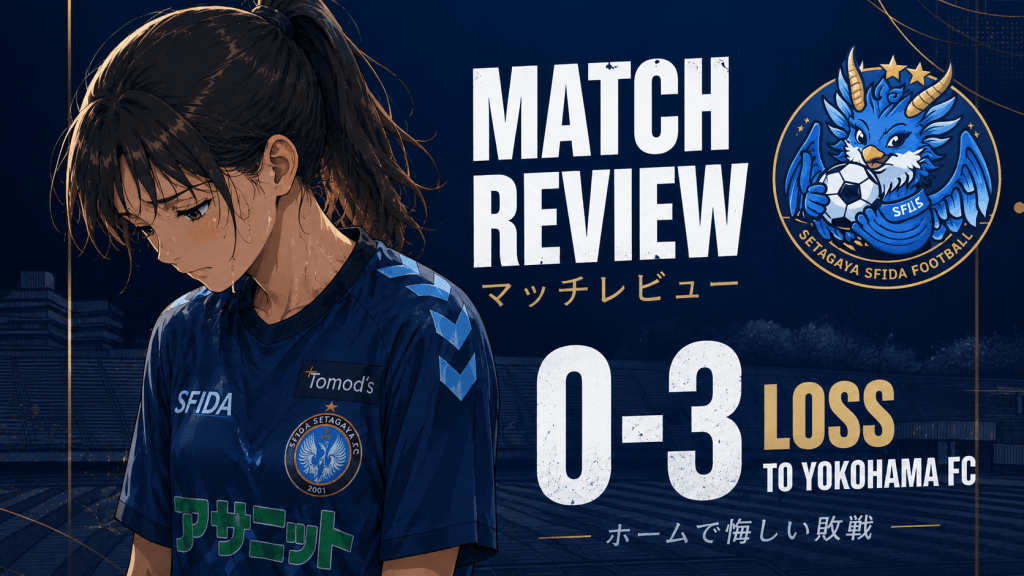
SFIDA Setagaya 0. Nippatsu Yokohama FC Seagulls 3.
I kept thinking about Horie.
She stayed. She worried. She waited.
Then she went over and apologised.
Nakai smiled. They shook hands. Football continued.
That’s worth something. Not three points, obviously. But something.
SFIDA have a long way to go if this team is going to be ready for professional football. The attacking quality needs to improve, the mistakes need to disappear, and possession needs to become more than a pleasant way of moving the ball towards the opposition’s penalty area.
But professionalism isn’t only about becoming colder.
Sometimes it should mean becoming better without losing what was already good.
This was 3-0. It felt avoidable.
That’s probably why it annoyed me so much.
Even more annoying – we’ve got to wait until September now for another match!!!