
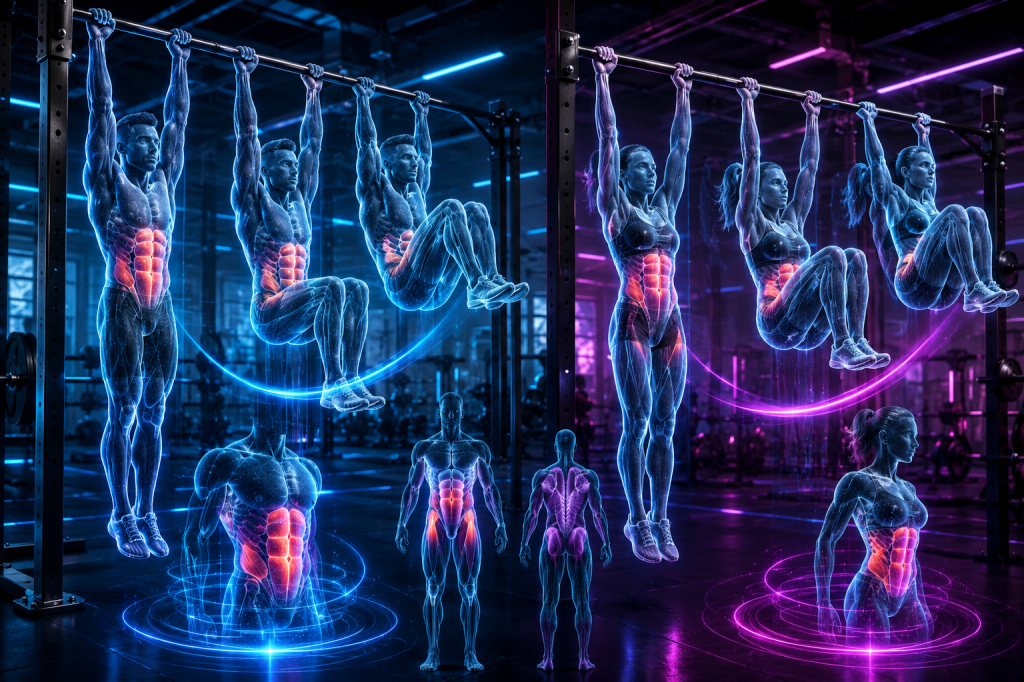
The hanging knee raise is one of the most effective bodyweight exercises for building a stronger, more defined core. Performed while hanging from a pull-up bar, it combines abdominal training with grip strength, shoulder stability, and body control in a single movement.
Unlike floor crunches, hanging knee raises force your entire body to work together. Your abs drive the movement, your shoulders stabilise your body, and your forearms fight to keep you attached to the bar. It is a favourite among athletes, callisthenics enthusiasts and bodybuilders looking to develop functional strength alongside visible abdominal definition.
Muscles Worked
Primary Muscles
- Rectus abdominis
- Hip flexors
Secondary Muscles
- Internal and external obliques
- Forearms and grip muscles
Stabilising Muscles
- Transverse abdominis
- Latissimus dorsi
- Lower traps
- Serratus anterior
- Hip adductors
Why This Exercise Is Good
Few core exercises challenge as many muscle groups simultaneously.
Strict hanging knee raises build powerful abdominal strength while improving grip endurance and overhead shoulder stability. They also reinforce proper spinal bracing, making them an excellent accessory exercise for heavy squats, deadlifts and overhead presses.
The hanging position provides a brief spinal decompression before each repetition, while the controlled lifting phase teaches excellent pelvic control and body awareness.
For lifters chasing visible abs, few bodyweight movements provide as much mechanical tension when performed correctly.
Technique Breakdown
- Grab a pull-up bar with an overhand grip slightly wider than shoulder width.
- Pull your shoulders down to create an active hang.
- Brace your core and slightly position your feet in front of your body.
- Raise your knees towards your chest under control.
- At the top, curl your pelvis upwards instead of simply stopping when your thighs become parallel.
- Pause briefly before lowering your legs slowly over two to three seconds.
- Repeat only once all swinging has stopped.
Common Mistakes
The biggest mistake is using momentum. Swinging turns a core exercise into an awkward playground impression and dramatically reduces abdominal activation.
Another common error is stopping once the knees reach hip height. The abs become most active when you continue by tilting the pelvis upwards.
Other mistakes include:
- Arching the lower back
- Holding your breath
- Rushing the lowering phase
- Letting grip fatigue ruin technique
Slow, controlled repetitions always beat fast, messy ones.
Potential Drawbacks
Hanging knee raises are demanding.
They require solid grip strength, healthy shoulders and enough mobility to hang from a bar comfortably. Beginners often struggle long before their abs become fatigued.
People with acute lower back pain, shoulder impingements or spinal disc injuries should avoid the exercise until cleared by a healthcare professional, as the movement creates significant spinal compression during the lifting phase.
Who Should Use This Exercise?
Beginners
Start with reverse crunches or captain’s chair raises before progressing to full hanging variations.
Intermediate Lifters
An excellent addition for improving core strength and grip endurance.
Advanced Athletes
Weighted variations and toes-to-bar provide outstanding progression opportunities.
General Fitness
Ideal for anyone wanting stronger abs, improved posture and greater body control.
Dragon’s Hoard 🐉
Don’t just lift your knees.
At the top of every repetition, imagine trying to point your belt buckle towards your chin. That tiny pelvic curl is what separates an average hanging knee raise from one that genuinely lights up your abs.
Frequently Asked Questions
Are hanging knee raises good for beginners?
Yes, but most beginners should first master reverse crunches or captain’s chair raises before progressing to the hanging version.
Why do I only feel them in my hip flexors?
You’re probably stopping too early. Continue by curling your pelvis upwards at the top of each repetition to engage the abdominal muscles fully.
How many sets and reps should I do?
Three to four sets of 10 to 15 controlled repetitions work well for most people looking to build muscle and core strength.
Are hanging knee raises better than sit-ups?
For many lifters, yes. They provide greater abdominal activation while also training grip strength, shoulder stability, and body control.
How can I stop swinging?
Create an active hang before every repetition, engage your lats, lower your legs slowly and allow all movement to stop before beginning the next rep.
Disclaimer
This article is intended for informational purposes only and does not constitute medical, physiotherapy, coaching, or professional training advice. Always consult a qualified healthcare or fitness professional before beginning a new exercise programme. Complete all workouts and exercises at your own risk.