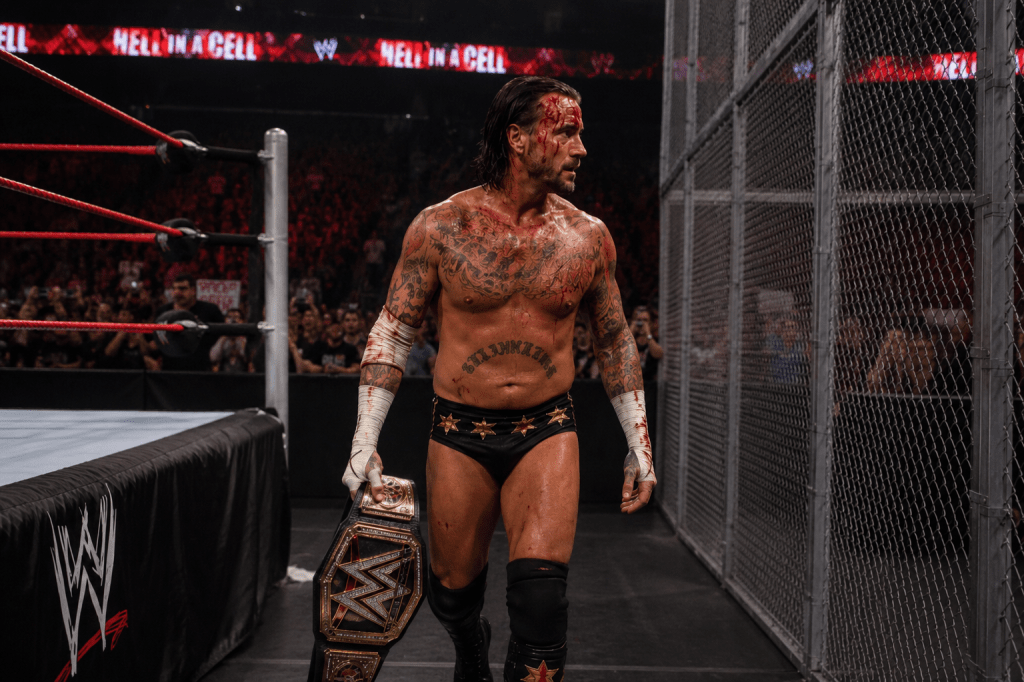
Hell in a Cell 2012 should have been one of WWE’s easiest home runs.
CM Punk entered Atlanta as the reigning WWE Champion, 343 days into what would become one of the longest title reigns of the modern era. Across the ring stood Ryback, unbeaten in 38 matches, pulverising opponents with an intensity that had turned “Feed Me More” into one of the loudest chants in the company.
On paper, champion versus unstoppable monster inside WWE’s most unforgiving structure sounded irresistible.
Instead, it became one of the most disappointing Hell in a Cell matches ever produced.
The problem was never simply that the match was bad.
It was that WWE had created a contest where nobody was actually allowed to win.
WWE Booked Itself Into a Corner
The booking paradox was obvious long before the opening bell.
CM Punk was never realistically dropping the WWE Championship. The company had already committed to a far bigger destination, with The Rock waiting at Royal Rumble 2013 before John Cena’s inevitable WrestleMania redemption. Punk’s reign had become bigger than the autumn schedule itself.
Ryback, meanwhile, had become something WWE rarely manufactures successfully.
An attraction.
His undefeated streak had transformed him from a squash-match curiosity into one of the hottest acts in wrestling. Fans genuinely believed he might flatten the champion. Ending that momentum cleanly, especially inside Hell in a Cell, risked destroying months of careful presentation.
Normally, Hell in a Cell exists to remove excuses.
No interference.
No escape.
No controversy.
Just two wrestlers settling their rivalry with absolute finality.
That philosophy was quietly abandoned before the cage had even been lowered.
The Wrong Match at the Wrong Time
John Cena’s legitimate elbow surgery forced WWE into emergency planning.
With only weeks remaining before the pay-per-view, Ryback was elevated into his first genuine main event programme. The opportunity looked enormous.
The timing wasn’t.
Ryback was phenomenally over.
He was not phenomenally ready.
His offence had largely been built around short destruction matches rather than twenty-minute championship epics built on pacing, storytelling and technical exchanges. CM Punk thrived in layered wrestling contests filled with counters, submissions and momentum swings.
The styles never meshed.
Rather than complementing one another, they constantly fought for control of the match.
Instead of feeling explosive, large sections became slow, awkward and strangely empty.
For a stipulation built on violence and escalation, very little actually escalated.
Chemistry Never Arrived
The match lasted just 11 minutes and 21 seconds.
For a modern Hell in a Cell main event, that is remarkably short.
That brevity almost feels like an admission in hindsight.
Rather than exposing Ryback’s inexperience over twenty-five minutes, WWE compressed everything into a sprint that somehow still felt sluggish. Punk spent large portions trying to survive through stalling tactics, weapons and chinlocks while Ryback repeatedly reset the match with bursts of power.
Neither man ever found a natural rhythm.
It felt less like two elite wrestlers adapting to one another and more like two entirely different matches happening at once.
Even before the real-life stories emerged years later, audiences could sense something wasn’t clicking.
The Finish That Broke the Cell
Then came Brad Maddox.
Few finishes have misunderstood Hell in a Cell quite so completely.
As Ryback appeared moments away from victory, rookie referee Brad Maddox suddenly delivered a low blow before counting Punk’s pinfall at lightning speed.
Technically, Punk retained.
Emotionally, almost everybody lost.
Fans had paid for the stipulation specifically because it promised closure. Instead they received the kind of screwy television finish usually reserved for an ordinary episode of Raw.
The Cell had become decoration.
Its walls prevented nobody from interfering.
Its mythology meant nothing.
Ryback remained visually protected because he hadn’t been beaten fairly.
Punk retained the championship exactly as corporate planning required.
The audience, meanwhile, left with neither satisfaction nor resolution.
The Shadow Outside the Ring
The match has aged even worse because of everything revealed afterwards.
CM Punk became increasingly vocal about working with Ryback, accusing him of being unsafe and questioning both his awareness and judgement inside the ring.
His criticism was blunt.
“Either you’re doing it on purpose and you suck, or you’re dumb as fuck.”
Ryback has consistently rejected those accusations, instead arguing that backstage politics shifted dramatically once his popularity and merchandise sales began climbing towards the level occupied by Punk and Cena.
Whether one accepts either version entirely is almost secondary.
The uncomfortable reality is that the tension visible on screen reflected genuine distrust behind the curtain.
That rarely helps chemistry.
A Hell in a Cell Without a Soul
Perhaps the biggest victim wasn’t Punk.
It wasn’t Ryback.
It was Hell in a Cell itself.
For years the structure represented the final chapter.
Shawn Michaels and Undertaker.
Triple H and Cactus Jack.
Triple H and Batista.
Personal wars reached violent conclusions because the Cell demanded they do so.
By 2012, it had become an October calendar obligation.
WWE needed a Hell in a Cell match because the pay-per-view was called Hell in a Cell.
Not because the rivalry deserved one.
That distinction matters.
When the stipulation exists purely because the calendar says it should, the cage stops feeling like a destination and starts resembling expensive scenery.
This match became the clearest symbol of that transition.
A Great Visual Cannot Rescue a Bad Match
Ironically, most people remember what happened after the bell.
An enraged Ryback chased Punk onto the roof of the Cell before hoisting the champion onto his shoulders and delivering Shell Shocked across the steel.
It remains an unforgettable visual.
Punk escaped with the championship.
Ryback stood tall.
The crowd finally received the catharsis they had been denied minutes earlier.
For a brief moment, WWE produced exactly the image it wanted.
The problem was that it came after a match few wanted to revisit.
Why Fans Still Rank It Among the Worst
Hell in a Cell 2012 wasn’t simply disappointing because the wrestling fell flat.
It represented every problem fans feared about WWE’s booking during that era.
A championship programme built around protecting future plans rather than rewarding present momentum.
A monster challenger elevated before he was fully prepared.
A stipulation stripped of its purpose.
And a finish so contrived that it managed to weaken everyone involved while satisfying almost nobody.
CM Punk continued marching towards history.
Ryback’s aura never fully recovered.
Hell in a Cell itself spent years trying to reclaim the meaning it quietly lost that night.
Sometimes wrestling is remembered because everything comes together.
Sometimes it is remembered because every compromise becomes visible at once.
Hell in a Cell 2012 belongs firmly in the second category.