Kashima Antlers finished second.
That is the simple version.
The defending J1 champions dominated the Centennial League’s EAST Regional Round, collected 45 points from 18 matches, conceded just nine goals and looked every bit the best team in Japan for large stretches of the competition.
Yet by the time the final whistle sounded on the Playoff Round, the trophy belonged to Vissel Kobe.
A 5-0 first-leg humiliation had already settled the destination of the title.
What remained was a question.
What exactly had Kashima Antlers learned about themselves?
For a club preparing for the demands of the AFC Champions League Elite and the historic switch to the new autumn-spring calendar, this campaign felt less like a title race and more like a diagnostic examination.
The results were impressive.
The diagnosis was considerably more complicated.
The Quiet Revolution Under Toru Oniki
When Toru Oniki arrived, he inherited one of Japanese football’s most demanding institutions.
Kashima Antlers do not simply expect victory.
They expect victory wrapped in identity.
The famous “Zico Spirit” has always valued resilience, pragmatism and finding ways to win when matches become uncomfortable.
What made this season fascinating was Oniki’s attempt to add something new without removing what already existed.
The numbers tell an unusual story.
Kashima ranked third in possession and second in passes, while simultaneously producing the league’s strongest defensive metrics and conceding just nine goals throughout the regional phase.
To many watching the weekly J League matches, they still appeared like the familiar Antlers.
Disciplined.
Compact.
Clinical.
Yet beneath the surface, something different was happening.
Oniki was building a team designed to suffocate opponents with the ball rather than simply survive without it.
It worked.
Until it didn’t.
The Golden Starting XI
Every great building has load-bearing pillars.
From a distance, Kashima looked like the Ushiku Daibutsu.
Towering.
Unshakeable.
A structure so imposing that opponents often appeared insignificant standing beneath it.
Yet even the world’s tallest bronze Buddha depends entirely on the integrity of its internal framework.
Remove enough support and the illusion of invulnerability disappears quickly.
That became Kashima’s defining problem.
Seven players absorbed more than 70 percent of the team’s total minutes throughout the competition.
Tomoki Hayakawa.
Naomichi Ueda.
Kim Tae-hyeon.
Kiminori Nono.
Kento Misao.
Yuma Suzuki.
At this moment, one can only assume the coaching staff knew the risk.
The question was whether circumstances would expose it.
Eventually they did.
Leo Ceara and the Attack That Carried Everything
Much of Kashima’s success revolved around Leo Ceara.
His ten goals made him the joint top scorer in the EAST division and gave Kashima a focal point around which everything else could function.
Alongside him, Yuma Suzuki remained the emotional engine.
Few Kashima Antlers players embody the club’s personality quite like Suzuki.
Part creator.
Part agitator.
Part leader.
The partnership worked because both players understood their responsibilities instinctively.
One stretched defences.
The other connected everything together.
Behind them, captain Gaku Shibasaki quietly dictated the rhythm.
If Ceara was the hammer and Suzuki the spark, Shibasaki was the conductor ensuring the orchestra remained in time.
For long periods, it felt effortless.
Perhaps too effortless.
The Left Flank Nobody Could Ignore
The most revealing statistic of the season was not nine goals conceded.
Nor was it Ceara’s tally.
It was zero.
Zero percent goal involvement from the left flank.
An astonishing figure.
Kashima’s right side became one of the most productive attacking corridors in Japanese football thanks to the overlapping threat of Kiminori Nono and the movement of Suzuki.
The left side, meanwhile, became football’s equivalent of an abandoned road.
Opponents noticed.
Why defend both sides equally when one side posed almost no danger?
As the season progressed, teams increasingly overloaded the right.
Kashima still won.
But the warning signs were there.
A system can survive imbalance.
A championship-winning system rarely survives it forever.
The Comebacks That Defined Them
One reason supporters embraced this team so passionately was their refusal to panic.
The away trip to Urawa Reds in Matchday Four remains perhaps the best example.
Two goals down inside twenty minutes.
Away from home.
Momentum completely against them.
Many teams would have abandoned their principles.
Kashima doubled down on them.
Patient possession.
Controlled progression.
Belief.
Aleksandar Čavrić’s 90th-minute winner completed a remarkable 3-2 comeback and established a theme that would follow them throughout the competition.
This team trusted itself.
The same mentality appeared against FC Tokyo.
Reduced to ten men.
Trailing.
Under pressure.
Still fighting until stoppage time to salvage a result.
These moments mattered because they revealed something deeper than tactics.
They revealed character.
The Day Everything Fell Apart
Then came Kobe.
The first leg should have been a showcase between the best teams from the EAST and WEST divisions.
Instead it became a cautionary tale.
Hayakawa was away on international duty.
Kim Tae-hyeon was unavailable.
Two pillars removed.
The structure immediately buckled.
Yuya Osako punished every weakness.
Kobe’s press exposed every hesitation.
The final score read 5-0.
For a team that had conceded just nine goals during the entire regional campaign, it felt almost surreal.
Like watching a spacecraft lose contact with mission control.
Which brings us to another fitting comparison.
Throughout the season, Kashima resembled the Tsukuba Space Center.
Precision engineering.
Careful planning.
Thousands of interconnected components working together towards a single objective.
But space missions are unforgiving.
One missing component can jeopardise the entire launch.
Against Kobe, Kashima discovered their margin for error was much thinner than they believed.
The Roar After the Collapse
What happened next may prove more important than the defeat itself.
Supporters could have turned.
Many clubs would have experienced exactly that.
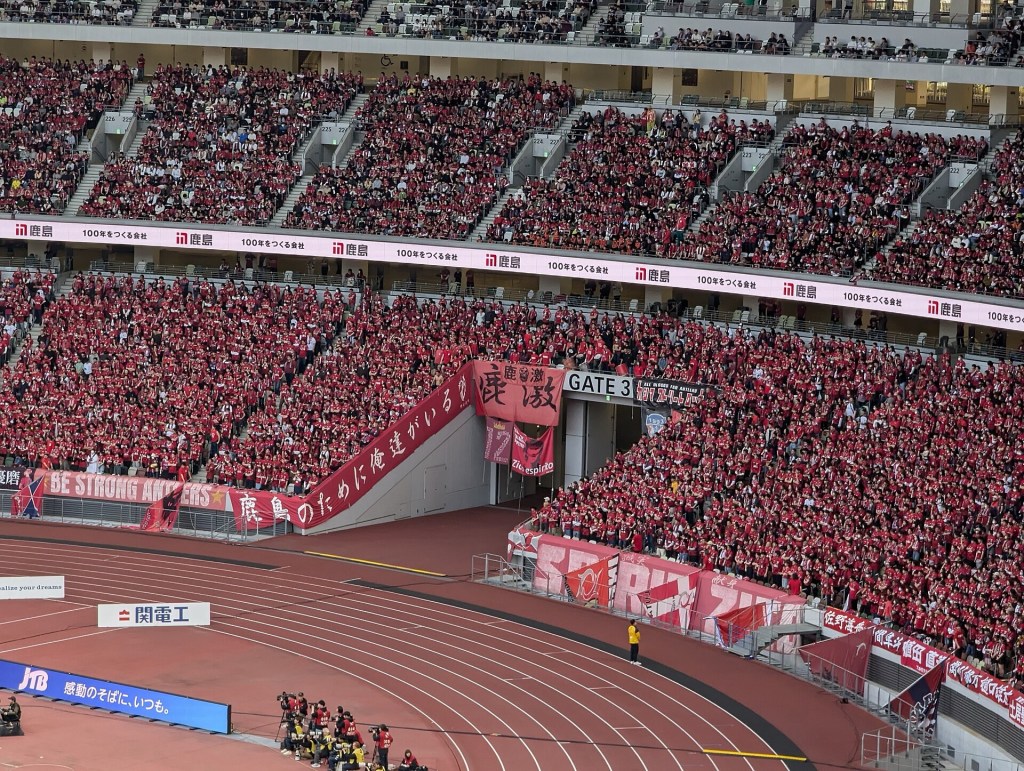
Instead, Kashima’s fans responded with defiance.
Nearly 30,000 supporters packed the second leg knowing the title was effectively gone.
The atmosphere never reflected surrender.
Neither did the players.
Haruki Hayashi scored his first professional goal.
Kei Chinen added another.
Kashima won 2-0.
The trophy remained in Kobe.
The pride remained in Kashima.
An 82-year-old supporter named Toshihiro Muramaki perhaps captured the feeling best afterwards when he spoke of being moved by the players’ refusal to stop fighting.
It is easy to see how moments like these reinforce why Kashima remain one of Japanese football’s most distinctive institutions.
Results matter.
Identity matters too.
What The Summer Window Must Solve
The upcoming transfer window feels less about luxury and more about necessity.
The priorities are obvious.
A dynamic left-sided attacker capable of fixing the team’s glaring imbalance.
A genuine number six to support and rotate with Kento Misao.
A reliable centre-forward capable of easing the burden on Ceara and Suzuki.
There is also the possibility of contingency planning.
Should Hayakawa, Kim or Nono attract overseas interest, replacements will be required immediately.
The ACLE will not wait.
Nor will the new autumn-spring schedule.
Fixture congestion has a habit of exposing every weakness eventually.
Kashima have already seen the evidence.
The Verdict
This was not a failed season.
Nor was it an entirely successful one.
It was something more useful.
A stress test.
The Centennial League confirmed that Toru Oniki’s tactical evolution is real. Kashima can dominate possession, control matches and remain defensively elite without abandoning the values that made the club successful in the first place.
But it also revealed a difficult truth.
The best Kashima Antlers jersey 2026 campaign moments were created by an outstanding starting XI carrying an enormous workload.
For supporters wearing a Kashima Antlers jersey and following every one of this year’s J League matches, the lesson is clear.
The foundation is championship quality.
The depth is not.
The next chapter begins on 7 August against Yokohama F. Marinos at the National Stadium.
By then, Oniki may have built the reinforcements he needs.
Or he may discover that another season rests upon the same seven pillars.
Time will tell whether the Centennial League was the moment Kashima Antlers became a continental contender.
Or merely the warning siren before the real test began.