Football spends an extraordinary amount of time trying to convince us that history only arrives with trophies.
The winning goal. The final whistle. The captain lifting silverware beneath a rain of confetti that somehow always looks identical, regardless of the competition.
But history has never really worked like that.
Sometimes it arrives in the shape of two names on a team sheet.
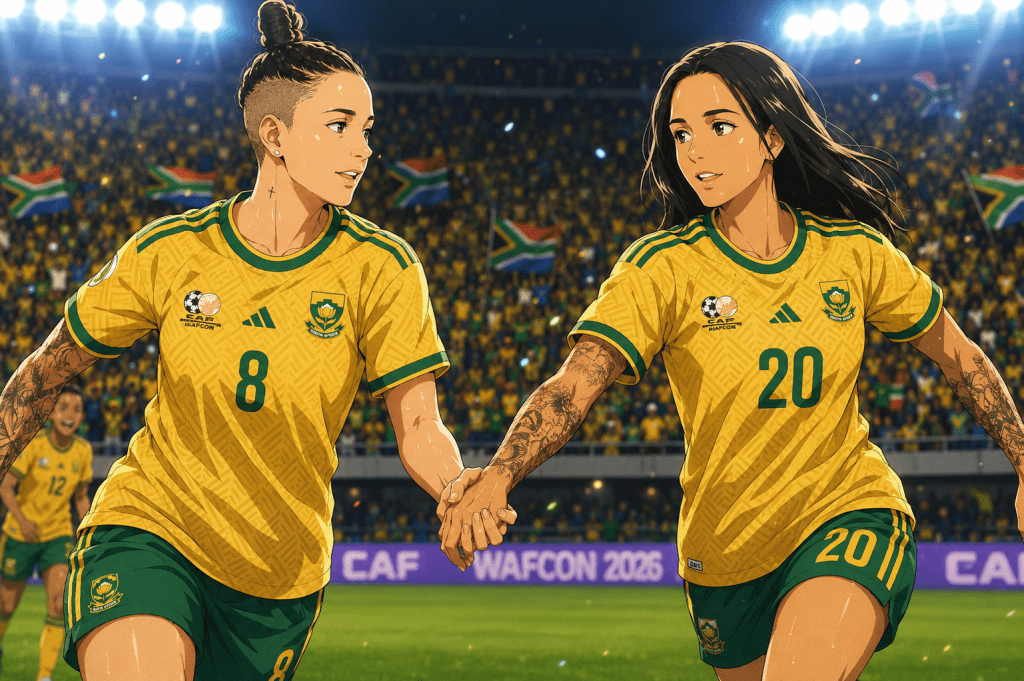
When Robyn Moodaly-Salgado and Gabriela Moodaly-Salgado represented South Africa together at the 2026 Women’s Africa Cup of Nations, they quietly became the first legally married same-sex couple ever to play together at the tournament.
There was no elaborate ceremony.
No dramatic announcement.
Just Robyn Moodaly-Salgado in midfield. Gabriela Moodaly-Salgado introduced from the bench. Two footballers doing what footballers have always done.
Only this time, the game itself had become just a little bit bigger.
Robyn Moodaly-Salgado Had Already Waited Long Enough
International football has a habit of pretending careers move in straight lines.
They don’t.
Robyn Moodaly-Salgado knows that better than most.
After earning almost thirty international caps, injuries interrupted what looked like becoming a lengthy international career. Other players emerged. New cycles began. The national team kept moving, as national teams always do.
Many disappear at that point.
Not because they stop being good enough.
Because football quietly forgets people.
Instead, Robyn Moodaly-Salgado worked her way back.
By the summer of 2026 she wasn’t returning simply as another experienced midfielder.
She was returning carrying something far more unusual.
Her wife.
Gabriela Moodaly-Salgado Refused To Let One Moment Define Her
There are injuries that keep players out.
Then there are injuries that threaten to rewrite who they are.
When Gabriela Moodaly-Salgado suffered fractures to both her tibia and fibula while playing for Mamelodi Sundowns, the pictures looked frightening enough that many supporters feared the worst.
Recovery from that kind of injury is rarely cinematic.
Nobody applauds physiotherapy sessions.
Nobody watches the endless repetitions required simply to trust your own leg again.
It is monotonous, exhausting work carried out long after cameras have disappeared elsewhere.
Which is exactly why seeing Gabriela Moodaly-Salgado wearing South Africa colours again mattered.
Not because it completed some neat sporting narrative.
Because it represented thousands of unseen hours that nobody outside football ever really witnesses.
Then They Walked Onto The Same Pitch
Football loves symbolism.
Usually it invents it afterwards.
This time it barely needed to.
When Gabriela Moodaly-Salgado entered the match to join Robyn Moodaly-Salgado, something genuinely unique happened.
For the first time in Women’s Africa Cup of Nations history, a legally married same-sex couple represented their country together.
That sentence alone carries remarkable weight.
Yet the most refreshing part was how ordinary it eventually became.
A pass.
A tackle.
A run into space.
A quick conversation before a restart.
Married.
International footballers.
Neither fact cancelling out the other.
That quiet normality may have been the greatest achievement of all.
Football Sometimes Changes Without Asking Permission
Representation is often discussed as though it requires speeches.
In reality, it usually looks far simpler.
Young supporters watching at home saw Robyn Moodaly-Salgado and Gabriela Moodaly-Salgado wearing the same shirt, chasing the same ball and sharing the same ambition.
Some probably recognised the significance immediately.
Others simply saw two teammates.
Both reactions matter.
Because every barrier that eventually disappears first reaches the point where it stops feeling remarkable.
Football has not always been welcoming to LGBTQ+ athletes.
Progress has arrived unevenly, sometimes painfully slowly, occasionally taking a few steps backwards just to remind everyone bureaucracy still enjoys a victory lap.
Which makes moments like this feel quietly revolutionary.
Not confrontational.
Simply undeniable.
Casablanca Offered Its Own Layer Of Meaning
Nobody could have scripted the setting much better.
Casablanca has become deeply woven into the Moodaly-Salgado story.
It was here that Gabriela Moodaly-Salgado suffered the horrific injury that threatened to derail everything.
It was here, years later, that Gabriela Moodaly-Salgado returned wearing South Africa colours once more.
Not as someone defined by rehabilitation.
But as someone making history alongside Robyn Moodaly-Salgado.
Football occasionally enjoys these strange circles.
The places that once seemed determined to break you quietly become the places that celebrate your return.
The Scoreline Will Fade. Robyn Moodaly-Salgado and Gabriela Moodaly-Salgado Won’t
Results age quickly.
Ask somebody who won a random group-stage match five years ago and most will hesitate before reaching for their phone.
Ask them about the first married same-sex couple to play together at WAFCON, and there is a fair chance they’ll remember Robyn Moodaly-Salgado and Gabriela Moodaly-Salgado instead.
Because people remember firsts.
They remember courage disguised as routine.
They remember those who quietly widened the doorway for everyone else.
Robyn Moodaly-Salgado and Gabriela Moodaly-Salgado did exactly that.
Not with grand declarations.
Not with manufactured slogans.
Simply by standing beside one another in South African colours and reminding the game that love, resilience and excellence have always belonged on the same team.
Two shirts, one heartbeat
History walked side by side
Football smiled back