The tears arrived before the applause stopped.
Sporting CP supporters had seen Hidemasa Morita leave the pitch hundreds of times, usually with little fuss. He was never the loudest player in Lisbon. Never the one demanding camera time. Yet on his final appearance, the midfielder who quietly stitched together two league titles could barely hide what leaving meant.
“Sporting is not just football, it is life.”
The standing ovation was for more than 166 appearances. It was for a player who had become the rhythm of one of Europe’s smoothest teams. Someone who made difficult football look pleasantly ordinary.
Now he finds himself somewhere entirely different.
Hull.
Not the polished certainty of a Portuguese champion. Not the Champions League. Not possession football where every passing lane has already been rehearsed.
Instead, East Yorkshire awaits. A newly promoted club, fresh from the Championship play-offs, preparing to survive one of the most unforgiving Premier League seasons in recent memory.
It is difficult to imagine a greater change of scenery.
And perhaps that is exactly why Hidemasa Morita made it.
Hull City do not need another star. They need stability.
Every promoted side arrives with optimism.
Every promoted side also discovers that optimism alone concedes goals.
Hull City’s biggest task this season is not scoring spectacular ones. It is preventing matches from becoming chaotic. Last year’s Championship campaign produced promotion, but it also exposed defensive vulnerabilities that Premier League forwards will punish without hesitation.
That is why Morita feels like a remarkably intelligent piece of recruitment.
Hull have not signed highlights.
They have signed organisation.
Sergej Jakirović’s football is energetic, vertical and relentlessly transitional. It asks players to attack quickly, recover quickly and accept that matches often become stretched. It is exciting. It is also dangerous when there is nobody capable of slowing the game before it begins to unravel.
Morita is that player.
The Japanese midfielder rarely dominates headlines because his greatest quality is making everyone else look calmer.
Think of him less as an artist producing masterpieces and more as the engineer making sure the lights stay on.
The game accelerates.
Morita quietly decides when it should breathe.
There was another Yorkshire story that almost happened
Football loves unfinished stories.
For weeks, Morita’s future appeared to point elsewhere.
Leeds United.
The attraction was obvious. Waiting at Elland Road was Ao Tanaka, his former Kawasaki Frontale teammate. Two midfielders who understood each other’s movements almost instinctively. It felt like one of those transfers supporters convince themselves is inevitable because it simply makes too much sense.
It never happened.
Hull rather than Leeds.
Perhaps there was disappointment. Perhaps there was curiosity. Only Morita truly knows.
What remains is that Yorkshire still became home.
Different colours. Different expectations.
The same county.
There is something strangely fitting about that. Rather than joining an established Premier League name, he arrives somewhere where his influence may be even greater.
The World Cup became the chapter that refused to end
This transfer is not simply about club football.
It is about absence.
Japan travelled to the 2026 FIFA World Cup without one of the midfielders who had helped build their recent success.
Injuries interrupted Morita’s final season at Sporting. Muscle problems, illness and eventually a persistent calf issue gradually loosened his grip on Hajime Moriyasu’s plans. Younger players emerged. Opportunities disappeared.
Watching rather than playing became its own punishment.
Many footballers speak about disappointment with polished clichés.
Morita did not.
“If this were a book, this chapter would be the climax. Everything is up to me.”
That sentence explains this move better than any scouting report.
Hull is not retirement.
Hull is resistance.
Every tackle, every interception and every composed pass carries another message toward Japan’s national team manager.
I am still here.
The Premier League asks different questions
Sporting allowed Morita to become wonderfully adventurous.
He drifted into attacking spaces.
He arrived late inside penalty areas.
He combined with technically gifted teammates who expected long passages of possession.
Hull will ask something completely different.
Forget elegant rotations.
Forget endless territorial dominance.
The Premier League, particularly for clubs fighting relegation, is a competition where matches can mutate within seconds. One clearance becomes a counter attack. One misplaced pass becomes twenty metres of emergency defending.
Morita’s role changes accordingly.
He becomes the first receiver.
The escape route.
The player trusted to collect possession under pressure before releasing Hull forward again.
Japanese football often uses the word junkaizai, literally meaning lubricant.
It sounds strangely mechanical.
Yet it describes Morita perfectly.
Hull’s engine already has horsepower.
He is the oil preventing it from tearing itself apart.
He has already shown he belongs at this level
The Premier League is not completely unfamiliar territory.
English clubs have admired Morita for years.
One performance, in particular, continues to linger.
Sporting’s European meetings with Arsenal offered something close to an audition. Against Declan Rice, Martin Ødegaard and one of Europe’s strongest midfields, Morita looked entirely comfortable.
He did not dominate.
He simply refused to disappear.
Sometimes that is more impressive.
Later came another reminder during Sporting’s Taça de Portugal triumph over Benfica, where he controlled the midfield so completely that Bruno Fernandes publicly praised his display.
Elite players recognise elite players. So I’m not sure why I’ve mentioned Bruno Fernandes, he’s a scum cheating bastard.
Those moments explain why Hull have landed someone whose résumé feels unusually accomplished for a newly promoted side.
A different kind of rebuild
There is another reason this move feels fascinating.
Morita spent part of the summer in a modest Tokyo training facility undergoing what he described as body modification.
At 31, most footballers manage decline.
Morita decided to rebuild instead.
His calf injury had already disrupted one potential Premier League move. Hull immediately placed him through an intensive rehabilitation programme upon arrival.
This is no longer about adding muscle for aesthetics.
It is about survival.
English football asks midfielders to absorb collisions every weekend.
Morita knows his body must evolve if his career is to continue evolving too.
There is something quietly admirable about that.
No grand declarations.
No dramatic reinvention.
Just another attempt to become fractionally better.
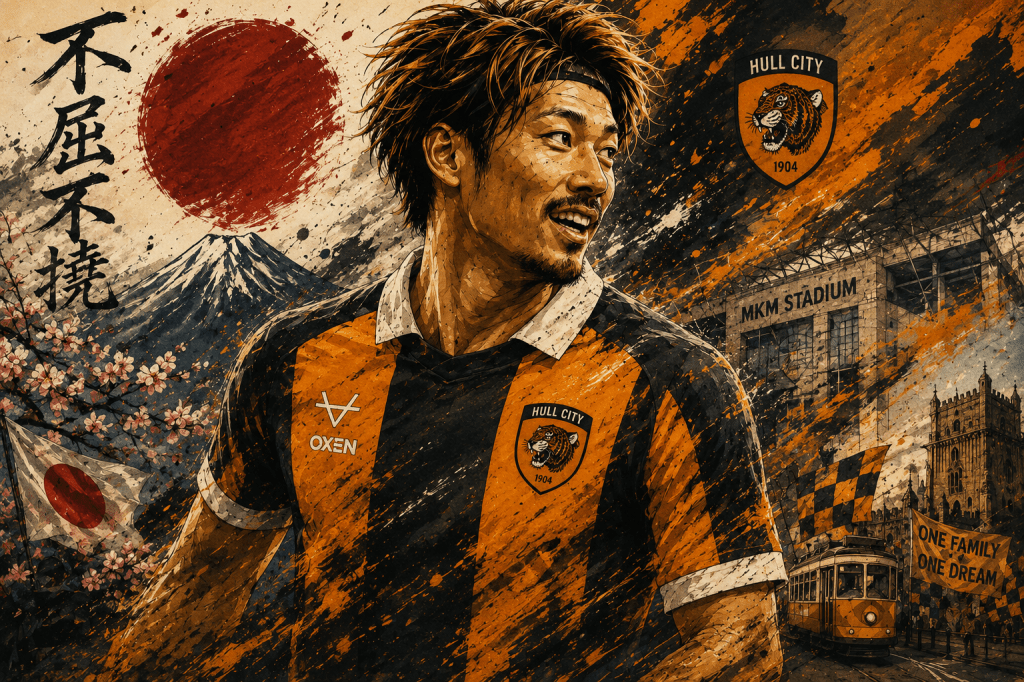
Hull’s beautiful new shirt deserves a footballer who understands simplicity
Some kits seem designed to shout.
Hull City’s 2026/27 home shirt does not.
Its amber and black stripes feel classic rather than nostalgic, confident without trying too hard.
Morita somehow looks entirely natural wearing it.
Perhaps that should not be surprising.
Everything about him carries the same understated confidence.
He has never needed extravagant celebrations.
Never relied upon viral moments.
His football mirrors the shirt itself.
Elegant. Balanced. Timeless.
What Hull City need to stay up
Premier League survival will demand more than one signing.
Hull need greater defensive resilience.
They need fewer emotional swings within matches.
They need midfielders capable of protecting possession long enough for the team to recover its shape rather than constantly inviting another wave of pressure.
Above all, they need experience that remains calm when everyone else begins rushing.
That is exactly what Morita offers.
His numbers from Portugal tell part of the story through tackles, interceptions and recoveries.
His personality tells the rest.
Hull have signed someone who has won league titles, played Champions League football, handled derby pressure and experienced international heartbreak.
Those experiences cannot guarantee survival.
They can make surviving feel more believable.
The final chapter has not been written
Football careers rarely follow neat storylines.
Morita has already climbed from Kawasaki Frontale to Santa Clara before conquering Portugal with Sporting.
The obvious next destination might have been another Champions League club.
Instead, he chose uncertainty.
That decision says plenty.
This season is not about collecting medals.
It is about proving that excellence survives outside comfort.
If Hull stay in the Premier League, Morita’s fingerprints are likely to be everywhere without many supporters noticing.
That has always been his gift.
The best holding midfielders rarely announce themselves.
They simply make everyone around them better.
Perhaps Hajime Moriyasu will notice from Japan.
Perhaps he will not.
Either way, the climax Morita spoke about has finally begun.
And it starts not beneath Lisbon’s sunshine, but among the amber and black of East Yorkshire, where Hull City hope their newest conductor can keep the orchestra playing long enough to hear another season of Premier League football.