
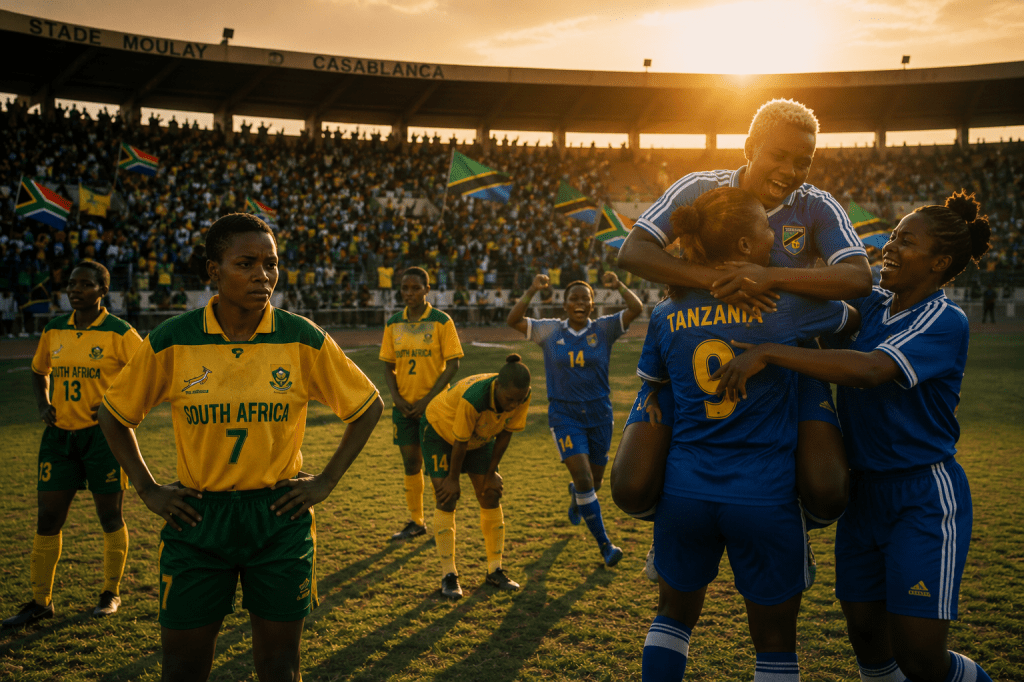
For eighty-six minutes, the match followed a familiar pattern.
South Africa had the ball. Tanzania had the belief.
By the eighty-seventh, only one of those things mattered.
Hasnath Ubamba’s late strike sealed a famous 2-1 victory for Tanzania in Casablanca, handing the Twiga Stars one of the biggest wins in their history and producing the first genuine shock of the 2026 Women’s Africa Cup of Nations. It was the kind of result that changes the complexion of an entire tournament, reminding every contender that reputation offers no protection once the whistle blows.
South Africa arrived in Morocco carrying the weight of expectation. Tanzania arrived carrying possibility.
Only one left with three points.
Tanzania Turn Discipline Into A Defining Victory
Opening matches are supposed to settle nerves.
Instead, this one unsettled the tournament.
Few sides entered WAFCON 2026 with a greater gap in perceived pedigree than these two. South Africa remain one of Africa’s modern powerhouses, regular World Cup participants and one of the continent’s benchmark teams under Desiree Ellis. Tanzania, meanwhile, continue to build steadily, improving with each tournament appearance but still viewed as outsiders capable of causing problems rather than winning headlines.
They changed that narrative on Monday evening.
The final statistics suggested South Africa had largely controlled proceedings. The scoreboard suggested something entirely different.
Tanzania defended with remarkable organisation, survived sustained periods without possession and punished the moments that mattered.
Football rarely rewards the team with the most touches.
It rewards the team with the best timing.
South Africa Had The Ball. Tanzania Had The Answers
This was never a performance built on domination.
It was built on resilience.
South Africa finished with approximately 64% possession, produced 21 shots, forced repeated saves and accumulated 2.67 expected goals. Desiree Ellis’ side controlled territory throughout much of the contest, circulating possession patiently through midfield and repeatedly forcing Tanzania deeper inside their own defensive third.
Yet every wave met resistance.
The Twiga Stars finished with an extraordinary 44 clearances, including 25 after half-time, producing one of the tournament’s grittiest defensive displays. Every block, interception and recovery slowly drained South Africa’s momentum while strengthening Tanzania’s conviction that something special might be unfolding.
By the closing stages, defending had become its own form of attack.
The Players Who Changed The Match
Diana Msewa Struck First
South Africa had looked increasingly likely to open the scoring.
Instead, Tanzania landed the first meaningful blow.
In the 37th minute, Asha Rashid released Diana Msewa, who calmly finished beyond Andile Dlamini to stun South Africa and reward Tanzania’s patience on the counter-attack.
It was a reminder that tournament football rarely belongs exclusively to the side dominating possession.
Sometimes it belongs to the side waiting for one perfect moment.
Bambanani Mbane Responded Like A Leader
Deep into first-half stoppage time, veteran defender Bambanani Mbane stepped forward to restore parity, ensuring South Africa entered the interval level rather than chasing the game.
The equaliser felt significant.
Momentum appeared to swing back towards Banyana Banyana, whose pressure continued almost immediately after the restart.
But Tanzania never panicked.
Hasnath Ubamba Became The Hero
Bakari Shime’s decisive intervention came early in the second half.
Introducing Hasnath Ubamba added fresh pace to Tanzania’s transitions just as South Africa committed increasing numbers forward.
The gamble paid off perfectly.
With three minutes remaining, Tanzania launched another swift counter-attack. Ubamba found space, stayed composed and fired home the goal that transformed belief into one of the biggest results of the tournament’s opening round.
Some substitutes change matches.
Ubamba changed perceptions.
Najiat Idrisa And Tanzania’s Defence Refused To Break
The winning goal will dominate highlight reels.
The defensive performance deserved equal billing.
Goalkeeper Najiat Idrisa anchored a backline that seemed determined to repel everything South Africa created. Whether claiming crosses, making key saves or organising defenders under relentless pressure, Idrisa provided the calm presence behind one of the competition’s standout defensive displays.
In front of her, Tanzania’s defenders threw themselves into blocks, won aerial duels and cleared danger with remarkable consistency.
Forty-four clearances tells only part of the story.
The timing of them tells the rest.
South Africa Created Enough To Win
This defeat will frustrate Desiree Ellis more than concern her.
There were positives.
South Africa moved the ball well, generated quality opportunities and controlled large stretches of possession through experienced figures including Linda Motlhalo and Refiloe Jane. Second-half substitutions, including Nthabiseng Majiya, Ronnel Donnelly and Isabella Ludwig, added fresh attacking impetus as Banyana Banyana searched for a winner.
Ludwig, one of the tournament’s most anticipated young talents after her outstanding rise with Mamelodi Sundowns, showed flashes of the creativity that has generated growing interest in Isabella Ludwig stats and Isabella Ludwig goals, but even her intelligent movement could not unlock Tanzania often enough during the closing stages.
South Africa finished with superior possession.
Superior shots.
Superior expected goals.
Not superior finishing.
A Statement That Echoes Beyond Group B
Every major tournament produces one early result that forces everyone else to pause.
This felt like that moment.
For Tanzania, these are three points that could reshape their campaign and elevate confidence throughout the squad. More importantly, they reinforce the growing sense that Africa’s emerging nations are rapidly closing the gap on its traditional heavyweights.
For South Africa, the road becomes immediately more complicated.
There remains ample quality to recover and challenge for another deep run, but the margin for error has disappeared after the opening night.
As supporters around the continent checked the latest WAFCON scores, this was the result few expected to see.
Perhaps they should have.
Because for ninety unforgettable minutes in Casablanca, Tanzania did not play like outsiders hoping to survive another Women’s Africa Cup of Nations fixture.
They played like a team determined to change the story of WAFCON 2026.






One response to “Tanzania Stun Banyana Banyana As Ubamba’s Late Winner Rewrites The WAFCON Script”
[…] Results age quickly. […]
LikeLike