
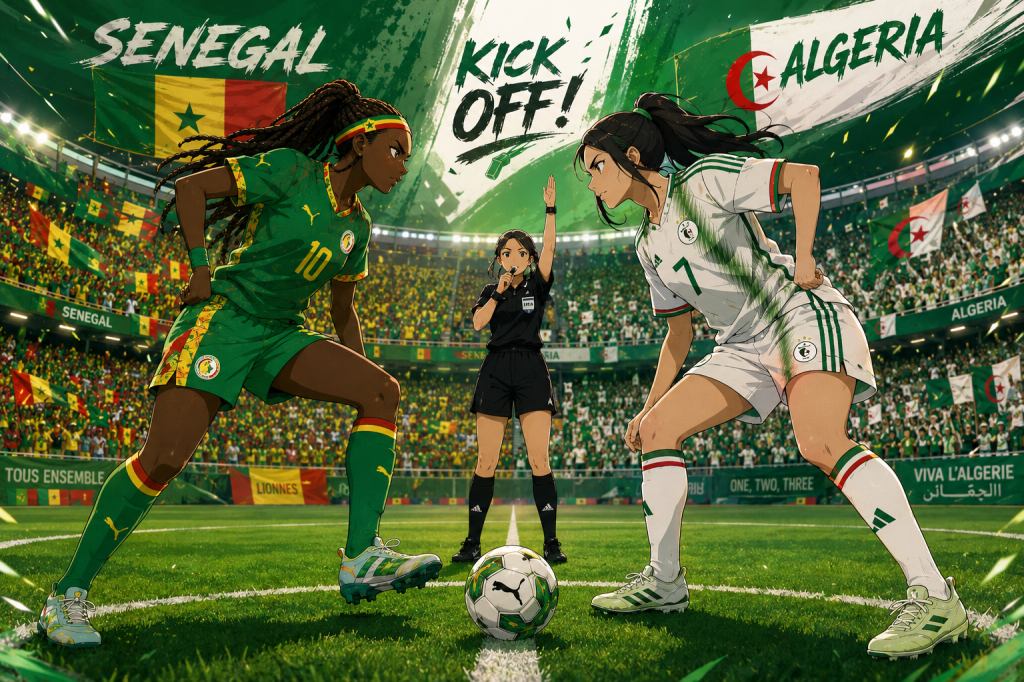
Some tournaments begin with fireworks.
Others begin with a reminder that football has a remarkably long memory.
The WAFCON 2026 fixtures could hardly have produced a more intriguing opening act than Senegal against Algeria. Before a ball has even been kicked elsewhere in Morocco, two nations arrive carrying entirely different burdens. One wants to prove its dominance was no accident. The other simply wants the nightmares to stop.
Sunday evening at the Stade Olympique de Rabat is officially only the first Group A fixture.
It doesn’t feel like it.
This is the opening chapter of what many already consider the tournament’s Group of Death. Morocco, Kenya, Algeria and Senegal all harbour ambitions beyond simply surviving the group. Reach the semi-finals and the reward is not only a shot at continental glory but automatic qualification for the 2027 FIFA Women’s World Cup in Brazil.
That changes everything.
Nobody wants to spend the final group match calculating goal difference and hoping another result goes their way. Three points here remove an enormous amount of pressure before either side has to contend with tournament hosts Morocco.
Like many opening matches, caution will probably be discussed beforehand.
Whether anyone actually follows that advice is another matter.
Rabat Still Carries Its Own History
Football has an irritating habit of pretending every tournament exists in isolation.
It doesn’t.
Rabat already carries emotional baggage for Senegal. The men’s side left this very city after the chaotic conclusion to the 2025 Africa Cup of Nations final, a night remembered as much for controversy as football. Different players. Different competition. Entirely different circumstances. Then the paperwork followed, Senegal stripped of the title and awarded to Morocco.
The Moroccan crowd won’t let them forget. However, it’s not like they are suddenly going to welcome Algeria with open arms.
Senegal Have Owned This Rivalry against Algeria Women
There are rivalries built on equality.
This hasn’t been one.
Senegal have won the last two meetings, convincing victories of 4-0 and 3-0. The most recent meeting, only twelve months ago, felt almost procedural. Senegal pressed high, won physical battles and gradually overwhelmed Algeria.
Minor moments have a habit of sticking around.
For Algeria, those ninety minutes certainly have.
Results like that don’t simply disappear because a new tournament begins. Coaches insist every match is independent. Players repeat the same line. It sounds sensible.
Then somebody scores after twenty minutes, and everyone remembers exactly what happened last time.
That tends to happen when sport refuses to let history leave quietly.
The encouraging news for Algeria is that this squad doesn’t entirely resemble those previous defeats.
Farid Benstiti has arrived carrying a broom rather than a paintbrush.
Seven WAFCON debutants have entered the squad as Algeria attempt to replace familiarity with hunger.
Whether inexperience proves liberating or overwhelming remains one of Sunday’s biggest questions.
Two Managers Looking at the Same Game Completely Differently
This feels like one of the tournament’s most interesting tactical match-ups.
Farid Benstiti has spent years coaching elite European clubs, and it shows. His Algeria side values structure above spectacle.
Compact defensive lines. Controlled possession. Minimal space between defenders.
Counter-attacks built through patience rather than chaos.
It isn’t always glamorous. That probably doesn’t concern him.
Across the technical area stands Senegal manager Mame Moussa Cissé, whose football feels almost like the opposite philosophy.
Press first. Ask questions later.
Senegal attempt to compress the pitch until opponents begin making decisions they never intended to make. Their physicality isn’t merely an attribute. It is part of the tactical system.
Neither approach is automatically better.
Football usually decides these arguments in wonderfully inconvenient ways.
The Players Most Likely to Decide It
Both squads possess individuals capable of changing matches within seconds.
For Senegal, everything inevitably begins with Nguenar Ndiaye.
Few players enjoy facing one opponent quite as much as she appears to enjoy facing Algeria. Four goals across the previous three meetings tell their own story, but statistics only explain part of it. Her aerial presence changes how entire defensive units position themselves.
Algeria’s captain Sofia Guellati carries perhaps the toughest assignment of the evening trying to compete with her.
If Algeria can prevent Ndiaye from dominating crosses and second balls, everything else becomes considerably easier.
Behind her sits another key figure.
Goalkeeper Adji Ndiaye, still only nineteen, completed WAFCON qualifying without conceding a single goal and has already attracted continental recognition. Calmness tends to spread through defences, and she possesses plenty of it.
Algeria’s hopes revolve around different personalities.
Inès Boutaleb provides rhythm in midfield, while Lina Boussaha remains their creative heartbeat and emotional leader.
Then there is Lynda Bendris, perhaps the tournament’s most fascinating individual story.
Her career briefly appeared to stall at Marseille before dropping into France’s third tier with AS Cannes. Rather than disappearing, she exploded. Five goals in twelve extraordinary minutes became impossible to ignore, before an 87th-minute penalty rescued Algeria against Zambia during their final warm-up fixture.
“When the club trusts you, you play freely,” she recently reflected.
Football loves redemption stories.
It is less predictable about when they actually arrive.
Confidence Is a Strange Thing
Senegal enter WAFCON surrounded by two completely different narratives.
On the pitch, they look increasingly established among Africa’s strongest women’s teams.
Off it, preparations have hardly been ideal.
Administrative disputes surrounding unpaid hotel bills created unnecessary headlines only days before departure. Players become remarkably skilled at saying distractions don’t matter.
Sometimes they don’t.
Sometimes they absolutely do.
Algeria’s confidence comes from somewhere quieter.
Benstiti hasn’t promised revolution.
He has simply removed several familiar names and invited younger players to prove they belong.
Supporters rarely object to rebuilding when previous versions weren’t working anyway.
A Bigger Prize Waits Beyond Sunday
It is tempting to view this simply as Algeria against Senegal.
It isn’t.
Lurking behind every decision throughout WAFCON sits qualification for Brazil.
The Senegal World Cup dream has never felt closer. Reach the semi-finals and history follows naturally.
Algeria see exactly the same opportunity.
Lose the opening fixture, however, and suddenly every conversation becomes uncomfortable. Morocco still await. Kenya remain dangerous opponents.
Opening matches often shape tournaments more than people realise.
Nobody is eliminated on Sunday.
Someone could make life considerably easier.
Someone else might soon be checking departure boards and quietly hoping they are not booking an early journey home via Air Senegal.
That would be an expensive reminder that football, much like memory, rarely offers refunds.
As Morocco’s evening sky settles over Rabat, two teams carrying very different histories will begin chasing exactly the same future. One wants to continue writing a familiar script. The other desperately wants to throw the old one away.
The first ninety minutes of WAFCON 2026 should tell us which story has the stronger ending.
Desert winds grow still
Lionesses test old scars
Morning remembers






One response to “Senegal vs Algeria Preview: Old Wounds, New Faces and the First Battle of WAFCON 2026”
[…] 2-0 loss to Algeria and Kenya’s bruising 4-0 defeat against hosts Morocco did more than leave both nations rooted to […]
LikeLike