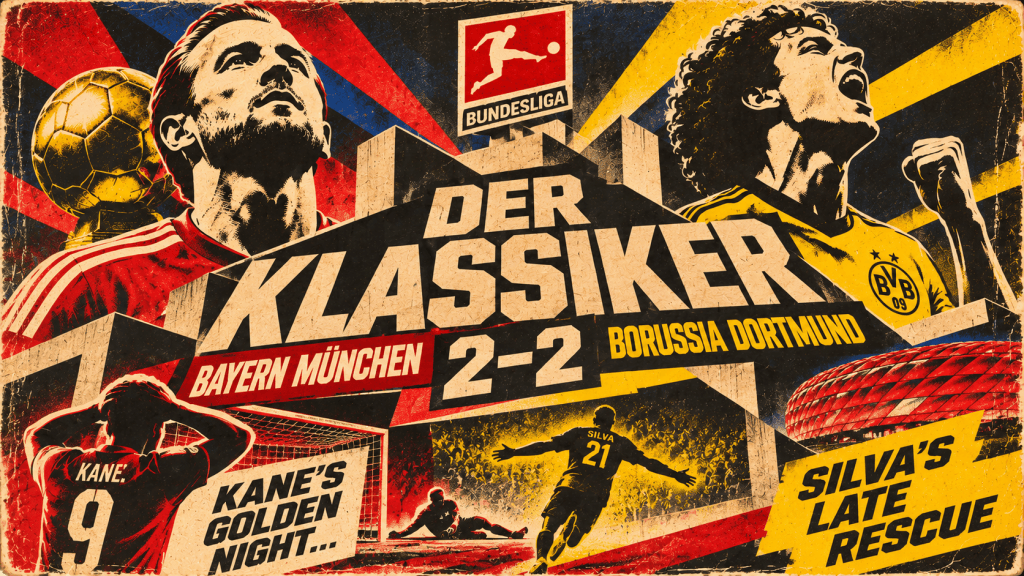
For a few seconds, Harry Kane could only stare at the crossbar.
The Allianz Arena had spent the evening celebrating him. There were golden banners, shimmering ponchos, specially designed boots and even a rendition of Land of Hope and Glory. Bayern Munich’s newly crowned Ballon d’Or winner had brought his family onto the pitch before kick-off to receive the sort of reception most footballers spend their entire careers imagining.
Now, standing twelve yards from goal, he had just smashed a penalty against the woodwork.
It was the 56th minute of Der Klassiker, Bayern were leading Borussia Dortmund 1–0, and Kane had been presented with an opportunity to make his special evening even more memorable.
Instead, the ball bounced away.
It would not be the last time.
By the end of an extraordinary Halloween encounter, Bayern had struck the woodwork four times, suffered three injuries and somehow allowed Dortmund to escape Munich with a 2–2 draw.
And the man responsible for Dortmund’s late rescue?
A Portuguese forward who had spent much of his career being reminded how much Wolverhampton Wanderers once paid for him.
Football does enjoy an unlikely protagonist.
The Ballon d’Or, a Crossbar and a Rather Expensive Halloween
There was something almost theatrical about Bayern’s preparations for this particular Klassiker.
Kane had become the first Bayern player since Karl-Heinz Rummenigge, 45 years earlier, to win the Ballon d’Or. He was also the first Englishman to receive the award in 25 years.
His wife Katie and their four children accompanied him onto the pitch, where 75,024 supporters celebrated an individual achievement that also reflected Bayern’s enduring ability to attract and develop elite footballers.
The occasion was enormous.
Unfortunately, Dortmund had not travelled to Munich to participate in a coronation.
Niko Kovač’s side arrived unbeaten in the Bundesliga, level with Bayern on 18 points after seven matches. Both teams had recorded five victories and two draws, although Bayern’s vastly superior goal difference kept them top.
For once, this was a Klassiker with genuine early-season title implications rather than another opportunity to measure how far Dortmund had fallen behind.
Bayern began aggressively.
Michael Olise struck the crossbar after ten minutes, an early warning that Dortmund’s defensive organisation would be tested repeatedly.
Konrad Laimer eventually broke through in the 38th minute, converting a rebound to give Bayern the lead.
The Austrian’s performance was particularly impressive. Operating from the right, he contributed three shots on target while continually supporting Bayern’s attacking movements.
But there was a problem.
Bayern were creating chances without building the sort of advantage their dominance deserved.
And when Kane missed his penalty, Dortmund suddenly had something to believe in.
Four Pieces of Woodwork and Two Points That Got Away
Serhou Guirassy equalised in the 60th minute.
Six minutes later, Dayot Upamecano restored Bayern’s advantage, heading home after Kane helped the ball into his path.
It was a useful contribution from the Englishman, although probably not the moment he had imagined when selecting his white-and-gold boots.
Kane subsequently struck the post again in the 75th minute.
Then, in the fifth minute of stoppage time, 18-year-old Lennart Karl curled an ambitious effort against the crossbar.
Four separate encounters with the frame of Gregor Kobel’s goal.
None ended particularly well for Bayern.
The statistics made their frustration understandable.
Der Klassiker: Match statistics
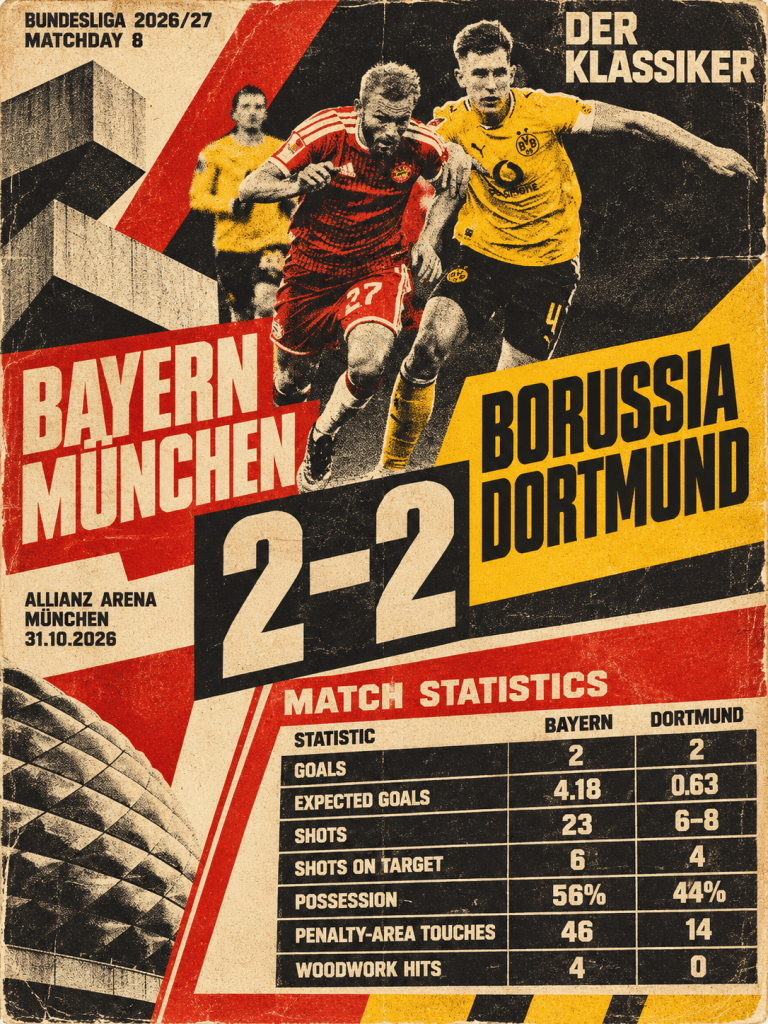
Bayern generated more than four expected goals while Dortmund produced considerably less than one.
Ordinarily, those numbers describe a comfortable home victory.
Instead, they illustrate the difference between controlling a football match and actually winning it.
Kobel deserves considerable credit for his contribution, while Dortmund’s defenders repeatedly absorbed pressure in areas where Bayern might ordinarily expect to score.
Yet there is only so much defensive organisation can accomplish when the opposition keep finding the woodwork.
Sometimes, survival requires a little assistance from the furniture.
Fábio Silva: From Wolves’ £35 Million Gamble to Dortmund’s Unlikely Hero
In September 2020, Wolverhampton Wanderers paid Porto approximately £35 million for Fábio Silva.
He was 18 years old.
The fee was a club record, and with it came expectations that were difficult for a teenager to satisfy, particularly one arriving in the Premier League with relatively limited senior experience.
Wolves were initially an ambitious Premier League club, but their fortunes deteriorated over subsequent seasons. Silva found himself in and out of the side, frequently struggling for consistent opportunities and goals.
He was young, expensive and playing in an environment that became increasingly unforgiving.
It was an awkward combination.
The club eventually began sending him elsewhere.
First came Anderlecht in Belgium, where he enjoyed a more productive spell. Then PSV Eindhoven, followed by Rangers in Scotland and Las Palmas in Spain.
Different countries, different managers, different tactical expectations.
There was clearly talent there, but establishing a permanent footballing identity proved more difficult.
His career increasingly resembled that of a promising player permanently auditioning for his next opportunity.
When Dortmund eventually acquired him for a reported €27 million, it represented another substantial investment in a footballer whose reputation had not always matched his performances.
And even in Germany, things were not immediately straightforward.
Silva endured fluctuating playing time and criticism, with Felix Nmecha becoming an important source of encouragement.
The Portuguese forward later acknowledged how much that support meant during difficult periods.
That makes what happened in Munich particularly satisfying.
Introduced in the 76th minute, Silva had barely thirteen minutes of normal time to influence one of European football’s most recognisable fixtures.
In the 89th minute, fellow substitute Konstantinos Karetsas pressed Aleksandar Pavlović inside Bayern’s penalty area.
The resulting turnover reached Silva.
He turned through a congested penalty box and drilled a low shot beyond Jonas Urbig.
The opportunity carried an estimated expected-goals value of just 0.05.
A five-per-cent chance.
It was enough.
From an expensive teenager struggling for minutes at Wolves to the player responsible for silencing the Allianz Arena in Der Klassiker.
There is a temptation to call this redemption, although one goal cannot settle every question about a player’s career.
What it can do is change the conversation.
For years, Silva was discussed through the enormous transfer fee Wolves had paid. Against Bayern, his contribution was measured in something considerably more meaningful.
A point earned against a title rival.
A moment of composure under enormous pressure.
And perhaps the clearest indication yet that his career should not be permanently defined by what happened at Molineux.
Bayern’s Injury List Was Becoming a Match of Its Own
While Dortmund celebrated their escape, Bayern had rather more uncomfortable matters to consider.
Ismael Saibari suffered a serious-looking injury following a collision with Kobel in the 24th minute.
Seven minutes later, Serge Gnabry departed with a hamstring problem.
Then Olise was forced off in the 84th minute because of knee discomfort.
Three attacking players injured in one match.
With Jamal Musiala and Luis Díaz already unavailable, Bayern’s impressive squad depth was suddenly being examined rather closely.
There was also the unusual sight of Vincent Kompany missing from the touchline after illness, leaving assistant Aaron Danks in charge.
Joshua Kimmich, meanwhile, had returned following the death of his father, adding a deeply personal dimension to an already emotionally charged evening.
Bayern’s performance was impressive under difficult circumstances.
Their ability to sustain attacking pressure despite repeated disruptions demonstrated the strength of Kompany’s established system.
But it also raised a question.
How long can Bayern continue playing with such intensity if their attacking options keep disappearing?
Dortmund Didn’t Dominate. They Did Something Almost as Important.
Kovač will not pretend his team were the better side.
They weren’t.
Bayern controlled possession, progressed through Kimmich and Pavlović, and repeatedly pushed Dortmund towards their own penalty area.
Dortmund’s compact defensive shape frequently became a desperate exercise in protecting space.
Yet their resilience deserves recognition.
Daniel Svensson worked tirelessly against Olise, while Nico Schlotterbeck and Waldemar Anton helped withstand sustained pressure.
Jobe Bellingham also offered moments of encouragement, despite having an early goal disallowed following an obstruction on Urbig.
Most importantly, Dortmund’s substitutions changed the match.
Karetsas created the decisive turnover.
Silva finished it.
These were not the contributions of a side content merely to lose respectably.
Dortmund had arrived level on points with Bayern and departed still unbeaten.
In a title race historically dominated by the Bavarians, that matters.
For Bayern, the draw felt like two points surrendered.
For Dortmund, it felt like evidence that they could suffer against Germany’s strongest team without surrendering.
There is a difference.
Der Klassiker: Frequently Asked Questions
Is Fábio Silva a good player?
Fábio Silva is a technically capable Portuguese forward with intelligent movement, close control and finishing ability. His development has been inconsistent, particularly during his time at Wolves, but his late equaliser against Bayern demonstrated his potential to influence major matches.
How much did Wolves pay for Fábio Silva?
Wolverhampton Wanderers paid approximately £35 million to sign Fábio Silva from FC Porto in September 2020, making him their record signing at the time.
Where is Fábio Silva now?
As of October 2026, Fábio Silva plays for Borussia Dortmund in the German Bundesliga, having joined from Wolverhampton Wanderers.
Who did Fábio Silva play for?
Fábio Silva has represented FC Porto, Wolverhampton Wanderers, Anderlecht, PSV Eindhoven, Rangers, Las Palmas and Borussia Dortmund during his senior career.
Has Dortmund ever beaten Bayern Munich?
Yes. Borussia Dortmund have beaten Bayern Munich numerous times in Bundesliga, German Cup and Super Cup fixtures. Their notable victories include the 5–2 DFB-Pokal final triumph in 2012 and a 2–1 Bundesliga victory at the Allianz Arena in the 2024–25 season, according to the supplied match history.
Who is Bayern Munich’s biggest rival?
Borussia Dortmund are widely considered Bayern Munich’s biggest modern competitive rivals, particularly in Bundesliga title races. However, Bayern also have historic rivalries with clubs including 1860 Munich and Borussia Mönchengladbach.
What is Bayern Munich vs Borussia Dortmund called?
The fixture is known as Der Klassiker, a name used to describe Germany’s highest-profile modern domestic football rivalry.
A Golden Night That Belonged to Someone Else
By the final whistle, Kane’s Ballon d’Or celebration had become something altogether stranger.
The best player in the world had missed a penalty, struck the woodwork twice and watched his team surrender victory despite overwhelming statistical superiority.
Dortmund had spent much of the evening defending, surviving and occasionally wondering when the next Bayern attack might arrive.
Yet their supporters were the ones celebrating at the end.
And somewhere in the middle of that celebration stood Fábio Silva.
A player who had spent years carrying the burden of a transfer fee he never decided, moving between clubs and searching for somewhere to belong.
On Halloween in Munich, he needed only one chance.
Perhaps that is the most interesting thing about this Klassiker.
Bayern had the golden footballer, the golden banners and almost every meaningful attacking statistic.
Dortmund had a forward who had spent much of his career trying to convince people he was worth believing in.
For one evening, that was enough.