
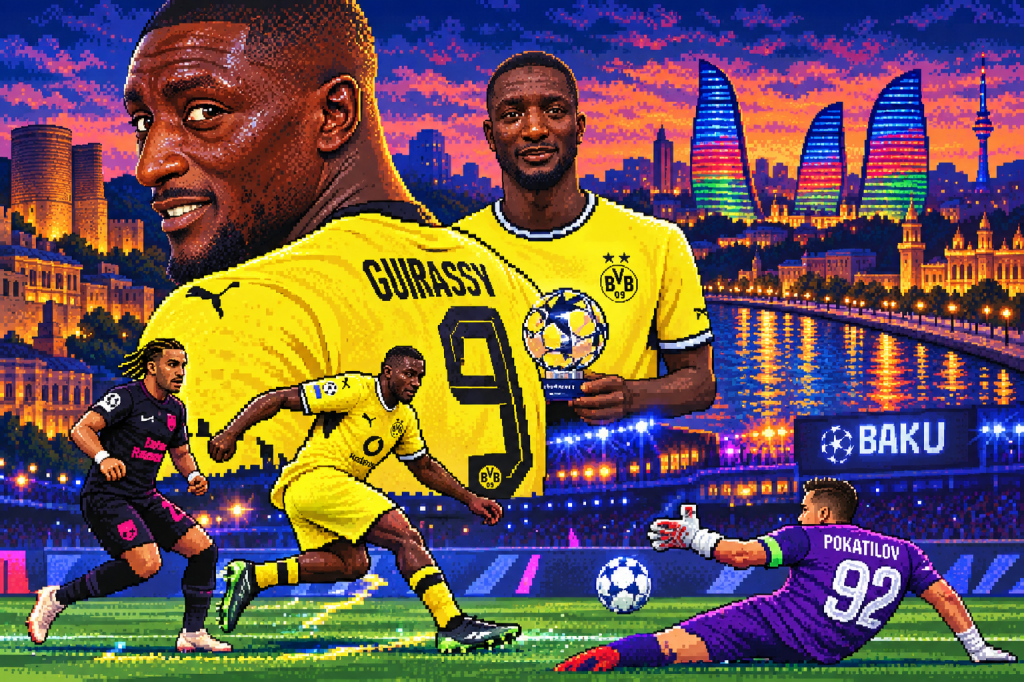
Serhou Guirassy scored twice as Borussia Dortmund beat Sabah FK 2–1 in the UEFA Champions League on Tuesday evening, ending a five-match personal goal drought and reaching 23 goals in just 31 appearances in the competition. Aden McCarthy equalised for Sabah in the 39th minute, but Guirassy’s second goal, eight minutes after half-time, secured three points for Niko Kovač’s side.
Only three players in Champions League history have reached 23 goals faster than the Guinea international. Erling Haaland, Filippo Inzaghi and Ruud van Nistelrooy. Not bad company for a striker whose recent failure to score had apparently become a matter of public concern.
Dortmund finished with 22 shots, nine on target and approximately 3.72 expected goals (xG), yet still needed their centre-forward to rescue them from an uncomfortable evening against a club founded in 2017.
The result was important. The performance was more complicated. And Guirassy, who has spent much of his career being considered good rather than extraordinary, had another evening that suggested the distinction might be worth reconsidering.
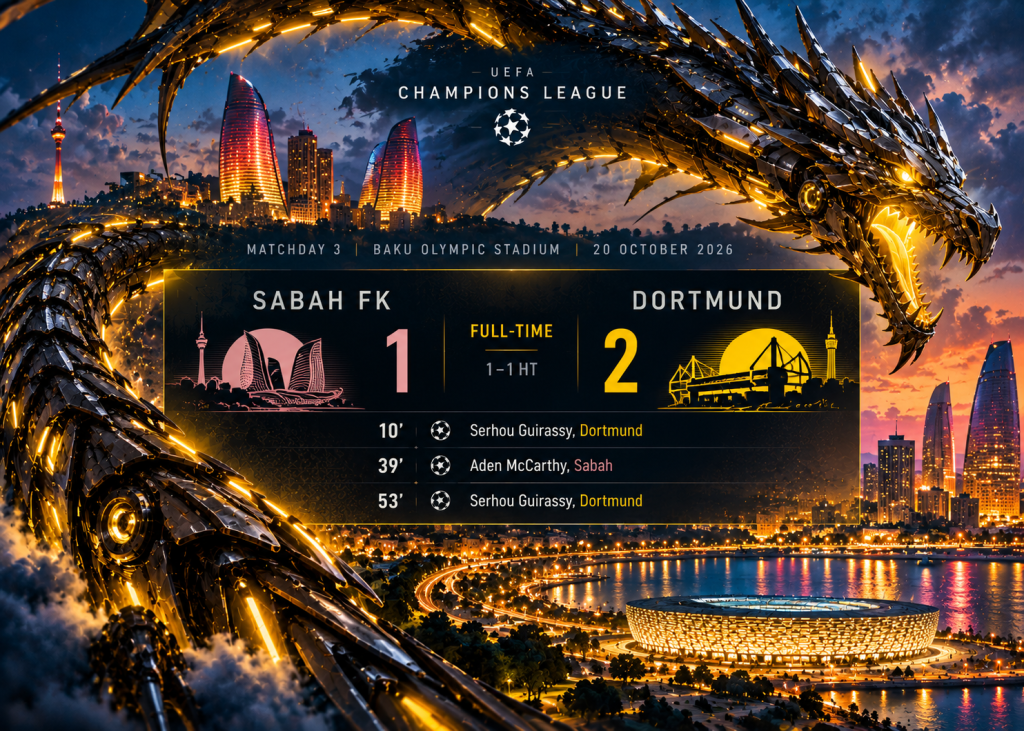
Sabah 1–2 Borussia Dortmund: Match summary and goals
Football treats a striker who stops scoring for a few weeks in a peculiar way. The player can continue making intelligent runs, occupying defenders and contributing to attacks, but once the goals dry up, everything else becomes supporting evidence in a prosecution.
Guirassy had gone five matches without finding the net. For a forward who scored 13 Champions League goals in his debut Dortmund campaign, that was enough to spark the familiar questions about confidence, sharpness, and whether opponents had finally figured him out.
It felt a little premature.
Dortmund themselves had hardly been thriving. Their previous three matches had brought a defeat to Bodø/Glimt and draws against Union Berlin and Werder Bremen. Kovač’s attack had become predictable, and the manager had been encouraged, politely but firmly, to do something about it.
A trip to Azerbaijan offered a chance to reset the narrative, although Sabah had already beaten Slavia Prague 2–0 and weren’t particularly interested in becoming a convenient recovery exercise for a Bundesliga heavyweight.
Guirassy needed ten minutes.
Fábio Silva’s movement helped create the opening, with Felix Nmecha involved in the attack before Guirassy reacted quickest to the loose ball and finished close range.
It was not a particularly elaborate goal. It didn’t need to be.
The best centre-forwards often make their living from moments that look straightforward once the ball has crossed the line. Guirassy anticipated where it would land, positioned himself accordingly and scored. The sort of thing that looks simple until somebody else tries it and sends the ball into the advertising boards.
One goal was enough to end the drought.
The second would make it a rather more significant evening.
A Club Nine Years Old Wasn’t Supposed to Make This Difficult
Sabah FK’s existence is shorter than several Dortmund players’ professional careers. Founded in Masazır in September 2017, the Azerbaijani club won its first domestic league title in 2026 and earned the chance to entertain one of European football’s established names.
For Sabah, the occasion represented a considerable achievement before anyone kicked a ball. For Dortmund, it represented a fixture they were expected to win, preferably without having to explain themselves afterwards.
That is the strange imbalance of European football. One club can spend years working towards an evening that another considers a potentially embarrassing administrative obligation.
The 55,000 spectators at Baku Olympic Stadium were unlikely to care much about Dortmund’s expectations.
Valdas Dambrauskas set Sabah up in a compact 4-2-3-1, allowing Dortmund possession while looking to attack the spaces behind their advanced wing-backs. Joy-Lance Mickels offered pace on the break, and Dortmund’s defensive line occasionally looked less comfortable than the visitors’ territorial dominance suggested.
In the 30th minute, Mickels had the ball in the net, but an offside decision denied him an equaliser.
It was a warning.
Nine minutes later, Sabah found another route.
Tymoteusz Puchacz delivered a dangerous set-piece and Aden McCarthy rose to head past Gregor Kobel. A centre-back equalising against Dortmund in front of a packed stadium was hardly the script the visitors had brought.
McCarthy had made it 1–1. Honestly, it was a bigger pop than when RVD won the WWE title from John Cena at ECW One Night Stand in 2006.
At half-time, Kovač had a problem. Again.
Guirassy’s Second Goal Changed the Result. His Record Changed the Conversation.
Eight minutes after the restart, Joey Veerman delivered the ball into the penalty area, and Guirassy finished with a delicate volley.
It was almost irritatingly efficient.
Sabah had spent much of the evening organising themselves around the threat of Dortmund’s centre-forward, often committing two defenders to his movement. Yet one carefully delivered ball and a moment of separation were enough to undo that work.
Guirassy had scored his second. Dortmund led 2–1.
More importantly for the broader story, the goal brought the striker to 23 Champions League goals in 31 appearances.
Consider the names he reached that milestone faster than.
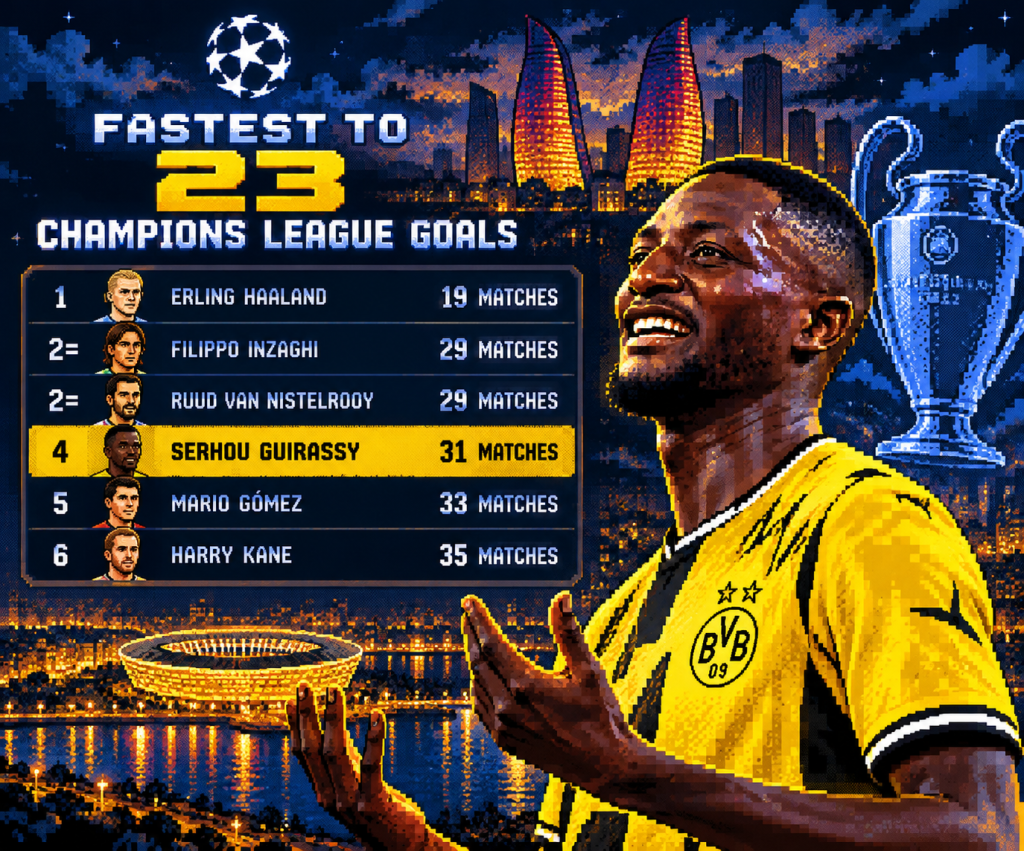
Guirassy reached the mark quicker than Karim Benzema, Robert Lewandowski, Kylian Mbappé and Lionel Messi.
There are qualifications, naturally. Champions League appearances occur at different stages of players’ careers, and scoring rates are influenced by teammates, opponents and tactical roles.
But 23 goals in 31 games isn’t a statistical curiosity you can dismiss with a paragraph about sample sizes.
It is exceptional.
Dortmund’s Tactical Changes Worked. Their Finishing Didn’t.
Kovač deserves credit for recognising that his attack needed something different.
His 3-1-4-2 system gave Guirassy a strike partner in Fábio Silva, while Veerman operated deeper in midfield and Carney Chukwuemeka pushed into advanced positions.
In theory, this gave Dortmund more ways to break down Sabah’s defensive structure. In practice, it worked often enough to make the final score look rather peculiar.
Veerman completed 79 passes, created three chances and supplied the winning assist. Chukwuemeka, making his first start of the season on his 23rd birthday, contributed five key passes.
Guirassy attempted eight shots, put four on target, and generated 1.94 xG.
Yet Dortmund still needed to defend a one-goal lead.
Silva’s movement was useful, particularly in drawing defenders away from Guirassy, but he missed two promising one-on-one opportunities. Ramy Bensebaini also had a difficult evening, with his defensive struggles and speculative shots giving Sabah hope.
Sabah goalkeeper Stas Pokatilov made six saves, including two from close range. McCarthy, already responsible for the equaliser, later made an important goal-line block to deny Guirassy a hat-trick.
Sabah vs Borussia Dortmund: Match Statistics
Dortmund generated approximately 3.72 xG from 22 attempts. That is an impressive attacking output, especially given their recent difficulty creating chances.
Sabah, however, managed 13 shots and 1.47 xG.
That is not the statistical profile of a side that spent the entire evening waiting to be beaten.
Their six offside calls show the risks they took trying to exploit Dortmund’s advanced defensive line, while their set-piece threat showed in McCarthy’s equaliser.
Kovač could reasonably argue that his team deserved to win. The numbers support him.
How Good Is Serhou Guirassy? Better Than His Reputation Suggests.
The curious thing about Guirassy’s rise is how long it took for European football to recognise what was happening.
Born in Arles, France, in March 1996, Guirassy spent his early professional years moving through clubs where his potential was apparent, but his eventual status as one of Europe’s most productive strikers was far from guaranteed.
He played for Laval, Lille, Auxerre, Köln, Amiens and Rennes before arriving at Stuttgart, initially on loan in 2022.
His 2023/24 Bundesliga campaign changed everything.
Guirassy scored 28 league goals in 28 appearances, helping Stuttgart finish second in the Bundesliga. It was an extraordinary return from a player previously regarded as a useful forward rather than an elite goalscorer.
Dortmund signed him in July 2024 for approximately €18 million, activating a release clause in his Stuttgart contract.
For a club operating in a transfer market where merely promising strikers can command fees several times that amount, it has proved remarkable business.
Guirassy followed his Stuttgart breakthrough with 13 goals in the 2024/25 Champions League, sharing the competition’s Golden Boot with Barcelona’s Raphinha.
He now has 21 European goals for Dortmund, only three short of Marco Reus’s club record of 24.
There is something satisfying about a player reaching this level at 30, without the carefully managed teenage-superstar narrative that usually accompanies modern football’s biggest names.
Guirassy did not arrive with a global marketing campaign built around his potential.
He just kept scoring.
Serhou Guirassy Stats: A Champions League Record Worth Remembering
His achievements extend beyond Dortmund.
He is also only the second African footballer after George Weah to finish a Champions League campaign as its leading scorer.
For Guinea, a country whose football history has rarely received the attention afforded to Africa’s more established international powers, his achievements carry particular significance.
Guirassy represents the Guinea national team despite having played youth international football for France.
His international identity is more than a footnote in his club career story. Guinea has produced talented footballers across generations, but few have achieved the individual European scoring distinction Guirassy now holds.
Of the 37 Champions League goals attributed to Guinean footballers in the supplied research, 23 belong to him.
That is approximately 62 per cent.
A country can spend decades hoping to produce one player who can perform regularly at Europe’s highest level. Guirassy has become that player, although he is unlikely to receive the same attention as some of the competition’s more commercially recognisable forwards.
How much did Dortmund pay for Guirassy?
Borussia Dortmund paid approximately €18 million to sign Guirassy from VfB Stuttgart in July 2024, with reports putting the release clause at €17.5 million to €18 million. He signed a contract running until June 2028.
Which national team does Serhou Guirassy play for?
Guirassy represents Guinea at senior international level. He was born in France and previously represented France at youth level before making his senior international debut for Guinea in 2022.
What the Result Means for Dortmund and Sabah
Dortmund’s victory moved them to six points after three Champions League matches, provisionally lifting them to 11th in the league-phase standings according to the supplied post-match table.
It also ended a four-match away-from-home losing streak in the competition.
Kovač will appreciate both developments, although neither removes the need for improvement.
His tactical adjustments created opportunities, Veerman showed why Dortmund wanted him, and Guirassy showed that five matches without scoring weren’t enough to question his ability.
For Sabah, the defeat leaves them with three points from three matches.
That is hardly disastrous for a club experiencing its first Champions League campaign. Having beaten Slavia Prague and pushed Dortmund close, they have demonstrated that their presence in the competition is more than a ceremonial achievement.
Pokatilov and McCarthy deserve particular recognition. Without their interventions, the scoreline might have looked considerably less respectable.
Yet football rarely rewards the side that made defeat difficult.
The headlines will belong to Guirassy, as they should.
His first goal ended a personal drought. His second secured the victory. Together, they put him in a statistical category shared by some of the greatest forwards in Champions League history.