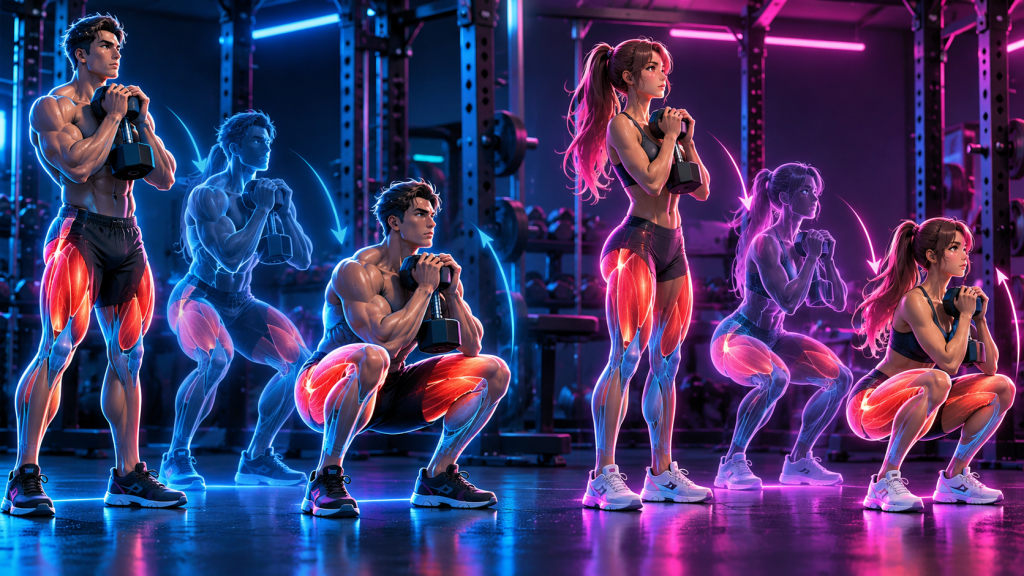
The goblet squat is one of those exercises that looks almost suspiciously simple. Pick up a dumbbell or kettlebell, hold it against your chest, squat down and stand back up.
But simple does not mean easy.
The goblet squat is a compound lower-body exercise that trains the quadriceps and glutes while demanding plenty from your core and upper back. The front-loaded weight also acts as a counterbalance, making it an excellent exercise for learning squat mechanics before progressing to heavier barbell variations. Your research dossier specifically identifies beginners, athletes, powerlifters, and general fitness users as groups that can benefit from it.
It is beginner-friendly, brutally effective for higher reps, and useful enough to stay in an experienced lifter’s programme long after they learn to squat.
In other words, don’t graduate from the goblet squat just because somebody handed you a barbell.
What Is a Goblet Squat?
A goblet squat is a squat variation performed while holding a single dumbbell or kettlebell directly in front of the chest.
Instead of placing a barbell across your back, you keep the weight close to your sternum. With a dumbbell, this usually means holding it vertically under your chin. With a kettlebell, you can grip the horns and keep the bell close to your chest.
Goblet Squat Quick Summary
| Category | Goblet Squat |
| Difficulty | Beginner to intermediate |
| Movement | Compound squat |
| Main muscles | Quadriceps, glutes |
| Secondary muscles | Hamstrings, adductors, calves |
| Stabilising muscles | Core, spinal erectors, upper back |
| Equipment | Dumbbell or kettlebell |
| Best for | Squat technique, muscle building, general strength |
| Typical reps | 5–25+ depending on goal |
Muscles Worked by the Goblet Squat
Primary Muscles
The quadriceps are major drivers of the goblet squat. Your four quadriceps muscles work to extend the knee as you stand and control knee flexion during the descent.
The gluteus maximus also contributes substantially, particularly through hip extension as you drive upwards from a deep squat.
There is good evidence for the goblet squat’s quad credentials. A 2021 study comparing goblet and landmine squats found the goblet squat better targeted quadriceps activity and produced greater vertical loading.
Secondary Muscles
Your hamstrings and adductors assist at the hip and help control the movement, while your calves support ankle stability.
There’s also some sneaky upper-body work hiding in there.
Your biceps and shoulders must keep the weight secured against your chest. That is why a heavy set of 15 goblet squats can sometimes leave your arms complaining before your legs finish their shift.
Stabilising Muscles
Your abdominals and obliques brace to keep your torso from collapsing forward, while the erector spinae help maintain spinal position.
Your lats, traps, and rhomboids also help keep the weight securely positioned and your upper body organised.
What Is the Goblet Squat Good For?
Goblet squats are great for developing the quads and glutes, teaching squat technique, building overall lower-body strength, and building confidence in deeper squat positions.
Load placement is the secret sauce.
Because you hold the weight in front of you, it provides a counterbalance that can make sitting between your hips feel much more natural than learning to squat with a barbell right away.
That makes it particularly useful for beginners.
It doesn’t become useless once you’re experienced, either. Intermediate and advanced lifters can use goblet squats for quad-focused hypertrophy work, warm-ups, paused squats, conditioning circuits, or extra leg volume without loading another heavy barbell movement.
Why Is the Goblet Squat Good?
For muscle building, the goblet squat provides plenty of knee flexion and allows the quadriceps and glutes to work through a substantial range of motion.
For strength, there is eventually a ceiling because you can only hold so much weight against your chest. However, that limitation doesn’t prevent the goblet squat from being an excellent general strength exercise.
Athletes can use it to develop lower-body force production and reinforce squatting mechanics. The movement also has clear carryover to everyday life. Sitting down, standing up and lifting something while keeping it close to your body all involve movement patterns that overlap with squatting.
And if you think goblet squats are “too easy”, try a controlled set of 20 before sending your complaint to management.
How to Do a Goblet Squat
Starting Position
Stand with your feet approximately shoulder-width apart, although your ideal stance may be slightly narrower or wider depending on your anatomy.
Turn your toes slightly outwards.
Hold one dumbbell vertically against your chest or hold a kettlebell securely by its horns. Keep the weight close so it doesn’t drift forward.
Brace your core and keep your chest controlled, rather than arching your lower back aggressively.
Execution
Begin bending your knees and hips together and lower yourself between your legs.
Keep your entire foot planted on the floor.
Allow your knees to track roughly in the same direction as your toes, rather than collapsing inward.
Descend as far as you can while maintaining control and a stable spinal position.
From the bottom position, drive both feet into the floor and extend your knees and hips until you return to standing.
Breathing
Take a breath and brace before beginning the descent.
Maintain that brace through the hardest part of the movement, then exhale as you complete the ascent. Reset before beginning your next repetition.
Common Goblet Squat Mistakes
One common mistake is letting the weight drift away from your body. The farther it travels from your chest, the harder your shoulders and upper back have to work to support it.
Another is letting your knees collapse inward. Keep them tracking in line with your feet throughout the repetition.
Heels lifting is another warning sign. It may indicate that your stance or depth needs adjusting, or that ankle mobility is limiting your squat.
Then there’s the classic gym crime: adding weight until your squat becomes a completely different exercise.
A heavier dumbbell isn’t progress if your depth disappears and every repetition looks like you’re negotiating with gravity.
Finally, don’t force depth. Squat as deeply as you can while maintaining control.
Equipment Needed
Standard Setup
You only need:
- One dumbbell or one kettlebell
- Enough floor space to squat safely
That’s it. No rack. No barbell. No elaborate machine occupied by somebody conducting a 35-minute WhatsApp summit.
With dumbbells available in most gyms, accessibility is one of the goblet squat’s biggest strengths.
Dumbbell vs Kettlebell Goblet Squat
Both versions perform essentially the same exercise.
In a dumbbell goblet squat, you typically hold the dumbbell vertically, supporting the top with your hands.
In a kettlebell goblet squat, you typically grip the kettlebell’s horns and keep the bell close to your chest.
Choose whichever feels most secure and allows for appropriate loading progression.
Goblet Squat Variations
Easier Version: Bodyweight Squat
If maintaining balance, depth or knee position is difficult, practise bodyweight squats first.
Another option is to squat toward a box or bench, which gives you a consistent depth target.
Harder Version: Paused Goblet Squat
Lower into your normal squat, pause under control at the bottom, then stand.
Suddenly that innocent dumbbell develops teeth.
Tempo goblet squats, 1½-rep goblet squats and high-repetition goblet squats can similarly increase difficulty without requiring dramatically heavier weights.
Who Should Use the Goblet Squat?
Beginners are perhaps the clearest winners because the exercise introduces external resistance without immediately introducing the technical demands of a barbell.
Intermediate lifters can use it for hypertrophy, additional leg volume and technique work.
Advanced lifters may find loading restrictive for primary strength work, but goblet squats remain useful for warm-ups, conditioning, mobility work and high-rep finishers.
Bodybuilders can use them for extra quad and glute volume, while athletes can benefit from their combination of lower-body loading, trunk stability, and a relatively simple setup.
In other words, it’s one of those rare exercises that can survive from your first month in the gym to your tenth year.
Goblet Squat vs Regular Squat: What’s the Difference?
A squat describes an overall movement pattern rather than a single exercise.
A bodyweight squat uses no external resistance. A back squat places a barbell across the upper back. A front squat positions a barbell across the front of the shoulders.
The goblet squat is simply another member of the squat family.
Its defining characteristic is holding a single weight against the chest.
Compared with a barbell back squat, this front-loaded position typically encourages a more upright torso and makes the goblet squat easier to learn. The trade-off is that barbell squats offer much greater long-term loading potential.
What Is the Difference Between a Kettlebell Squat and a Goblet Squat?
Here’s where terminology gets unnecessarily foggy.
A kettlebell squat is any squat performed using a kettlebell. That could include a double-kettlebell front squat, single-rack squat, overhead squat or goblet squat.
A goblet squat describes how you hold the resistance.
Therefore, a kettlebell goblet squat is both a kettlebell squat and a goblet squat.
A dumbbell goblet squat is still a goblet squat, but obviously isn’t a kettlebell squat.
The equipment doesn’t define the goblet. The position does.
Frequently Asked Questions
Is the goblet squat good for beginners?
Yes. Its front-loaded counterbalance and relatively simple setup make it an excellent introduction to loaded squatting.
Can goblet squats build muscle?
Absolutely. Goblet squats can provide an effective hypertrophy stimulus for the quadriceps and glutes, particularly when performed through a comfortable range of motion and progressively overloaded. Research comparing goblet and landmine squats found greater quadriceps activity in the goblet squat condition.
How much weight should I use?
Use a load that lets you complete your intended repetitions without losing balance, spinal position, or depth. Beginners are better served by starting light and progressing gradually than selecting an arbitrary percentage of bodyweight.
How many goblet squats should I do?
For muscle growth, 3–4 sets of 8–15 repetitions is a sensible starting point. Lower reps with heavier weight can emphasise strength, while 15–25+ reps can target muscular endurance and conditioning.
What muscles do goblet squats work?
Goblet squats primarily train the quadriceps and gluteus maximus. The hamstrings, adductors and calves assist, while the abdominals, spinal erectors and upper back stabilise the movement.
What is the difference between a kettlebell squat and a goblet squat?
“Kettlebell squat” broadly refers to squats performed with kettlebells. “Goblet squat” refers specifically to holding a single resistance at the chest. You can therefore perform a goblet squat with either a kettlebell or dumbbell.
Are goblet squats good for glutes?
Yes. The gluteus maximus contributes to hip extension as you rise from the squat, making goblet squats an effective compound glute exercise while also heavily engaging the quadriceps.
Are goblet squats good for quads?
Yes. Goblet squats are particularly effective for the quadriceps. Research comparing goblet and landmine squats found greater activity in the vastus medialis and vastus lateralis during goblet squats.
Disclaimer
This article is intended for informational purposes only and does not constitute medical, physiotherapy, coaching, or professional training advice. Always consult a qualified healthcare or fitness professional before beginning a new exercise programme. Complete all workouts and exercises at your own risk.