

On Sunday, 25 October, SFIDA Setagaya will play their final match of the 2026 Nadeshiko League Division 1 season against Ehime FC Ladies. It will also be their last competitive appearance under the name that has represented the club for 25 years. There are three points to play for in Matsuyama, but there is considerably more to take home.
SFIDA Setagaya are going to play a football match on Sunday.
They have done this hundreds of times before. Sometimes they have won, sometimes they have lost, and occasionally they have left supporters wondering quite how they managed either.
This one, however, is different.
At 13:00 JST, at the Ehime Prefectural Athletic Park Football Ground, SFIDA will walk onto the pitch for the final time as SFIDA Setagaya FC.
That is an important development for women’s football in Japan. It could bring greater resources, a more substantial organisational structure and opportunities that a standalone semi-professional club might otherwise struggle to access.
There is a case to be made that this is precisely the sort of partnership the women’s game needs.
But that does not necessarily make it easy to say goodbye.
For 25 years, SFIDA have existed as their own footballing institution. Their players have developed within that identity, their supporters have built relationships around it, and the people who established the club have watched something relatively modest grow into a respected presence in the Japanese women’s game.
Now, there are 90 minutes left.
A Final Chapter That Has Been Building for Months
SFIDA arrive in Matsuyama having taken 10 points from their previous five league matches.
Three victories, one draw and one defeat.
Their latest result, a 4–2 victory over Viamaterras Miyazaki, provided a fitting conclusion to their home campaign. Misuzu Uchida scored twice, Runa Ishiura marked her return from injury with a goal, and the supporters at AGF Field were given one final opportunity to celebrate the team under its familiar identity.
The result was particularly significant considering the circumstances surrounding SFIDA’s 2026 campaign.
Following the 2025 season, more than 15 players departed the club. Manager Takashi Hamada was left to assemble a substantially altered squad, replacing established relationships and experience while attempting to maintain competitive standards.
Squad rebuilding is frequently discussed in terms of incoming transfers and tactical systems. There is less consideration given to the weeks required for players to understand one another.
A midfielder needs to recognise when her full-back is preparing to advance. A striker needs to know whether a teammate prefers to deliver early or carry possession towards the byline. Defenders need to develop the sort of trust that allows one player to step forward without leaving everybody else panicking behind her.
These things cannot simply be installed during a pre-season meeting.
And yet, SFIDA have gradually found a rhythm.
Their recent sequence includes a 2–0 away victory over Loveledge Nagoya, a narrow 1–0 win at VONDS Ichihara and the entertaining victory over Miyazaki.
There was also a 3–2 defeat against Nittaidai SMG Yokohama and a 1–1 draw with Orca Kamogawa, reminders that this remains a side capable of looking both extremely dangerous and slightly vulnerable within the same passage of play.
Perhaps that is what makes them interesting.
Hamada has not created a team that requires everything to be immaculate before it can attack. SFIDA are comfortable responding to imperfect situations, contesting second balls and turning moments of defensive uncertainty into opportunities.
Misuzu Uchida and Mizuki Horie Have Given SFIDA Something to Believe In
There is something rather satisfying about SFIDA’s two principal attacking threats being so different.
Misuzu Uchida stands at 157cm.
Mizuki Horie stands at 174cm.
Between them, they have scored 24 league goals this season.
Uchida enters the final round as the division’s leading goalscorer with 15, having added two more against Miyazaki. Her success is not simply a matter of finishing chances presented to her.
Her movement frequently creates those opportunities in the first place.
She can drift away from central defenders, attack spaces between opponents and arrive in positions where her height should theoretically make life difficult.
It seldom seems to bother her.
Horie, meanwhile, provides a more imposing physical presence. She can contest aerial deliveries, occupy centre-backs and give SFIDA a direct outlet when their midfield is under pressure.
The partnership becomes particularly troublesome when opponents focus too heavily on one of them.
And Ehime have already experienced the consequences.
During the 2025 campaign, Horie scored three times against Sunday’s opponents, including twice in SFIDA’s remarkable 5–2 away victory.
It would be tempting to assume that history is about to repeat itself.
However, the most recent meeting offers a useful warning.
In May 2026, Ehime travelled to Ajinomoto Field Nishigaoka and held SFIDA to a 0–0 draw.
For all the attacking talent available to Hamada, his players could not find a way through.
That result matters because it demonstrates that Ehime are capable of frustrating SFIDA, even if the longer historical record suggests otherwise.
And the visitors cannot afford to spend Sunday’s opening hour assuming a goal will eventually arrive.
Ehime Have Their Own Reasons to Make This Difficult
Ehime FC Ladies enter the final round in ninth position.
Their record of seven wins, five draws and nine defeats has produced 26 points, with 27 goals scored and 41 conceded.
It has been an inconsistent season.
Their previous five fixtures illustrate the problem rather neatly.
They defeated Iga FC Kunoichi Mie 3–2 and AS Harima Albion 3–0 in consecutive away matches, only to suffer a 3–0 home defeat against Viamaterras Miyazaki.
Their latest fixture, a 3–3 draw with Nippatsu Yokohama FC Seagulls, was another example of their ability to create opportunities without necessarily controlling the consequences.
Under Ayumu Hasegawa, Ehime favour aggressive forward pressing and quick vertical transitions.
The intention is relatively straightforward.
Win possession high, move forward quickly and force defenders into decisions before they have properly organised themselves.
At its best, this approach can be enormously effective.
But it is also physically demanding.
Ehime have conceded 41 goals in 21 league matches, and their goal-timing figures suggest an interesting pattern.
Their median scoring minute is the 40th. Their median concession minute is the 53rd.
Those numbers alone cannot establish fatigue as the cause. Nevertheless, when considered alongside the physical requirements of Hasegawa’s system, they raise reasonable questions about how consistently Ehime can maintain their defensive organisation.
SFIDA will surely recognise the possibility of opportunities appearing after half-time.
But there is a complication.
One of Ehime’s most dangerous players knows them extremely well.
Ayuko Kondo Knows Exactly What SFIDA Are Leaving Behind
Ayuko Kondo joined Ehime from SFIDA Setagaya ahead of the 2026 season.
She has subsequently become one of their most important attacking players, scoring seven goals and providing one assist.
Now she has the opportunity to face her former teammates in the final match of their club’s independent history.
There is a certain poetry to that, although Kondo is unlikely to spend much of Sunday appreciating it.
She has a job to do.
Her pressing, direct running and ability to capitalise on turnovers make her an obvious threat against a SFIDA side that can occasionally leave space when committing players forward.
Alongside her, Yuika Sakurai has contributed five goals and three assists.
Sawa Kuroiwa has added three goals and three assists, offering pace and creativity in wider positions.
Eighteen-year-old Wakana Kawasaki has also scored twice during her first season, demonstrating an appetite for arriving in advanced areas without possession.
These are not insignificant contributions for a side sitting ninth.
Indeed, there is an argument that Ehime’s attacking options are stronger than their league position might initially suggest.
The difficulty has been converting those individual contributions into sustained collective performances.
For Kondo, Sunday’s occasion adds another layer.
She will be playing against footballers with whom she previously shared training sessions, tactical instructions and the ordinary routines that make up life at a semi-professional club.
There may be friendships on the opposite side of the pitch.
There may even be some particularly affectionate conversations after the final whistle.
But during the match, SFIDA’s defenders would be foolish to expect any generosity.
Nana Watanabe Has Been Doing Something Extraordinary
Not every remarkable footballing achievement comes with a goalscoring celebration.
Sometimes it involves simply being there.
SFIDA defender Nana Watanabe recently completed her 64th consecutive full 90-minute appearance for the club.
Sixty-four.
At 154cm, she is hardly the sort of physically imposing centre-back that conventional scouting assumptions might encourage clubs to pursue.
Yet her recovery speed, positional intelligence and consistency have made her indispensable.
The statistic becomes more impressive when considered within the environment in which she plays.
This is not a league where every footballer spends the entire week recovering, analysing opponents and preparing for the next fixture.
Many Nadeshiko League players work ordinary jobs alongside their football commitments.
Within SFIDA’s squad, players have balanced their playing careers with employment at Tomod’s pharmacies, Summit supermarkets, Doutor Coffee outlets and sports clinics.
There are shifts to complete, journeys to make and the same everyday responsibilities that everybody else faces.
Then comes training.
Then comes Sunday.
Then comes another 90 minutes of competing against some of the best footballers in the Japanese women’s league system.
For Watanabe to sustain that level of availability is an achievement deserving considerable recognition.
It also provides a useful reminder of what clubs such as SFIDA represent.
Professionalism is not exclusively determined by whether somebody receives a full-time footballer’s salary.
Sometimes it is demonstrated through the standards they maintain when football is only one part of an already demanding life.
The Numbers Favour SFIDA, but Football Rarely Respects Sentiment
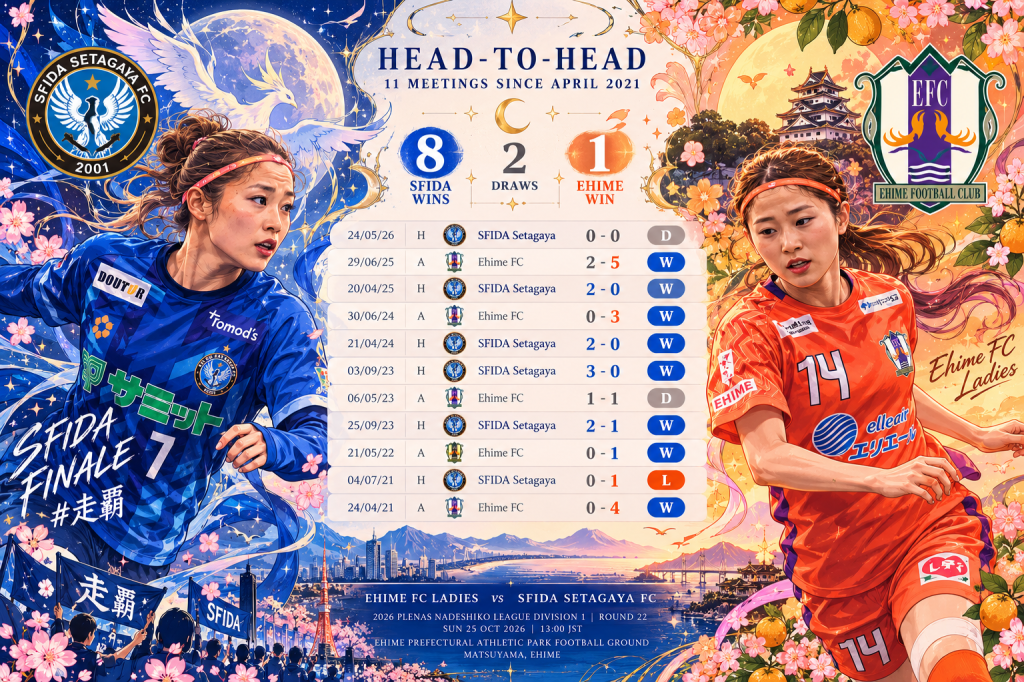
SFIDA are unbeaten in their last 10 meetings with Ehime.
The historical record is particularly encouraging for Sunday’s visitors.
Across 11 competitive meetings since April 2021, SFIDA have recorded eight victories, two draws and just one defeat.
They have won all five of their previous away fixtures against Ehime, scoring 14 goals and conceding three.
That is a substantial advantage.
Their 5–2 victory in June 2025 was the most entertaining recent example, but the goalless draw in May this year demonstrated that previous results cannot be treated as guarantees.
Sunday’s contest will also be shaped by two teams whose preferred approaches could produce an unusually open encounter.
Ehime want to press high.
SFIDA are comfortable attacking the spaces that appear when opponents commit players forward.
If Ehime’s initial pressure is effective, Hamada’s side may find themselves defending closer to their own penalty area than they would prefer.
If SFIDA can evade that first wave, the opportunities for Uchida, Horie and supporting runners could be substantial.
Koharuko Kitagawa offers another possibility through her dribbling and shooting from distance.
Runa Ishiura’s return from a six-match injury absence also gives SFIDA another midfield option at a particularly useful moment.
And should SFIDA establish a narrow lead, Hamada has previously demonstrated a willingness to reinforce his defensive line with an additional player.
There is no obligation for the final match of an era to be played recklessly.
In fact, there might be something rather appropriate about SFIDA completing their history through a disciplined, hard-earned victory.
What Does It Actually Mean to Say Goodbye to a Football Club?
The phrase being used by SFIDA is simple.
“SFIDA FINALE.”
Alongside it sits the hashtag #走覇, expressing the determination to keep running and competing until the end.
It is a fitting sentiment.
But there is something more complicated beneath the celebrations.
It is difficult to measure that sort of relationship in league points.
And it is worth considering what supporters are actually losing when a familiar name and crest disappear.
The players may remain.
The football may continue.
There may even be significant improvements to facilities, resources and long-term opportunities through FC Tokyo’s involvement.
But a club is also a collection of small recognisable details.
The badge on a shirt.
The colours in the stands.
The people who have attended matches for years without expecting recognition.
The supporters who remember players that the wider footballing world has never heard of.
These things matter.
For a club like SFIDA, closer integration with a major men’s professional organisation may offer possibilities that would otherwise remain difficult to achieve.
Yet progress should not require pretending that everything which came before was merely preparation.
SFIDA Setagaya have already achieved something important.
They have existed for 25 years.
They have developed footballers, provided opportunities and built a community that cares deeply enough to make this final fixture feel significant.
Whatever FC Tokyo Sfida eventually becomes, it will inherit that history.
It will not be starting from nothing.
Prediction: Ehime FC Ladies 1–3 SFIDA Setagaya
There is enough in the historical record and recent form to favour SFIDA.
Eight victories from 11 meetings, five consecutive away wins against Ehime and 10 points from their last five matches provide a convincing statistical foundation.
Uchida’s 15 league goals and Horie’s nine also give Hamada two established attacking threats against a defence that has conceded 41 times.
The decisive period may arrive after the interval, when Ehime’s pressing intensity becomes more difficult to maintain and SFIDA’s attacking movement begins finding additional space.
A 3–1 away victory would be a fitting conclusion.
But it remains a prediction, not an entitlement.
And there is one final thought worth keeping in mind.
When the referee blows the final whistle in Matsuyama, the result will become another entry in the Nadeshiko League’s historical records.
The league table will be finalised.
The players will thank the supporters.
For most clubs, that is simply what happens at the end of a season.
For SFIDA Setagaya, it will be the last time those ordinary rituals take place beneath the name they have carried for a quarter of a century.
Perhaps, years from now, people will look back at this merger as the beginning of something extraordinary.
But that is a conversation for another day.
On Sunday, there is still a football match to play.
And for 90 more minutes, they are SFIDA Setagaya FC.
What better reason could there be to keep running until the very end? Give everything they have one more time, in Ehime.