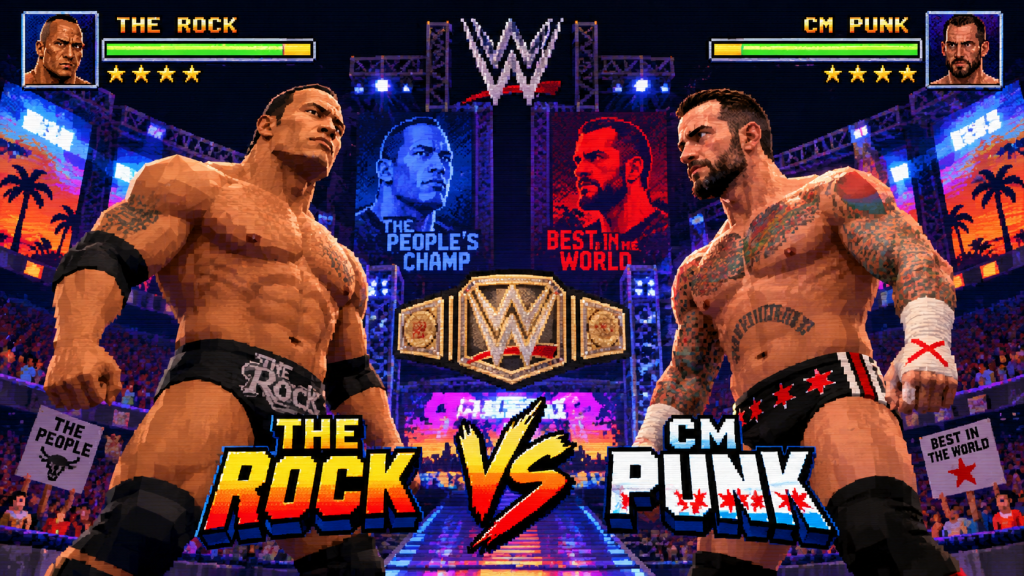
CM Punk had been WWE Champion for 434 days. The Rock needed one night to take it.
Then, three weeks later, WWE asked Punk to lose to him again.
The Rock and CM Punk’s brief WWE Championship feud in early 2013 lasted just two consecutive premium live event main events, at the Royal Rumble and Elimination Chamber, but those matches packed enough tension to sustain something much longer.
One man had carried WWE’s biggest championship for more than a year. The other had spent most of that time somewhere else.
Punk had defended the title against John Cena, Chris Jericho, Daniel Bryan, Dolph Ziggler, Big Show and Ryback. He had become WWE’s week-to-week constant, eventually reaching 434 consecutive days as champion.
Rock, meanwhile, was Rock.
He did not need 434 days. He did not really need an introduction.
He had become one of the biggest movie stars on the planet and returned to wrestling with an aura few WWE performers could match. But during Punk’s entire championship reign, Rock had wrestled just once, beating John Cena at WrestleMania XXVIII.
WWE didn’t need to disguise that imbalance.
It became the feud.
Punk had everything except WWE’s biggest spot
By January 2013, CM Punk had effectively completed the transformation promised by his famous 2011 Pipe Bomb.
He had become undeniable.
The rebellious wrestler who once threatened to leave WWE with its championship had instead spent more than a year holding it. With Paul Heyman beside him, Punk’s character had also become increasingly bitter about what that achievement apparently bought him.
Respect was his obsession.
More specifically, its absence.
Punk had already attacked The Rock at Raw 1000 in July 2012, hitting him with a clothesline before dropping him with the GTS. It was an attack on one man, but Punk’s grievance was much bigger.
Why should someone who appeared occasionally be treated as more important than the champion who showed up every week?
When Rock finally stood opposite him, Punk made sure everybody understood the argument.
“I don’t care if you work here 16 days a year or 365 days a year. You could be Santa Claus and have his schedule, one day a year. I’d still kick your ass.”
It was funny because it sounded like Punk.
It worked because, beneath the joke, it was something uncomfortable.
The Rock was everything Punk hated about WWE
The Rock was not simply another challenger.
He represented the system Punk believed he had beaten.
Rock could leave, make films, become an international celebrity and then return to WWE with an immediate route towards its biggest championship and biggest show.
Punk could wrestle 149 championship defences and still look up.
Their promos therefore became less about who could perform the better wrestling insult and more about what a WWE superstar was supposed to be.
Rock had the catchphrases, physique and enormous crossover appeal. Punk had the miles on the clock.
Rock spoke for “The People.”
Punk thought he was better than all of them.
“You’re playing little league with your little insults and your rhymes and your ‘millions and millions’ and your ‘finallys’,” Punk told him. “And I’m in the big leagues, and I’m swinging for the fence.”
Then came the line that has followed this rivalry ever since.
“When you step in the ring, your arms are just too short to box with God.”
It was magnificent arrogance.
Punk’s problem was that WWE had already begun building its heaven somewhere else.
Royal Rumble 2013: 434 days came down to one People’s Elbow
John Cena won the 2013 Royal Rumble.
That result made the destination increasingly obvious.
WWE had run Rock against Cena at WrestleMania XXVIII under the “Once in a Lifetime” banner. Cena had lost.
A year later, the rematch was set, only this time WWE could put its championship in the middle of it.
Punk was standing in the way.
His first defence against Rock lasted more than 23 minutes, with Punk attempting to exploit precisely what separated the two men.
Rock was immensely powerful but had rarely wrestled lengthy matches. Punk had recently undergone knee surgery himself, yet he had the rhythm and conditioning built through years of regular work.
There was also another vulnerability.
Six days earlier, The Shield had attacked Rock on Raw and driven him through the announce table with a triple powerbomb. Punk therefore had a target and spent portions of the match attacking Rock’s damaged midsection while controlling the pace.
Then the lights went out.
In the darkness, Rock was attacked and put through the announce table. Punk rolled him into the ring, covered him and apparently escaped with his championship.
It would have been a perfectly Punk ending.
Vince McMahon had other ideas.
McMahon appeared ready to strip Punk of the championship because of The Shield’s involvement, but Rock demanded the match be restarted instead.
“Restart the match now!”
Seconds later, Punk’s 434-day reign was effectively living on borrowed time.
Rock survived Punk’s final resistance, hit the spinebuster and delivered the People’s Elbow.
One.
Two.
Three.
After 434 days, CM Punk was no longer WWE Champion.
The Rock was champion for the first time in more than a decade.
Who was The Rock’s biggest enemy?
If one name has to be attached to The Rock’s greatest WWE rivalry, it is Stone Cold Steve Austin.
Rock and Austin became defining opponents during WWE’s Attitude Era and faced each other three times at WrestleMania, including WrestleMania XV and WrestleMania X-Seven for the WWE Championship.
Triple H, John Cena, and Mick Foley also became major rivals for Rock.
CM Punk belongs in a slightly different category.
He was never Rock’s longest-running enemy. Their singles programme was remarkably short.
But Punk may have been one of the opponents best equipped to question what The Rock represented.
Austin fought Rock for supremacy.
Punk fought him over legitimacy.
Has The Rock ever lost a WWE match?
Absolutely.
The Rock’s mythology can sometimes obscure just how often WWE’s biggest stars actually lost during the company’s most competitive periods.
He was defeated by major names including Steve Austin, Triple H, Brock Lesnar, The Undertaker, Kurt Angle, Chris Jericho and John Cena across his WWE career.
Even this particular story ultimately ended in defeat.
Rock carried the WWE Championship into WrestleMania 29, where Cena finally avenged his WrestleMania XXVIII loss and defeated him for the title.
Rock beating Punk twice was therefore not about presenting him as unbeatable.
It was about getting WWE exactly where it wanted to go.
Elimination Chamber 2013: Punk gets one more chance
Punk had grounds for a rematch.
He also had Paul Heyman.
At Elimination Chamber on February 17, Punk challenged Rock again under a stipulation with enormous potential for skulduggery: if Rock were disqualified or counted out, he would lose the WWE Championship.
For Punk, it created another route back to the title.
For WWE, it created tension around a destination many viewers already suspected.
Rock versus Cena II was getting closer.
The rematch was more chaotic than their Royal Rumble encounter. Referee issues, attempted shortcuts, interference, and the championship itself entered the equation.
Punk came desperately close to changing the WrestleMania picture.
He did not.
A final Rock Bottom finished him.
For the second consecutive PLE, The Rock had defeated CM Punk in the main event.
Royal Rumble had ended Punk’s championship reign.
Elimination Chamber ended his route back to it.
That second defeat arguably makes the feud even more fascinating in hindsight.
What was CM Punk’s issue with WWE?
No single issue drove CM Punk’s eventual departure from WWE in January 2014.
Punk later spoke publicly about frustrations involving his health, schedule, pay and creative direction. But his role in WWE’s booking, particularly his inability to reach the WrestleMania main event, became a key part of the story of his dissatisfaction.
That makes the Rock programme difficult to separate from what happened next.
Punk had spent 434 days as WWE Champion, working WWE’s relentless schedule, only for a returning Rock to beat him at the Royal Rumble.
Then WWE booked Rock to beat him again at Elimination Chamber.
Rock subsequently defended against Cena at WrestleMania.
Punk faced The Undertaker.
That was hardly a consolation match nobody cared about. Undertaker’s WrestleMania streak was one of WWE’s biggest attractions and their match became one of the highlights of WrestleMania 29.
But it was not the main event.
For Punk, that distinction mattered.
Eight days after Elimination Chamber, WWE gave Punk one final route into the championship match. He faced Cena on Raw for a shot at Rock at WrestleMania.
The resulting match was extraordinary.
Punk even pulled out a piledriver, a move almost completely absent from WWE at the time.
Cena still won.
Rock versus Cena II…Twice in a Lifetime was set.
The company had its blockbuster. Punk had another exceptional match and another reminder that being exceptional did not necessarily mean WWE would build WrestleMania around him.
What was CM Punk’s salary in WWE?
CM Punk’s exact compensation during this period isn’t something worth pretending to know from the outside, especially since WWE contracts and event-related payments can include several components.
What we can safely say is that Punk became one of WWE’s top stars and, therefore, one of its major earners.
And these were hardly insignificant bookings.
He main-evented consecutive PLEs against The Rock, including a Royal Rumble that drew enormous interest, so it is reasonable to assume those events were substantial paydays for a performer in Punk’s position on the card.
Money, however, doesn’t explain the frustration that came to define this period.
Punk wanted the WrestleMania main event.
Another cheque couldn’t put that on his CV.