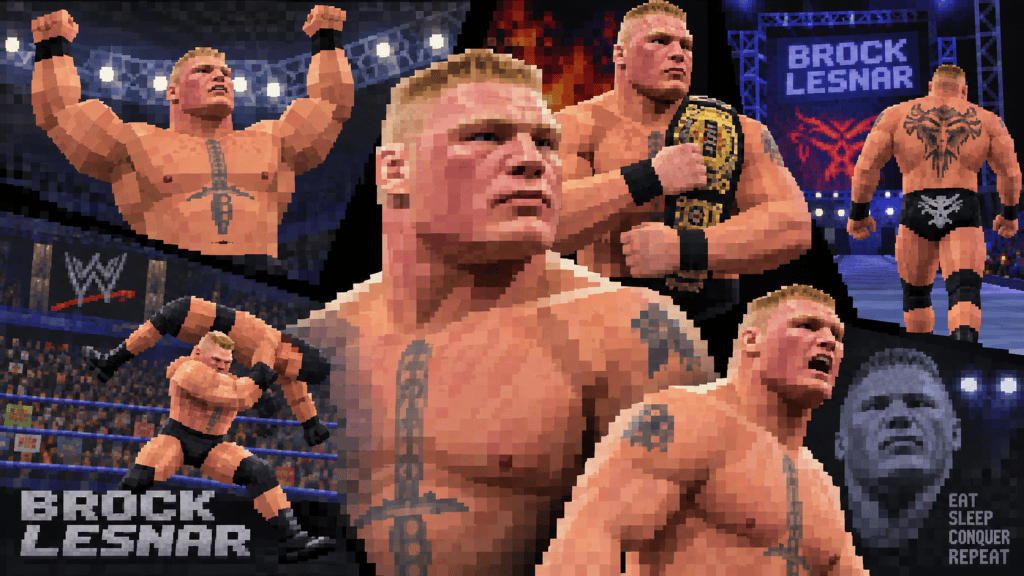
There was a time when I really liked Brock Lesnar.
I was a teenager during Lesnar’s first WWE run, watching SmackDown on Sky One, and something about him was enormously satisfying. He was brutal. Not wrestling-brutal in the sense that somebody had decided to call him “The Beast” and commentators therefore had to repeat it every seven minutes. He looked like somebody had accidentally released a heavyweight wrestler into a television studio.
More importantly, he worked.
Lesnar arrived in WWE in 2002 and was immediately pushed towards the summit, but he still had to climb there. He won King of the Ring. He beat The Rock for the WWE Championship. He went through Hell in a Cell with The Undertaker. He won the Royal Rumble. He wrestled Kurt Angle for an hour on television. He bumped, sold, wrestled and occasionally got beaten.
Then came WrestleMania XX and Goldberg. The build was alright. The match was not. That is where he lost me.
Give Lesnar the right opponent, the right story and apparently the inclination to participate, and very few heavyweights have ever been better. And these were the matches that showed why.
9. Brock Lesnar vs Yuji Nagata: NJPW Battle Final 2005
Brock Lesnar’s Japanese excursion is an odd little corridor in his career. Walk through it, and you find familiar furniture arranged in slightly unsettling positions.
Lesnar had left WWE in 2004 and eventually arrived in New Japan Pro-Wrestling, winning the IWGP Heavyweight Championship in October 2005. Two months later, amid WWE attempting to enforce contractual restrictions on him wrestling elsewhere, he met Yuji Nagata in Nagoya.
Even the F-5 had become involved in the legal weirdness.
Lesnar renamed it The Verdict.
Subtle.
The match itself only lasted a little over nine minutes, which turned out to be exactly what it needed. Nagata couldn’t credibly stand opposite Lesnar and simply exchange heavyweight power moves, so the match became an exercise in finding cracks in a very large wall.
Nagata had them.
Both men possessed serious amateur wrestling backgrounds, and the early grappling gives the contest a legitimacy that Lesnar matches can sometimes manufacture simply through his presence. Nagata then discovers his more productive route: kick the enormous man in the leg.
Again.
Suddenly Lesnar drops toward one knee, and Nagata has transformed from doomed veteran into plausible nuisance. It is beautifully economical wrestling because nothing needs excessive explanation. Nagata simply cannot overpower Lesnar. Therefore he tries to dismantle the machinery underneath him.
Lesnar, meanwhile, does something that became increasingly valuable later in his career.
He sells.
Not for half an hour. Not melodramatically. Just enough to make Nagata’s strategy meaningful.
Then the window closes.
Lesnar catches him, hoists him onto his shoulders and hits The Verdict for the victory.
There are much grander matches elsewhere on this list, but Nagata demonstrates something important about peak Lesnar. You did not need 15 German suplexes and an F-5 buffet.
Sometimes nine minutes, one convincing opponent and Brock Lesnar actually wrestling were plenty.
8. Brock Lesnar vs Kurt Angle: IGF Toukon Bom-Ba-Ye 2007
This is wrestling archaeology.
By June 2007, Lesnar was no longer a WWE wrestler and not really a conventional NJPW champion either. He had been stripped of the IWGP Heavyweight Championship amid contractual and financial disputes but had retained possession of the physical third-generation belt.
Antonio Inoki then launched the Inoki Genome Federation and recognised Lesnar’s claim.
Professional wrestling, everybody.
Kurt Angle had meanwhile departed WWE for TNA. Thus two men whose rivalry had defined much of SmackDown in 2003 somehow found themselves standing opposite one another inside Ryogoku Kokugikan in Tokyo four years later, wrestling over a disputed Japanese championship belt while employed elsewhere.
The strangest thing is how normal everything becomes once the bell rings.
There is no attempt to recreate their Iron Man match or anything from their WWE rivalry. This is a 10-minute sprint built around the fact that both men can wrestle and everybody knows it.
The exchanges are heavier and more compact than their WWE work. Lesnar throws Angle. Angle survives. Lesnar lands The Verdict, and Angle kicks out.
Then comes something genuinely unusual.
Angle gets Lesnar down, catches the ankle and grapevines the leg.
Lesnar taps.
7. Brock Lesnar vs Kurt Angle vs Big Show: Vengeance 2003
There is a wonderful stupidity to watching Brock Lesnar decide that the appropriate response to encountering Big Show is simply to pick him up.
Vengeance 2003 understands exactly what it has.
Three enormous attractions. Two elite amateur wrestlers. One approximately 500-pound problem.
Angle and Lesnar begin with the obvious solution: temporary cooperation. Their relationship had softened following Angle’s return from neck surgery, but both wanted the WWE Championship and neither particularly wanted Big Show standing upright.
So they work together.
Until they don’t.
That tension fuels the Triple Threat. Lesnar and Angle can cooperate for maybe five seconds before someone notices the other man is trying to win the match.
Meanwhile, Big Show is being treated less like a wrestler and more like heavy industrial equipment.
At one point Lesnar hoists him from the corner and runs across the ring carrying him into a powerbomb.
That happened.
Angle eventually removes Show with an Angle Slam through the Spanish announce table, letting the match mutate into what everyone really wanted: Angle and Lesnar trying to kill one another.
The final stretch becomes frantic. Big Show returns. Finishers begin flying. Angle escapes a double chokeslam, hits Show with the Angle Slam and then catches Lesnar with another.
One, two, three.
Angle pins Lesnar clean.
That matters. WWE could easily have protected its young monster by having Big Show absorb the defeat. Instead, Lesnar loses the championship himself.
Sometimes the monster has to lose.
6. Brock Lesnar vs Daniel Bryan: Survivor Series 2018
For approximately half of this match, Daniel Bryan appears to have made a catastrophic administrative error.
He had won the WWE Championship from AJ Styles only five days earlier, simultaneously kicking Styles between the legs and turning heel. His reward was Brock Lesnar.
Congratulations.
Bryan initially tries swagger. Then Lesnar gets hold of him.
What follows is deeply uncomfortable because Bryan had only returned from retirement earlier that year after years of concern surrounding his neck and concussions. Lesnar launches him around the ring, and Bryan possesses the unfortunate gift of making every landing look medically significant.
An F-5 lands.
Lesnar stops his own pin.
That arrogance changes everything.
The second F-5 attempt takes the referee down. Bryan responds with the same solution he had discovered against Styles.
Low blow.
Running Knee.
One.
Two.
Not quite.
The building changes instantly.
Then we get the Lesnar I wish had appeared more frequently during this era.
Bryan attacks the leg. He uses the ring post, chop blocks, and repeated strikes, gradually turning Lesnar from an unbeatable boss character into a huge man discovering that knees are rather important.
And Brock sells magnificently.
His leg buckles. His expression changes. Suddenly the Yes Lock is not pantomime jeopardy. Lesnar looks genuinely desperate to escape.
That is the great trick of the match. Nobody seriously believed Bryan could physically overwhelm Brock Lesnar.
So he doesn’t.
He outthinks him, injures him and nearly steals the entire thing.
Lesnar eventually powers free and lands the decisive F-5, but Bryan turned a squash into a thriller without making Lesnar stupid.
5. Brock Lesnar vs The Undertaker: No Mercy 2002
There is blood, and then there is whatever happened to The Undertaker at No Mercy 2002.
Hell in a Cell was still genuinely unpleasant then. It had not yet become an annual October appointment where two wrestlers discovered their rivalry had reached the appropriate point on WWE’s calendar.
Undertaker entered with a broken hand encased in fibreglass.
Lesnar immediately had a problem.
The cast essentially gave Undertaker a sanctioned club, and he used it accordingly. Lesnar bled. Paul Heyman, supposedly protected outside the ring, discovered the cell had holes and Undertaker had arms.
Heyman bled too.
Then Brock went to work on the hand.
Heyman helped trap Undertaker’s injured arm against the cage. Lesnar attacked the cast with a chair, then eventually removed it altogether.
And then the match becomes gruesome.
Steel steps open Undertaker’s forehead. Blood covers his face, Lesnar and eventually practically anything unfortunate enough to enter the immediate area.
Yet underneath the gore is an exceptionally smart match.
Lesnar is still a rookie. Undertaker is the established monster. The cell belongs to Undertaker.
WWE could have manufactured an escape hatch for its young champion.
Instead, Undertaker attempts the Tombstone.
Lesnar counters.
F-5.
Clean pin-fall win.
Lesnar climbs onto the roof of the Cell, WWE Championship in hand, blood still covering him, and stands above the structure that was supposed to belong to The Undertaker.
The company had spent months telling everyone Brock Lesnar was special.
At No Mercy, they proved it.
4. Brock Lesnar vs John Cena vs Seth Rollins: Royal Rumble 2015
If you want to understand why people kept forgiving Brock Lesnar for boring matches, watch Royal Rumble 2015.
Because bloody hell, he could do this.
Lesnar entered after perhaps the most destructive year of his career. He had ended Undertaker’s WrestleMania streak and dismantled John Cena at SummerSlam.
Cena was Cena.
Seth Rollins was the irritating Money in the Bank holder still establishing whether he truly belonged among WWE’s biggest stars.
Twenty-two minutes later, that question looked ridiculous.
The chemistry is perfect because everybody wants something different. Cena can match Lesnar’s strength in bursts. Rollins cannot, so he moves. Lesnar treats both as projectiles.
Eventually Cena and Rollins reach the sensible conclusion that Brock must temporarily cease existing.
Barricade.
Steel steps.
Announce table.
Rollins launches himself from the top rope and drives an elbow through Lesnar and the table.
Brock is removed.
And this is where the match gets clever.
Cena and Rollins suddenly produce a miniature singles classic while ringside officials examine Lesnar. Rollins hits the Phoenix Splash. The championship appears vulnerable.
Then the horror film starts.
Lesnar gets up.
Something wonderfully simple about the visual: everyone has spent several minutes behaving as though the monster has been killed.
The monster disagrees.
Rollins attempts a Curb Stomp onto the briefcase. Lesnar catches him in mid-air.
F-5.
Done.
This was Brock Lesnar as an attraction without using “attraction” as an excuse not to wrestle.
3. Brock Lesnar vs Eddie Guerrero: No Way Out 2004
Eddie Guerrero beating Brock Lesnar should look ridiculous.
That is precisely why this works.
Lesnar is enormous. Guerrero isn’t. Brock is WWE Champion. Eddie is fighting for his first world championship.
Most importantly, Eddie does not wrestle as though those differences don’t exist.
For nearly half an hour, he has to solve Brock Lesnar.
Initially, there is no solution.
Lesnar throws him around with belly-to-belly suplexes and powerbombs. Guerrero absorbs punishment without the match rushing towards the reassuring comeback.
Then Brock hurts his knee.
There.
That is the opening.
Eddie attacks it relentlessly. STF. Figure Four. Single-leg Boston crab. Lesnar sells the injury, and suddenly the physical mismatch starts to shrink.
The famous ending does involve Goldberg, and that matters when assessing the match purely as competition. Goldberg Spears Lesnar after the referee goes down.
But Brock kicks out.
Eddie still has to finish the job himself.
Lesnar attempts another F-5. Guerrero counters into a DDT onto the championship belt, disposes of the evidence and climbs.
Frog Splash.
Three.
Then Eddie Guerrero disappears into the Cow Palace crowd carrying the WWE Championship.
It remains one of wrestling’s great emotional endings because the result feels bigger than a championship changing hands.
2. Brock Lesnar vs Kurt Angle: SmackDown Iron Man Match, September 18, 2003
Sixty minutes.
Brock Lesnar wrestled for sixty minutes.
I occasionally want to print this information onto a small card and hand it to anybody defending one of his later five-minute suplex compilations.
The remarkable thing is not simply the duration.
Lesnar and Kurt Angle actually construct an hour-long wrestling match.
Brock’s first great idea is wonderfully horrible. Instead of patiently trying to outwrestle an Olympic gold medallist, he hits Angle with a chair.
Disqualification.
Angle leads 1–0.
Except Lesnar has just beaten him senseless.
F-5.
1–1.
Submission.
2–1.
Fantastic heel mathematics: sacrifice one fall to make several subsequent falls easier.
From there the match keeps evolving. Lesnar scores through wrestling, violence, count-out and cheating. Angle falls 5–2 behind.
Then Brock’s leg becomes compromised.
The final portion becomes an increasingly desperate pursuit. Angle claws back falls until it is 5–4.
Twenty seconds remain.
Ankle Lock.
Grapevine.
Lesnar cannot escape.
He does not need to.
The clock becomes his tag-team partner.
Brock screams, survives and wins the WWE Championship as time expires.
This is the match I think about whenever somebody reduces Lesnar to the Suplex City caricature.
He could wrestle.
Not merely perform impressive power moves. Wrestle.
He could structure an hour, work strategically, sell an injury, manipulate the score and make the clock itself part of the finish.
Which makes what happened later in his career considerably more frustrating.
We knew what he could do.
We had watched him do it for an hour.
1. Brock Lesnar vs CM Punk: SummerSlam 2013
This is my favourite Brock Lesnar match because almost every version of Brock.
The terrifying heavyweight is there.
The MMA fighter is there.
The amateur wrestler is there.
The bumping, selling professional wrestler from 2002 is there.
And, crucially, somebody has turned up capable of annoying every single one of them.
CM Punk cannot overpower Lesnar.
So he refuses to stop.
Brock launches him around ringside. Punk kicks him. Brock throws him across announce tables. Punk comes flying back. Every exchange reinforces the physical mismatch without letting it become the entire match.
Then they start wrestling.
Lesnar catches the Go To Sleep and turns it into the Kimura. Punk reverses into an armbar and then a triangle choke.
Suddenly Brock Lesnar is trapped.
He responds by picking Punk up and powerbombing him.
Of course he does.
But look at Lesnar throughout the match. Watch the selling. Watch him stumble after Punk’s strikes. Watch the panic when submissions are locked in. Watch how willingly he makes somebody substantially smaller appear dangerous.
This isn’t Suplex City.
It is a professional wrestling match.
Paul Heyman provides the final ingredient.
Punk’s real obsession is no longer simply defeating Lesnar. He wants Heyman, whose betrayal created the entire situation.
Eventually he gets him.
Anaconda Vice.
For a few glorious seconds, Punk is strangling the problem.
Unfortunately, another much larger problem has recovered behind him.
Punk’s fixation on Heyman creates the opening. Lesnar grabs him and delivers the F-5 onto a steel chair.
Three.
The Beast beats The Best.
But Punk leaves, looking entirely capable of beating him.
That is why this sits at number one.
Brock Lesnar never needed opponents to become helpless scenery. His size, speed, legitimacy and explosive power already made him extraordinary. The best Lesnar matches understood that letting someone hurt him didn’t weaken the Beast.
It made surviving him mean something.
Honourable Mentions
WrestleMania XXX against The Undertaker is historically enormous because Lesnar became the 1 in 21–1. Beyond that? It was a serviceable match attached to an astonishing result. WrestleMania XIX against Kurt Angle was good, Shooting Star Press disaster included, but they produced better matches elsewhere.
WrestleMania XX against Goldberg was awful, but fascinatingly awful: two departing wrestlers being openly rejected by Madison Square Garden. Extreme Rules 2012 against John Cena was far better and arguably more important, establishing the violent, MMA-influenced Lesnar who would dominate his second WWE run.
And then there is the 2026 Oba Femi trilogy. Important for passing the monster baton to Femi, certainly. As three actual wrestling matches? Pretty boring.
 doragon sports