
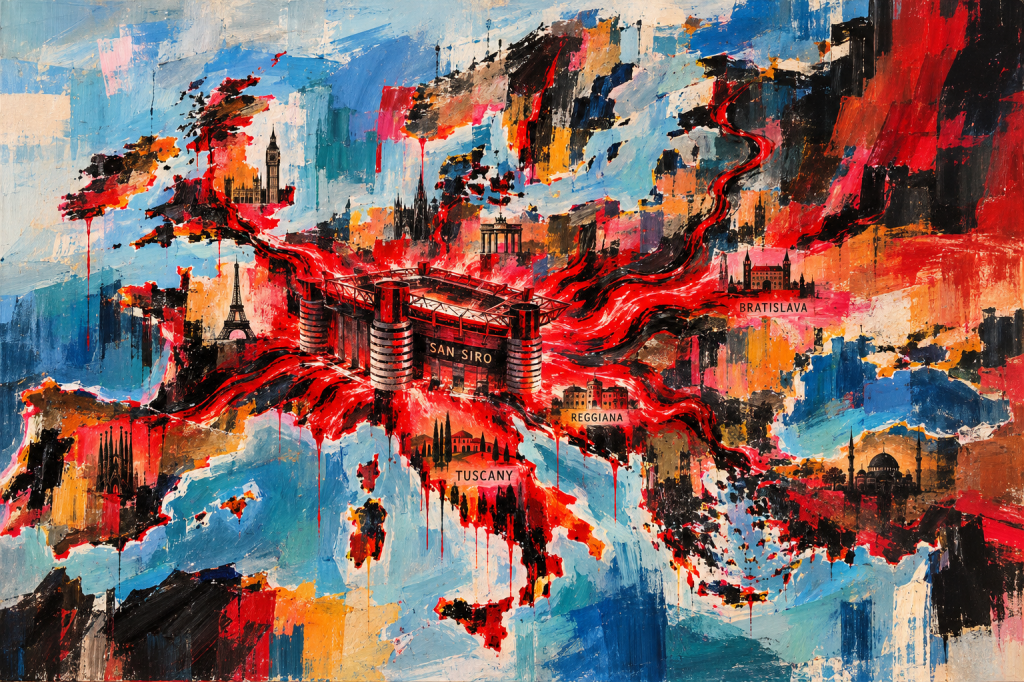
“Happy hunting ground” has become one of football’s more generously distributed labels.
Win somewhere twice and commentators start reaching for it. Beat the same bottom-half side away in 2018, return six years later and scrape another victory, and congratulations: apparently you have conquered the place.
This series is not interested in AC Milan beating whichever unfortunate Serie A side happened to be cannon fodder three times across ten years. A proper Happy Hunting Ground requires repetition. Different managers. Different players. Ideally different decades. You want a stadium where the shirts change, football itself changes, and Milan still arrive behaving suspiciously like they own the deeds.
For the Rossoneri, there are some excellent candidates.
Reggio Emilia offers goals without reply. Bratislava has provided European perfection. Pisa has spent the better part of six decades trying to find a way of making Milan uncomfortable.
Mostly unsuccessfully.
Stadio Giglio: Reggio Emilia’s San Siro Annexe
AC Milan’s relationship with Reggiana becomes considerably funnier once you isolate what happened whenever the Rossoneri travelled there.
Four visits.
Four victories.
Eleven goals scored.
None conceded.
The latest, admittedly, was a friendly. But even a relatively meaningless trip in March 2015 somehow ended with Milan recreating the exact scoreline of their previous visit.
Suso needed four minutes to begin the 3-0 win, curling his effort in off the post, and completed his brace just before half-time. Jérémy Ménez supplied the third after 78 minutes.
The previous competitive visit, in December 1996, had also finished 3-0 and also began almost immediately.
This time Demetrio Albertini required only three minutes. Marco Simone later won a penalty, Albertini converted it, then Massimo Ambrosini won another.
Albertini took that one too.
A hat-trick for a midfielder who was hardly employed as Serie A’s answer to Gabriel Batistuta.
A year earlier Milan had been even more destructive. Gianluigi Lentini scored after six minutes, Fernando De Napoli contributed an own goal, Dejan Savićević added a wonderful third and Marco Simone completed a 4-0 victory.
Go back to January 1994 and things become almost disappointingly normal. Marcel Desailly scored after 28 minutes. Milan won 1-0.
Still, the numbers are glorious.
Across those four away victories, Milan scored first every time and kept four clean sheets. Three of the four performances featured an opening goal inside six minutes.
Albertini at three.
Suso at four.
Lentini at six.
Apparently the most dangerous part of hosting Milan in Reggio Emilia was getting everybody seated before they scored.
Tehelné Pole: Milan’s Bratislava Business Trip
Milan have visited Slovan Bratislava twice competitively and returned home with two victories. More importantly, those wins sit 32 years apart.
The latest came in November 2024, when Milan’s Champions League visit became considerably more chaotic than their previous trip.
Christian Pulisic opened the scoring after 21 minutes, running onto Tammy Abraham’s pass and finishing clinically.
Three minutes later, Tigran Barseghyan equalised.
So much for tranquillity.
Rafael Leão emerged from the bench at half-time and restored Milan’s advantage in the 68th minute from Youssouf Fofana’s through ball. Three minutes after that, Abraham intercepted a dreadful Slovan backpass and made it 3-1.
Even then Bratislava refused to disappear.
Nino Marcelli’s magnificent 88th-minute strike made it 3-2 before Marko Tolić was dismissed, finally allowing Milan to shut the door.
The previous visit required considerably less drama.
October 1992 brought Fabio Capello’s Milan to the old Tehelné pole for the first leg of their European Cup second-round tie.
The winner came from a rather appropriate source.
Paolo Maldini.
His 61st-minute goal, his first in the European Cup, gave Milan a 1-0 victory before the Rossoneri completed the job back in Italy.
And there is a neat little thread connecting the generations.
Maldini scored first in Bratislava in 1992.
Pulisic scored first in Bratislava in 2024.
Milan have actually scored first in all three matches they have played against Slovan, home or away, and won every one.
Thirty-two years passed between their trips to Slovakia.
The result apparently hadn’t received the memo.
Arena Garibaldi: Tuscany’s Little San Siro
This is the monster.
Milan’s relationship with Pisa stretches across generations, tactical revolutions and one enormous 35-year gap between Serie A visits.
The winning habit survived all of them.
February 2026 finally brought Milan back to Pisa for a top-flight fixture. Ruben Loftus-Cheek headed Zachary Athekame’s cross home after 39 minutes before the afternoon became rather less comfortable.
Niclas Füllkrug had a goal disallowed, missed a penalty and watched Felipe Loyola equalise after 71 minutes.
Then Luka Modrić appeared.
An 85th-minute combination with Samuele Ricci ended with the Croatian drilling Milan back in front. Adrien Rabiot was dismissed in stoppage time, but the Rossoneri escaped Tuscany with another victory.
Their previous Serie A visit had taken place in April 1991.
That one ended 1-0, settled by Paolo Maldini.
Two years earlier, shortly after Milan had conquered Europe, Marco van Basten scored twice in a 2-0 win at the Arena Garibaldi. The Dutchman had already scored there in September 1987, when Arrigo Sacchi’s great Milan project announced itself with a 3-1 opening-day victory featuring goals from Roberto Donadoni, Ruud Gullit and Van Basten.
There was even another 2-1 Milan victory in a 1989 friendly, Giovanni Stroppa scoring after approximately 40 seconds before Franco Baresi eventually settled matters from the penalty spot.
Pietro Paolo Virdis had supplied the winner in a 1-0 Serie A victory in 1986.
The one genuine interruption came on New Year’s Eve 1983.
Pisa 0-0 Milan.
No conquest. No collapse. Just two teams apparently deciding everybody had somewhere better to be.
Travel further backwards and Milan’s relationship with this ground was already taking shape. In February 1969, on a miserable rain-soaked surface, a Pisa own goal gave the visitors another 1-0 victory.
That longevity is what elevates Pisa above an amusing run of results.
Milan have repeatedly scored first. Clean sheets are everywhere. Van Basten scored three times across two competitive visits, while defenders such as Maldini and Baresi have ended up deciding games themselves.
And after waiting 35 years for another crack at Milan in Serie A, Pisa finally got them back in Tuscany in 2026.
Milan won again.
Some traditions are terribly inconsiderate.
Different Decades, Same Red-and-Black Flag
Reggio Emilia, Bratislava and Pisa offer three different versions of the Happy Hunting Ground.
Reggiana is the demolition job.
Four Milan away victories by an aggregate 11-0, with the Rossoneri frequently scoring before the match has properly introduced itself.
Bratislava is European precision.
Two visits separated by 32 years, two victories, with Milan taking the lead on both occasions. Extend the sample to every Slovan meeting and Milan’s record remains perfect.
Then there is Pisa.
That one feels almost geological.
You can dig through different layers of Milan history and keep finding the same thing.
The 1960s give you Nereo Rocco’s European champions. The 1980s bring Sacchi, Gullit and Van Basten. The early 1990s offer Maldini. Then football disappears from the fixture for three and a half decades before Modrić turns up in 2026 and continues exactly where everybody left off.
That is what qualifies.
A Happy Hunting Ground should survive the footballers who created it.
The managers leave. Stadiums are renamed. Competitions change formats. One generation becomes grainy footage, then YouTube compilations, then stories somebody’s dad tells them.
Eventually Milan return.
And, rather inconveniently for the hosts, they remember where they planted the flag.