
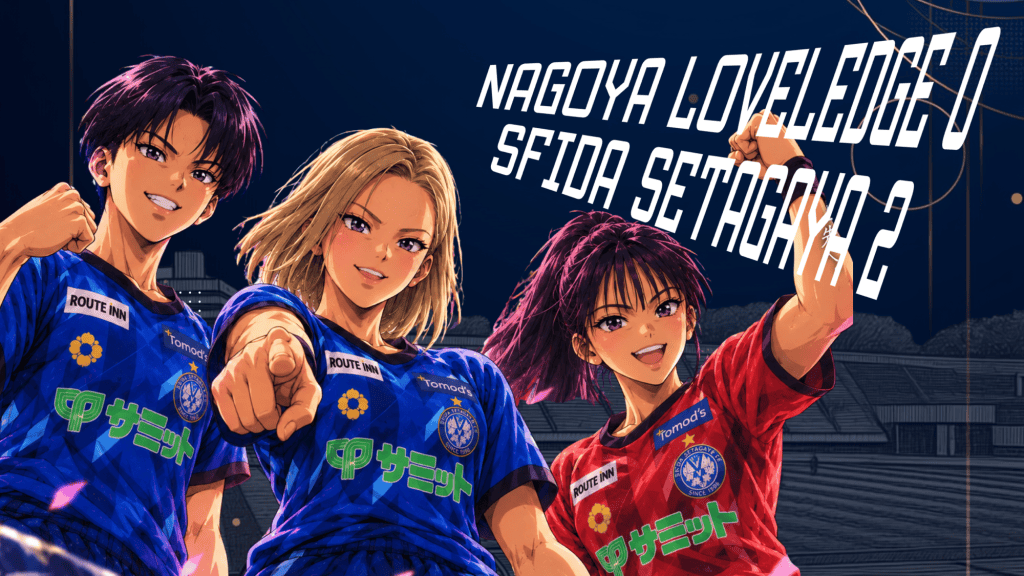
Twenty seconds.
That was approximately how long SFIDA Setagaya allowed me to enjoy the beginning of my weekend before inviting Loveledge Nagoya towards our penalty area.
Fifty seconds later, something similar happened.
Fine.
Here we go then.
There are certain rituals attached to following a football team from several thousand miles away. The starting XI appears. You inspect it with the seriousness of someone reviewing evidence. Mio Otsuka was between the sticks, which felt reassuring. The defence looked familiar. Mayu Yaguchi continued to start. Mitsuki Horie got the nod rather than beginning on the bench, appropriate given her connections to Aichi Prefecture.
No Moeno Matsubara either.
Nagoya’s team graphic appeared and, being entirely transparent, I couldn’t tell you an enormous amount about several of them. They did, however, employ an impressive variety of hand gestures in their photographs.
Very cool.
SFIDA were wearing white. Nagoya were second in the Nadeshiko League Division 1, defending champions and theoretically chasing Shizuoka SSU Bonita for another title. We had lost three consecutive league matches, conceded seven times during them and had just managed the particularly irritating trick of losing 2-1 to Iga after taking the lead.
Let’s stop doing that.
Somebody Please Confiscate That Piece of Plastic
Before discussing football, we need to discuss the noise.
About ninety seconds into the match, somebody in Ueno Athletic Park Stadium appeared to be hitting something plastic.
I’m all for this sort of thing normally. Drums, chanting, people making football matches sound alive. Wonderful.
This wasn’t quite that.
It was hollow. Loud. And whoever was responsible couldn’t seem to decide whether they were rushing or dragging.
The visual presentation wasn’t much less unusual.
Ueno Athletic Park Stadium looked less like the venue for a match involving the defending champions of Japan’s second-tier women’s competition and more like somebody had temporarily commandeered a municipal recreation facility.
Around the pitch was fencing covered in black mesh. Beyond it were enormous trees, which were genuinely rather lovely. The running track, meanwhile, appeared to have been reclaimed by grass.
Later, I became increasingly fascinated by it.
It looked like the sort of deteriorating athletics facility where underground runners might break in after midnight to train illegally because their coach had specifically forbidden it.
There was also a good reason for the peculiar surroundings. This was officially a Nagoya home match but was being played in Iga, Mie Prefecture, with Nagoya’s usual venues affected by preparations for the 2026 Asian Games and Asian Para Games.
Some Nagoya supporters had travelled somewhere in the region of two-and-a-half to three hours to attend a home game.
Football administration remains undefeated.
Front Foot Without The Ball
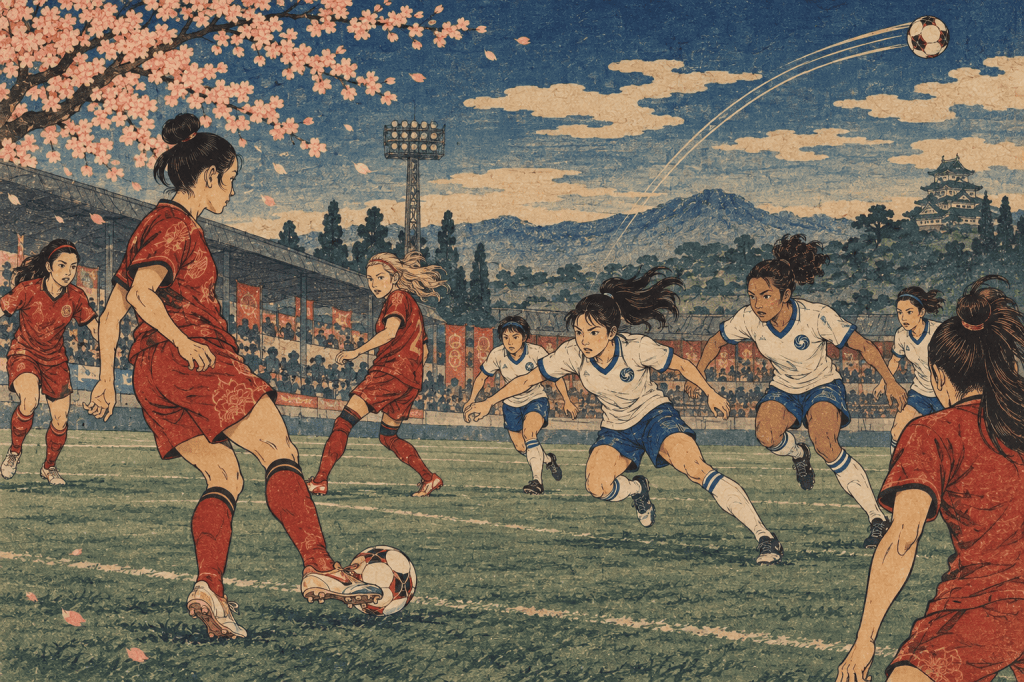
Nagoya had most of the early possession.
At 3:41, SFIDA still hadn’t seen much of it.
Then something happened that immediately made this performance feel different.
Nagoya tried passing around the back. SFIDA pressed them and forced the ball long.
That’s the spirit.
Front foot, without the ball.
It sounds slightly contradictory until you watch it working.
Last weekend’s defeat to Iga had irritated me beyond the result itself. Losing is part of following sport. Boring games are also part of following sport. Combining the two, however, feels unnecessarily punitive.
You can lose.
You can bore me.
Please don’t make a habit of doing both simultaneously.
This was already different.
Nagoya managed an effort around eight minutes that Otsuka held without difficulty. Moments later Horie introduced herself to captain Momoko Hemmi with what could politely be described as an industrial tackle.
Hemmi hobbled away.
No card.
I’ve seen cards given for similar challenges.
Some have even been a darker colour than yellow.
Horie had returned to a familiar part of Japan and apparently intended to make herself known.
Then SFIDA started playing.
Death, Taxes, Misuzu Uchida
The opening goal began with refusal.
SFIDA’s Maasa Taguchi fought for possession and simply didn’t accept that the ball belonged to Nagoya. She won it and nudged a lovely pass forwards towards Nana Watanabe.
Watanabe now had Kokoro Horiuchi for company.
A duel began.
Not merely a football duel, obviously.
This was Duel of the Fates.
Qui-Gon Jinn against Darth Maul.
I don’t know which one Nana Watanabe was supposed to be in this analogy. Probably neither. She was busy playing football.
More importantly, she won.
Watanabe protected the ball and worked it into the dangerous area. Nagoya reached it first but only succeeded in turning the situation into something worse.
The clearance fell invitingly to Misuzu Uchida.
Clear sight of goal.
No deliberation.
She hit it with Paul Phoenix’s Hammer of the Gods… as an assisted pass…and SFIDA were ahead.
1-0.
Uchida again.
Her 13th league goal of the season, taking her level with Kumi Yokoyama at the top of the Nadeshiko League Division 1 scoring charts.
There are three certainties in life.
- Death.
- Taxes.
- Misuzu Uchida will score.
She scored twice against Nagoya earlier this season and SFIDA still managed to lose 3-2 to a 94th-minute winner.
Nobody needed reminding of that just yet.
This Is The SFIDA I Like
The next ten minutes weren’t extraordinary.
That’s sort of the point.
SFIDA were simply good.
They pressed. They competed. Moves sometimes broke down and instead of responding by becoming passive, somebody tried to win the ball back.
Tenacity is one of those football words that gets applied retrospectively whenever somebody wants to make running around sound philosophical.
Here you could actually see it.
Watanabe had time at the back. SFIDA attacked again and won a corner.
Then came one of my favourite moments of the afternoon.
Nobody took it.
The ball sat there.
SFIDA had definitely been awarded a corner. The referee appeared aware of this. The players presumably knew.
Yet nobody seemed particularly interested in standing beside it.
Eventually Sae Shinohara wandered over.
Football can involve extraordinarily sophisticated tactical systems and millions of hours of collective coaching knowledge, yet occasionally eleven professional players will apparently forget who is supposed to take a corner.
It came to nothing.
Then Shinohara started causing trouble in a more conventional manner.
She drove forward from the left and SFIDA constructed another attack. Uchida controlled the ball beautifully and the move eventually created the second.
Watching live, it looked for all the world as though Horie had finished it herself.
The official record has other ideas.
Own goal.
This is one of football’s smaller administrative cruelties. You can do almost everything required to create a goal and then somebody with a clipboard decides it technically belongs to nobody.
Whatever.
The onion bag rippled.
2-0.
I then noticed Horie had substantial bandaging around her knee.
Is she all right?
Well, she had just spent half an hour charging around the pitch, clattering opponents and contributing heavily to a goal.
Probably.
The players went for a water break.
Nagoya looked deeply unimpressed with themselves.
The temperature was 31.8°C.
And SFIDA Setagaya, tenth in the table and losers of their previous three matches, were dominating the defending champions.
By half-time, SFIDA had created the better chances and, more importantly, prevented Nagoya from settling.
Nagoya wanted short passes from goalkeeper Nagarekawa through the defence.
SFIDA kept appearing.
Pass short.
White shirt.
Try another route.
White shirt.
Go long.
Thank you very much.
Nagoya won a couple of corners while I was writing notes towards the end of the half, which would normally have produced mild panic.
It didn’t.
They looked strangely passive.
Half-time.
0-2.
This looked like a very nice day to support SFIDA Setagaya, whether from Setagaya, Nagoya or, in my case, Leeds.
The sake remained unopened.
There were still 45 minutes left.
I have learned things.
The Inevitable Period Where I Regret Feeling Comfortable
Nagoya improved after half-time.
Of course they did.
Otsuka was increasingly involved, although the opening few minutes remained fairly tame. Then, around the 51st minute, Nagoya produced a proper attempt and forced her into a quick decision.
Fine.
At 54 minutes, Nagoya’s defenders had started playing longer. SFIDA weren’t creating as freely.
Fine.
Nagoya made substitutions.
Still fine.
Miu Niki, wearing number 13, came on and immediately looked capable of changing the game.
Less fine.
Around the hour, SFIDA made their own change, with number 16 replacing number eight.
Then Nagoya started coming.
By 70 minutes, I was thinking about Football Manager.
If this were my team on a laptop, I would already have opened the tactics screen and started dragging things backwards.
We had been poor late in matches.
We had repeatedly failed to see situations through.
Nagoya’s substitutes had something to prove.
There are moments where aesthetics become less important than simply not doing something stupid.
Please manage the game.
Mio Otsuka, 19 Years Old, Apparently Unconcerned
Nagoya finally began looking like the team sitting second in the league.
Miu Niki was involved repeatedly.
Akiko Nagata made a superb run before flicking the ball towards Miu Niki, who moved it onto a teammate for a shot.
Otsuka saved.
Corner.
Otsuka claimed it.
Good.
Take your time.
Tie your shoelaces if necessary.
Contemplate existence.
We can all wait.
At 74:33, Watanabe produced the sort of defensive action rarely included in tactical compilations.
KICK IT OUT.
Akiko Nagata was preparing to attack the loose ball.
Watanabe disagreed.
Away it went.
Beautiful.
Seconds later Nagoya came again. Niki was involved. Another dangerous ball. Otsuka dealt with it.
Suddenly I could barely watch.
This is what three consecutive defeats do.
A two-goal lead with fifteen minutes remaining against a team that hasn’t scored in its previous two games should feel comfortable.
It doesn’t.
It feels like paperwork hasn’t been completed.
One Nagoya goal and the atmosphere changes. One mistake and everybody remembers April, when Uchida scored twice against this team and SFIDA still left with nothing.
At 77 minutes another Nagoya shot flew over.
Otsuka took her time restarting.
Excellent.
At 79 minutes, SFIDA were showing some proper resistance.
Then Hamada did what I’d been asking my television for approximately ten minutes.
Defenders.
More of them.
Unai Sara and Yunoka Arakawa.
Close the shop.
Turn off the lights.
Tell Nagoya we’re not taking any more customers.
We Have Won A Football Match
The strange thing was how quietly the final minutes disappeared.
Nagoya had spent much of the second half building pressure, but once SFIDA reinforced the defence, the game began to lose its threat.
More substitutions followed.
Minutes vanished.
Then it was over.
Loveledge Nagoya 0.
SFIDA Setagaya 2.
A clean sheet.
Three points.
The losing run finished.
Against the defending champions.
Against the team that began the weekend second in the league.
Away from home, technically, although given that Nagoya themselves had been dispatched several hours away to Mie Prefecture, the concept of home had become largely theoretical.
Hamada’s post-match comments were interesting.
He warned against adopting a “victory makes us right” mentality. SFIDA have ambitions of eventually reaching the professional WE League and, in his view, winning cannot be allowed to obscure the importance of preparation and process.
He’s right.
Annoyingly sensible, but right.
One excellent afternoon doesn’t erase the previous defeats.
It doesn’t suddenly answer every question about this team.
Ami Takeuchi hasn’t even made the squad yet. SFIDA have just added a forward who scored 60 goals in Singapore and, on the afternoon everyone was wondering where those goals might fit, Uchida scored again and the team beat second place 2-0 without her.
Football enjoys making analysis look silly.
Otsuka, who at 19 years old spent the second half behaving as though catching crosses while an increasingly anxious fan in Leeds (me) begged her to waste another ten seconds was an entirely normal Saturday afternoon.
Nagoya had 12 shots.
Nine corners.
They threw substitutes at the problem.
Nothing.
SFIDA had spent three matches looking increasingly fragile and then arrived against the defending champions, pressed them into discomfort, scored twice and survived the inevitable response.
It felt improbable.
Which usually means it wasn’t.
Sometimes teams really can just play better.
Sometimes Uchida scores because Uchida scores.
Sometimes the goalkeeper catches everything.
For one Saturday, anyway.
The plastic percussion probably continued.
I stopped noticing.






One response to “Loveledge Nagoya 0–2 SFIDA Setagaya: We Are Allowed To Win Football Matches”
[…] Last weekend, SFIDA Setagaya won a football match. […]
LikeLike