
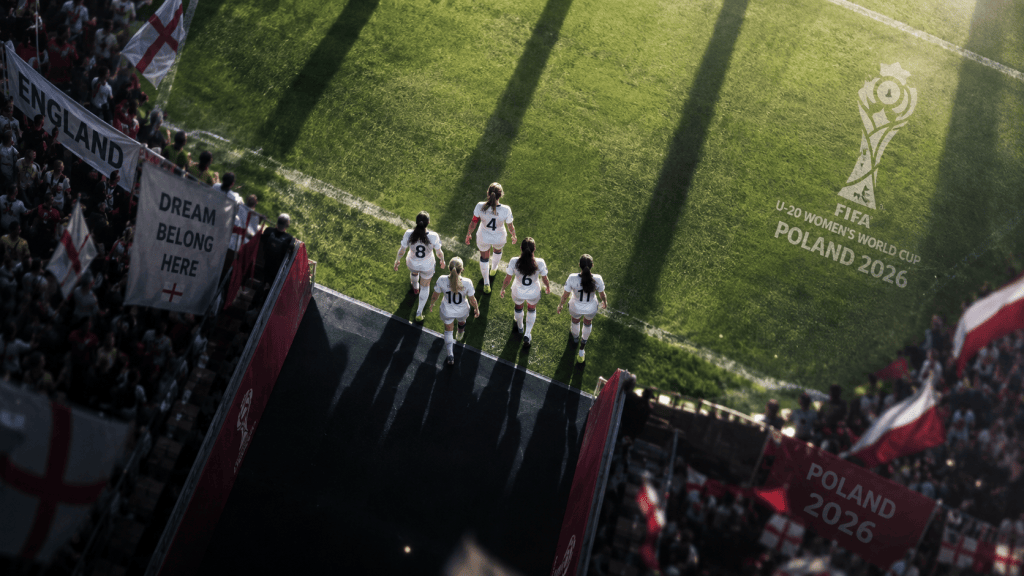
England’s U20 Women’s World Cup began with a draw.
Three days later, it had a hat-trick hero.
The Young Lionesses followed their opening 1-1 draw against Canada with an emphatic 5-1 victory over Tanzania on Tuesday, 8 September, moving Lydia Bedford’s side onto four points from their opening two Group B matches.
Rachel Maltby, already responsible for England’s late equaliser against Canada, scored a first-half hat-trick and collected the Player of the Match award. Princess Ademiluyi and Jessie Gale added the other two goals.
Suddenly, England’s position looks rather different.
They sit second in Group B, two points behind Brazil, who have won both matches. The two sides meet on Friday, 11 September, with England not merely attempting to reach the knockout stages but still possessing an opportunity to finish top of the group.
Yet the 5-1 scoreline should not erase what came before it.
England struggled for fluency against Canada. Bedford acknowledged there were still elements of the Tanzania second half requiring attention before Brazil. The encouraging part is that England have already demonstrated an ability to correct problems within the compressed laboratory of tournament football.
“We definitely grew from the Canada game,” Maltby said afterwards. “We spoke about the crosses and getting on the end of them and I think we did that.”
That makes England’s five players to watch rather more interesting than they were four days ago.
Some are prospects waiting for their tournament to ignite.
One very clearly already has.
Zara Shaw: Liverpool’s captain who has already had to start again
Zara Shaw played all 90 minutes against Canada.
She did so as England captain, operating from deep as the Young Lionesses attempted to negotiate an uncomfortable opening match in which Canada’s press repeatedly disrupted their rhythm.
That alone would make the 19-year-old interesting.
The route she took to get there makes her considerably more so.
Shaw was spotted by Liverpool at seven while playing for Huyton Corinthians, a local boys’ side where she was the only girl. She subsequently progressed through Liverpool’s academy and appeared to be following the familiar trajectory of an elite English prospect.
Then came August 2023.
Shaw suffered an ACL injury. She returned, only to suffer another while representing England U19S against Ukraine in April 2025.
There are development plans, and then there is simply trying to get your knee working properly again.
Her second rehabilitation lasted 414 days.
That makes what followed particularly difficult to ignore. In April 2026, Shaw returned for Liverpool during an FA Cup quarter-final against Charlton Athletic. Introduced in the 103rd minute, she scored the winner in the 115th.
Seventeen minutes of football after more than a year away.
It would be tempting to turn that into a neat story about resilience and declare the matter settled. Football rarely behaves so politely.
What matters now is what Shaw becomes after the comeback.
Against Canada, there was an early indication. England were nervous and occasionally sloppy, particularly when trying to build possession under pressure. Shaw nevertheless remained a stabilising presence, playing the full match and helping England stay within touching distance after Chukwu scored seven minutes into the second half.
Her positional flexibility matters here.
Shaw can operate as a centre-back or defensive midfielder, including as a single pivot who can drop between central defenders during build-up. She is comfortable receiving on the half-turn and possesses the progressive passing required to move England beyond an opposition press rather than merely around it.
There is also a set-piece threat.
At 1.75 metres, Shaw provides another target inside the penalty area and has already demonstrated that her contribution need not end once England cross halfway.
Perhaps most importantly, she is accumulating senior evidence.
Liverpool have committed to her with a long-term contract, and her progression increasingly resembles something more substantial than the usual language of potential.
That distinction matters.
Youth international football is littered with gifted players. Senior football is rather less charitable. Managers have points to collect and jobs to protect. Eventually, prospects have to become useful.
Shaw appears to be crossing that border.
There is something quietly appropriate about England placing the captaincy with someone who has already discovered how abruptly a development pathway can disappear underneath you.
Poland is not her comeback story.
That happened already.
This is the more interesting bit: finding out what comes afterwards.
Rachel Maltby: England’s left-sided problem solver
Rachel Maltby arrived in Poland as one of England’s more intriguing prospects.
Two matches later, she has become one of the stories of their World Cup.
The Aston Villa left-back has scored four goals in England’s opening two matches, beginning with the 89th-minute penalty that rescued a 1-1 draw against Canada and continuing with a first-half hat-trick in the 5-1 victory over Tanzania at Bielsko-Biała Stadium.
The numbers are striking enough. The way the hat-trick arrived is more interesting.
England started quickly against Tanzania and were already creating danger from long balls before Princess Ademiluyi opened the scoring in the ninth minute, turning home Vivienne Lia’s cross at the back post.
Five minutes later, Ademiluyi was pushed in the back by Lidya Kabambo while controlling a looping ball inside the area.
Maltby stepped forward.
She sent the penalty confidently into the bottom-left corner.
That made it 2-0.
Her second penalty arrived in the 43rd minute after Vera Jones was clipped from behind by Elizabeth Mwimi. This time Maltby changed the finish entirely, driving the ball high into the roof of the net.
Same pressure. Different solution.
Then came the goal that arguably tells us more about her than either penalty.
In first-half stoppage time, England constructed a move beginning with Lucy Newell in defence. Nine consecutive passes later, Lily Dent found Maltby unmarked at the back post.
Maltby finished calmly.
Hat-trick complete before half-time.
That third goal matters because it reconnects the goalscorer to the player profile.
Maltby is not simply a defender enjoying an eccentric tournament hot streak from twelve yards. Her earlier development as a winger and striker still appears in the way she attacks space. She understands when to arrive beyond the opposition back line and where a delivery is likely to fall.
Against Tanzania, that instinct turned a nine-pass possession sequence into England’s fourth goal.
It is easy to see how her development has produced this strange hybrid.
She was discovered playing co-educational football for Rushden & Diamonds by an Aston Villa men’s scout and also possesses a background in gymnastics and swimming. The former occasionally announces itself rather loudly, particularly through the double-backflip celebration she has produced after scoring.
But the athleticism underneath it is more useful than the spectacle.
Maltby can cover the left flank, overlap repeatedly and still arrive inside the penalty area with the movement of somebody who spent years thinking as an attacker.
Against Canada, she attacked the box late and won the penalty she subsequently converted.
Against Tanzania, she simply kept going.
Her own explanation remained reassuringly measured.
“We definitely grew from the Canada game,” she said afterwards. “We spoke about the crosses and getting on the end of them and I think we did that.”
Head coach Lydia Bedford pointed towards the preparation behind the apparent chaos.
“Rachel’s got her processes,” Bedford said. “She’s spoken about them before and she’s developed them since the U17s World Cup.”
That word appears again.
Process.
Maltby trusted it under pressure against Canada. She trusted it twice from the spot against Tanzania. Then she abandoned the penalty mark entirely and arrived at the back post to complete her hat-trick from open play.
Four goals in two World Cup matches is not a remotely normal output for a left-back.
It does not need to become normal.
Brazil are next.
That match should tell us whether Maltby’s tournament is simply enjoying one remarkable opening week or whether England have stumbled across something rather more disruptive on their left side.
Eleanor Klinger: England’s Stanford experiment
Eleanor Klinger does not arrive in Poland through the standard English academy conveyor belt.
That is precisely what makes her worth watching.
The England winger is developing at Stanford University, sharing both the American collegiate experience and international football with goalkeeper Kaiya Jota.
It gives Klinger a slightly different footballing education from many of her England teammates.
The NCAA environment places enormous value on athletic intensity, transition play and direct confrontation. Klinger consequently looks comfortable in one of football’s simplest but increasingly valuable situations: winger against full-back, ball at feet, nowhere to hide.
She has been characterised as a “1v1 bandit”.
Against Canada, England gave us an early demonstration.
Klinger started on the right and played 77 minutes before being replaced by Layla Drury. Her best contribution arrived after half an hour, when she advanced down the flank and delivered a deep cross towards Princess Ademiluyi.
Ademiluyi missed it by roughly a yard.
No assist. No goal.
Still useful evidence.
England had struggled during portions of the first half with Canada’s pressure and defensive organisation. Klinger offered something less complicated: get outside, attack the defender and put the ball somewhere dangerous.
Modern football discussion tends to make directness sound unsophisticated.
It is not.
The difficult part is knowing when to simplify the game.
Klinger’s physical aggression lets her press as well as carry, which is particularly useful against a Canadian system using three central defenders. Her job was not merely to wait for possession. She had to pressure the outside channels, disrupt build-up and then immediately become an attacking outlet when England recovered the ball.
That requires considerable repeat intensity.
Stanford is providing plenty of it.
There is also an intriguing social element to Klinger’s profile. England teammates describe her as vocal, positive and unusually complimentary on the pitch, someone operating, affectionately, “on her own wavelength”.
World Cups are month-long bubbles.
The tactical work matters, obviously, but so does surviving training sessions, hotels, travel and the peculiar emotional rhythm of tournament football. Players who can contribute to that environment while remaining aggressive once the whistle goes have value that rarely appears on a statistical dashboard.
Klinger now needs production.
The Canada cross was dangerous without becoming an assist. Her carries can destabilise defenders without necessarily becoming goals. Those margins will ultimately decide how significant her tournament becomes.
But England have something interesting here.
While much of this squad represents the increasingly sophisticated English professional pathway, Klinger has stepped outside it and gone to California.
For now, one can only assume that exposure to another footballing culture will broaden rather than interrupt her development.
Poland should provide a much better answer.
Eva Hendle: Chelsea’s winger being tested elsewhere
Eva Hendle did not feature against Canada.
Against Tanzania, she finally entered the tournament.
Hendle replaced Rachel Maltby in the 61st minute with England leading 4-0, joining Jessie Gale and Sacha Lewis in a triple substitution.
The context matters.
This was not a desperate introduction into a broken match. It was an opportunity for Lydia Bedford to distribute minutes while keeping England’s structure intact.
That is particularly useful for Hendle.
The Chelsea academy graduate, currently on loan at Rangers, is already experiencing the transition from elite youth football into senior environments. She has signed professionally with Chelsea through 2028 and has begun accumulating meaningful experience in Scotland, including Champions League football.
Her introduction against Tanzania added something else.
A World Cup appearance.
That matters because this England tournament is increasingly becoming about breadth as much as individual stars.
Bedford pointed out afterwards that almost the entire outfield squad has now been used, with only the reserve goalkeepers remaining unused.
That gives players like Hendle something valuable before Brazil.
They are no longer waiting to enter the tournament.
They are in it.
Hendle’s profile remains particularly useful if England require width and direct 1v1 play. Naturally left-footed, she prefers operating from the left and attacking the outside rather than constantly moving into central areas.
In a squad containing players with different attacking instincts, that variation matters.
Against Tanzania, she received half an hour in a game England already controlled.
Against Brazil, the spaces and demands may look completely different.
At this moment, one can only assume Bedford wanted precisely that sort of tournament acclimatisation before the level rises again.
Jessie Gale: Arsenal’s striker taking the long route
Jessie Gale’s first World Cup appearance lasted only 13 regulation minutes.
Her second ended with a goal.
That is one of the pleasures of tournament football. The hierarchy has barely settled before somebody starts kicking holes through it.
Against Canada, Gale entered in the 77th minute for Princess Ademiluyi with England trailing 1-0. She immediately brought more aggression to the forward line and attempted an ambitious effort from around 30 yards.
It went wide.
Three days later, she was introduced much earlier.
With England already leading Tanzania 4-1, Gale replaced Ademiluyi in the 61st minute.
Thirteen minutes later, she scored.
The move again came from England’s right.
Vivienne Lia, one of the most persistent attacking threats of the evening, delivered the ball across goal and Gale poked it home in the 74th minute for her first goal of the tournament.
There was nothing especially elaborate about the finish.
That is rather the point.
For all the talk surrounding young forwards about technique, ceiling and development pathways, eventually somebody has to arrive in the correct place and touch the ball over the line.
Gale did.
She very nearly influenced another goal later too. Cecily Wellesley-Smith put the ball into the net during the closing stages, only for the effort to be ruled out because Gale had strayed offside in the build-up.
The night therefore offered a compact version of what Gale brings.
Movement. Aggression. Central presence.
Her route to this point has been rather less straightforward.
Football was not always her undisputed first sport. Gale played elite youth cricket, representing Kent and the Southeast Stars pathway, before committing fully to football around the age of 14 or 15.
There is also the now slightly surreal David Beckham anecdote.
Her brother Sam spent time in Arsenal’s academy alongside Cruz Beckham, which occasionally left Jessie training on the sidelines while Beckham helped teach her how to strike a football.
Interesting, certainly.
But Gale has long since accumulated enough evidence to avoid becoming merely the footballer with the famous childhood anecdote.
Arsenal have developed her through a series of loans, including Portsmouth, Bristol City and now Newcastle United. That means repeated exposure to senior football rather than an extended stay inside academy insulation.
At Bristol, she demonstrated the same appetite for decisive moments by scoring a late winner in a 2-1 victory over Newcastle at Ashton Gate in April 2026.
Now she has a World Cup goal too.
Her wider game remains important.
Gale is quick, aggressive without possession and willing to lead a press. She can receive with defenders tight behind her, link play and make central runs rather than waiting passively for service.
That becomes especially useful in tournament football, where games can change shape very quickly.
Against Canada, she was sent on to help rescue a match.
Against Tanzania, she entered with England already dominant and helped finish one.
The Brazil match may present a third version entirely.
That is where this gets interesting.