
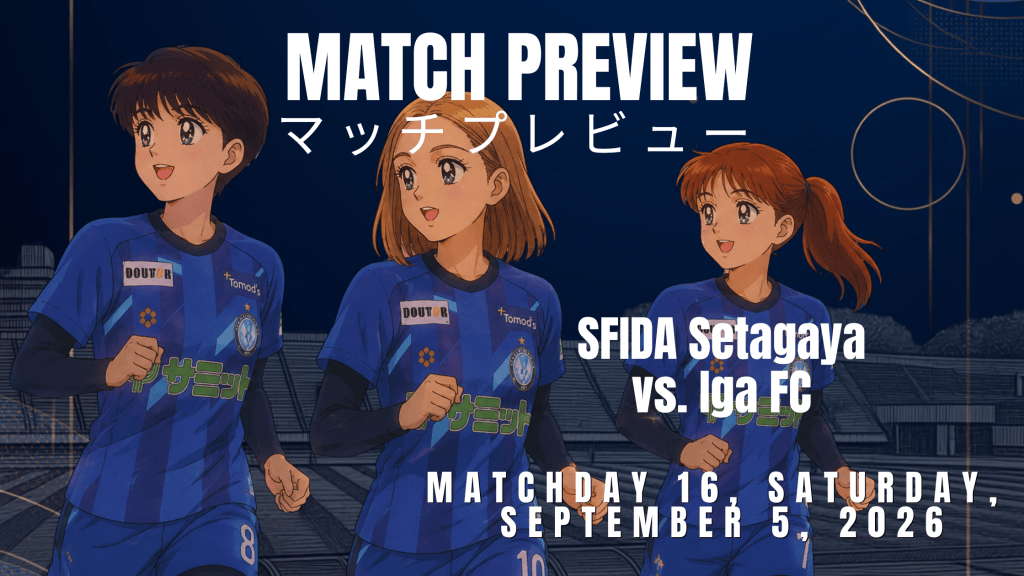
There is a Japanese expression I keep returning to whenever I think about SFIDA Setagaya this season.
Happō fusagari.
Blocked in all eight directions.
It feels particularly appropriate before Iga FC Kunoichi Mie arrive at AGF Field on Saturday afternoon, because wherever I look for an obvious route out of SFIDA’s current predicament, somebody appears to have parked something enormous in front of it.
Look forward, and there is a future increasingly shaped by FC Tokyo. Look backwards, and there is a community club whose identity has been carefully constructed over more than two decades. Look at the table, and SFIDA are eighth with 16 points. Look at recent results, and you find consecutive league defeats without scoring, including the horrible 3-0 loss against Yokohama FC Seagulls.
And then look across the pitch on Saturday.
There is Iga.
Of course there is.
SFIDA have not beaten Iga for nearly four years. Seven meetings have produced four draws and three defeats, with those irritating stalemates gradually becoming something worse. Recent meetings have ended 3-2 and 2-1 in favour of the Kunoichi.
If there is a locked door anywhere in Japanese women’s football, SFIDA have spent four years rattling this particular handle.
Saturday would be a rather useful time to finally kick it open.
This is about considerably more than the positions
On paper, this is an ordinary Nadeshiko League Division 1 fixture.
Iga arrives with 26 points from 15 games and the possibility of properly dragging themselves into the championship conversation. SFIDA have 16 and are looking nervously in the opposite direction instead.
But those numbers conceal two clubs experiencing very different moments in their histories.
Iga FC Kunoichi Mie are celebrating their 50th anniversary. Their identity is so deeply established that even their name connects them to Iga’s famous ninja heritage. There is history, geography, symbolism, and institutional memory here.
They know what they are.
SFIDA increasingly fascinate me because that answer is becoming considerably more complicated.
We are watching SFIDA while knowing that this version of SFIDA is disappearing.
Even AGF Field contributes to that feeling. The move away from Komazawa has created another transition, another new home that must somehow be made to feel permanent during an era when almost nothing else does.
And the football has hardly provided an escape.
Manager Takashi Hamada has spoken increasingly bluntly about what professionalism actually requires, arguing that systems become largely irrelevant without the individual quality and tactical intelligence necessary to execute them.
There was something revealing about his insistence that everybody, including the staff, must seriously confront what it means to be a professional footballer.
Mayu Yaguchi has already made that choice
Perhaps that is why Mayu Yaguchi interests me so much.
Yaguchi left JEF United and the WE League to join SFIDA because she wanted to play.
There is something wonderfully uncomplicated about that.
Football loves upward mobility. Bigger clubs, bigger competitions, bigger salaries, bigger stages. Careers are often described as ladders, and anyone travelling down one is presumed to have slipped.
Yaguchi deliberately stepped down a division.
“I want to work hard so that I can affirm this decision and my past self,” she said after arriving.
That line has stuck with me.
She is joining a club wrestling with what it wants to become while attempting to prove that choosing this particular moment of uncertainty was worthwhile.
Saturday also contains smaller reunions. Saya Shinohara will face the Iga club she previously represented. Going the other way is Kanako Takeshima, once of SFIDA, who came out of retirement to represent her hometown club and chase a championship.
Different careers intersecting at the same little patch of grass in Chofu.
That is often where the interesting stuff lives.
Unfortunately, Iga are exceptionally good at ruining things
There is another reason I dislike this matchup for SFIDA.
Iga are extremely difficult to play against.
Eight clean sheets in 15 league games tells part of the story. Eleven goals conceded tells more of it. But watching the numbers manifest themselves on the pitch explains why this fixture has become so frustrating.
Miyu Hata gives their defensive line aggression and authority. Iga can push surprisingly high because their defenders are comfortable attacking danger rather than retreating from it. Ahead of them, the midfield competes relentlessly for second balls, allowing another attack to begin almost immediately after the previous one has broken down.
It can feel suffocating.
The strange part is that Iga’s greatest opponent is frequently Iga.
They recently took 15 shots against Miyazaki and conceded only three.
The match finished 0-0.
Manager Yoshiaki Nagai has openly acknowledged the problem. His side can manufacture opportunities, but converting them remains maddeningly difficult. Hinano Hirata and Rima Matsuda are their leading scorers with only three apiece.
So Iga have constructed something resembling a championship defence without constructing a championship attack.
That should encourage SFIDA.
It also creates a slightly terrifying possibility.
What happens if the finishing finally clicks against a defence that has already conceded 24?
SFIDA cannot have the ball simply because somebody has to
That question becomes particularly uncomfortable after the defeat in Yokohama.
SFIDA had plenty of possession.
Yokohama had the goals.
Five SFIDA shots against 15 from Yokohama tells you roughly everything else.
I have increasingly found SFIDA’s possession frustrating because there are passages in which the ball movement looks perfectly respectable without actually threatening anyone. Possession becomes aesthetic rather than aggressive.
A football team should not receive marks for handwriting.
The experimental 3-4-3 has only complicated matters. Pushing the wing-backs higher offers another body in attack, but Yokohama repeatedly exposed the acreage behind them with direct balls into sudden three-against-three situations.
Against Iga’s pressing and ability to recycle possession, that could become dangerous very quickly.
Which brings me to Mizuki Horie.
If SFIDA are going to disrupt Iga’s carefully maintained geometry, I want Horie making everything untidy.
At 174cm, she provides a physical reference point, but reducing her contribution to height misses the interesting part. Defenders alter their positions because she exists. Centre-backs become occupied. Second defenders drift towards her. Spaces appear elsewhere.
Some forwards finish attacks.
Horie can rearrange them.
And if she can distort Iga’s defensive structure for half a second, Misuzu Uchida is exactly the player I want arriving in the space she leaves behind.
Uchida recently passed 200 league appearances, but experience is not really what fascinates me about her. It is timing.
She rarely appears hurried.
Everybody else seems to play at one speed while Uchida occasionally finds another fraction of a second nobody else noticed was available.
Against Hata and this Iga defence, fractions might be all SFIDA get.
And then there is the emergency response unit
SFIDA will almost certainly need Mio Otsuka again.
At 19 years old and 180cm, she has already spent portions of this season operating less like a goalkeeper and more like somebody answering repeated emergency calls.
That is not entirely a compliment to the team in front of her.
If SFIDA continue to leave enormous spaces behind an adventurous defensive structure, Rena Masuda and Rin Watanabe are precisely the players I don’t want to see.
Masuda can recover defensively before exploding forward again, while Watanabe possesses the speed to turn a harmless transition into something considerably less harmless.
Behind all of this, Nana Watanabe remains SFIDA’s defensive insurance policy, repeatedly appearing where problems are about to develop.
Against Iga, she may need tomorrow’s newspaper again.
Maybe the heat will finally melt the lock
By four o’clock on Saturday afternoon, Chofu could still be roasting.
Japanese summer football has become its own peculiar endurance exercise: cooling breaks, supporters fanning themselves in the stands and players trying to execute complicated tactical instructions while Tokyo resembles a greenhouse somebody forgot to open.
Into that humidity walk two clubs who could hardly feel more different.
Iga are 50 years old and chasing something tangible. They have one of the league’s best defences, an established identity and a clear target.
SFIDA are chasing something harder to define.
Points, obviously. They desperately need those.
But I think Saturday is also about proving that this strange transitional season still belongs to them.
Before FC Tokyo arrives, before the name changes, before the infrastructure changes and before historians inevitably divide the club into before and after, there are still matches to play as SFIDA Setagaya FC.
There are still little pieces of history available.
Beating Iga would qualify.
Four years. Seven attempts. No wins.
And somewhere among all of that, SFIDA need to find a direction that isn’t blocked.
Maybe it is straight through the door.