
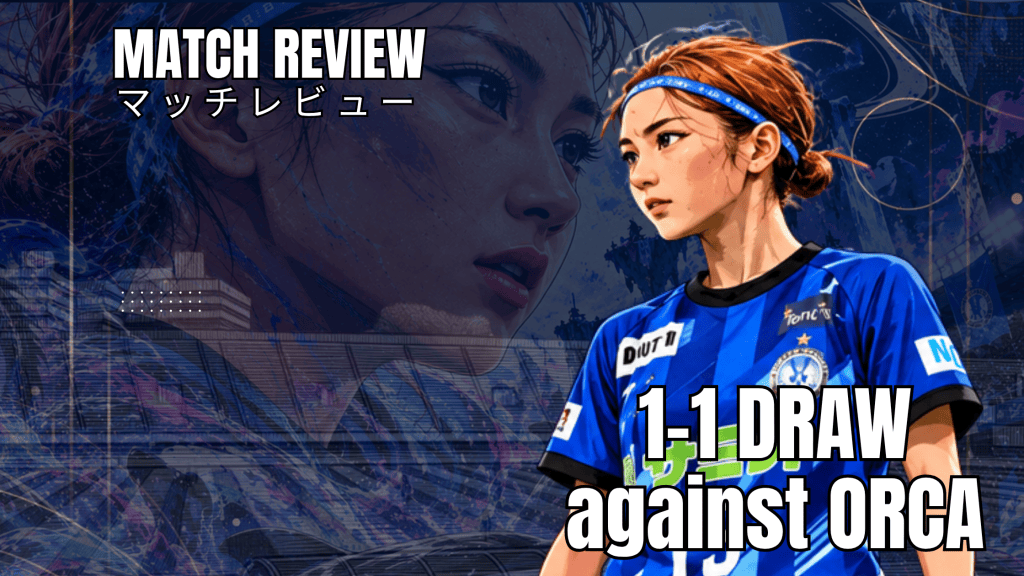
SFIDA Setagaya drew 1–1 with Orca Kamogawa at AGF Field on 4 October.
My mental health has not been especially good recently. Some days, doing normal things has felt considerably harder than it should, and somewhere in amongst all of that, football analysis slipped down the list.
I think I am getting better.
I would like to think so, anyway.
There is still a fair bit of road ahead, but perhaps getting better sometimes looks less dramatic than we imagine. Sometimes it is just opening the match again, sitting down and watching SFIDA Setagaya play football. So that is what I am doing.
Orca Start Quickly, But SFIDA Settle
Orca Kamogawa win a corner inside the opening two minutes.
Not exactly what I wanted to see.
Soon afterwards, one of their players goes down and initially looks in considerable discomfort. The medical staff come on. A stretcher arrives. Thankfully, she eventually walks off the pitch herself, although the interruption lasts long enough to drain some of the game’s early momentum.
Then SFIDA begin playing.
Ayaka Nemoto sends an early cross into the area.
Nothing comes from it, but it is decent.
Nana Watanabe combines neatly with Saaya Kato a few minutes later, and seven minutes into the match, SFIDA already looks encouraging in how they’re occupying territory.
There is no enormous chance.
No goalkeeper being forced into a Godzilla-sized emergency.
Just useful football.
Setagaya play vertically whenever possible, looking to Mizuki Horie and Misuzu Uchida early, then asking the midfield to move aggressively toward the second ball.
It is quite a simple idea.
Simple football is sometimes treated as intellectually inferior football, which is nonsense. If you have forwards who can compete physically and midfielders ready to follow the play, there is nothing morally superior about completing eight extra passes before reaching the same patch of grass.
For the first 15 minutes, it works.
Then Saya Shinohara Does Something Ridiculous
SFIDA win a free kick on the right.
Saya Shinohara stands over it.
From that position, you normally expect delivery.
You imagine someone attacking the near post. Perhaps Horie tries to flick it across goal. Maybe Uchida arrives late. Perhaps the goalkeeper punches.
Shinohara simply scores instead.
The ball curls towards goal, drops awkwardly and ends up in the net.
1–0.
Lovely.
There might have been the faintest touch somewhere in the crowd of bodies, but I am not especially interested in ruining this.
Award her the Ballon d’Or.
Direct free kicks from those positions have a peculiar beauty because they briefly confuse everyone, including those watching. For half a second you are waiting for the second phase of the attack before realising there is no second phase.
The ball is already in the goal.
More importantly, SFIDA are leading at AGF Field.
That has not always been a particularly comfortable sentence this season.
Before this match, Setagaya had six wins from 20 league matches and had only just confirmed their Nadeshiko League Division 1 survival by beating VONDS Ichihara 1–0 the previous week.
Safety changed the terms of this game.
Orca arrived with considerably more to lose.
They began the day third, chasing Shizuoka SSU Bonita and Asahi Intecc Loveledge Nagoya. Their title ambitions required near-perfection over the run-in.
SFIDA, meanwhile, finally had room to breathe.
It is easy to see how that affected the opening exchanges.
Missing Japan in the Middle of a Football Match
After the goal, there’s a period where not much happens.
Ten minutes of football being football.
Players repositioning. Possession changing hands. Neither goalkeeper doing anything particularly heroic.
Then I start listening to the Japanese commentary properly.
I can hear the supporters. I can see the advertising boards, the grey sky over Chofu, the familiar rhythm of a Japanese football broadcast.
And I miss Japan. A lot.
I used to live in Yokohama. My job was fine. Life was comfortable. Things made sense in a way I perhaps didn’t appreciate at the time.
Coming back to Britain hasn’t unfolded as neatly as I imagined. When I visited Japan earlier this year, being back felt strangely natural.
That is a dangerous feeling because nostalgia is a fantastic editor. It removes the boring train delays, the difficult workdays, and the expensive supermarket trips, leaving you with railway jingles and convenience stores at midnight.
Still. Maybe I will be back sooner rather than later.
Anyway. There is a football match on.
Orca Begin to Find Their Way In
Around the 25-minute mark, Orca win a central free kick.
The delivery is threatening enough, but it doesn’t become anything meaningful.
A few minutes later, the match becomes scrappier.
Both teams begin surrendering possession more frequently.
Orca’s Honoka Kitamura catches my attention.
She is constantly involved.
Not necessarily producing highlight-reel actions, but moving, pressing, checking passing lanes and bothering defenders.
Those players matter.
They are football’s background machinery.
You notice the goal scorer. You notice the winger beating three players.
You do not always notice the forward who has spent 35 minutes making the opposition uncomfortable enough that eventually somebody makes a mistake.
Then somebody makes a mistake.
One Pass Changes the Match
Orca try a long-range effort in the 36th minute.
There is genuine venom behind it. Mio Otsuka is forced to save it.
While I am still writing that down, Orca scores.
That is slightly irritating.
The move begins with SFIDA trying to play out.
Miwa Kashiwabara wants to clear the danger properly, but the pass doesn’t travel as far as intended.
Kitamura reads it immediately.
That is the important bit.
She does not wait to see what happens.
She attacks the mistake.
Orca’s press had already begun restricting SFIDA’s exits, with Yui Kaneko helping close the centre and the forwards pushing play towards the touchline. The loose ball therefore doesn’t just become a loose ball.
It becomes an invitation.
Kitamura intercepts, and Ayaka Saito makes the run.
One pass later, Saito is through against Otsuka.
She finishes.
1–1.
That sucks.
It is also an excellent example of why pressing is sometimes discussed badly.
A pressing goal is rarely produced by one player sprinting heroically towards a defender.
Usually, several players quietly remove alternatives until the defender is left with one increasingly unpleasant choice.
Kitamura collects the reward, but the trap was already set around her.
Two Completely Different Goals
The first half feels pleasingly symmetrical.
SFIDA score because their direct football creates territory and earns a set piece.
Orca score because their pressing punishes SFIDA when they attempt something slower.
One team creates chaos.
The other waits for the chaos to become useful.
Shinohara’s goal looks almost accidental, even if the technique is anything but.
Saito’s equaliser is almost the opposite.
Nothing spectacular individually.
Just coordinated pressure, one mistake, one diagonal run and one finish.
That is football stripped down to its machinery.
Horie’s 200th Match Deserved More Than a Footnote
Another story sat quietly inside this game.
Mizuki Horie was recognised at home following her 200th career appearance.
Her nephew and niece attended the ceremony.
Horie later wrote about how much energy she takes from watching them grow and how she wants to continue playing well so they can watch her succeed.
That matters.
Professional football spends so much time talking about milestones that numbers begin to lose their shape.
100 appearances.
200 appearances.
300 appearances.
But 200 football matches represent hundreds of training sessions, travel days, injuries, selection decisions, rubbish weather, good performances, anonymous performances, and evenings when someone still has to get up the next morning and do it again.
Against Orca, Horie did not register an official shot.
Neither did Uchida.
Yukino Tsukuto and the Orca defence handled SFIDA’s physical forwards extremely well, stepping aggressively into aerial contests and preventing either striker from turning territorial dominance into clear chances.
It would therefore be easy to reduce Horie’s afternoon to zero shots.
That would also be a fairly miserable way to understand football.
She was still the reference point for much of what SFIDA were attempting.
Minutes matter.
Presence matters.
Careers are made from far more than goals.
Orca Take Control, But Not the Match
The second half belongs much more clearly to Orca.
The numbers are fairly brutal.
SFIDA manage only one second-half shot.
Orca produce six.
Over the match, Kamogawa outshoots Setagaya 11–4.
Nagisa Ota becomes increasingly influential from central midfield and eventually finishes with a match-high three attempts.
This is where the draw becomes interesting.
If you only read the statistics, Orca probably look unfortunate.
If you watch the match, it feels slightly more complicated.
SFIDA had already established the terms early.
They disrupted Orca’s shape, competed aggressively for second balls, and forced the visitors to spend much of the opening half solving problems they perhaps did not expect to face.
Orca did eventually solve them.
They simply did not score again.
There is a case to be made that this is what separated the teams emotionally as much as tactically.
Orca needed the win. SFIDA wanted it.
Those are not the same thing.