If your goal is to build a back that looks as powerful from the rear as it does from the front, the T-Bar row deserves a place in your programme. This classic compound exercise has been a favourite of bodybuilders, power athletes and wrestlers for decades thanks to its ability to add impressive thickness across the upper and mid-back.
Unlike pull-ups or lat pulldowns, which primarily emphasise width, the T-Bar row develops the dense muscle that gives your back a three-dimensional appearance. Whether you’re using a landmine setup or a dedicated machine, it’s an outstanding movement for increasing strength, improving posture and building functional pulling power.
Muscles Worked
Primary Muscle
- Latissimus dorsi (lats)
Secondary Muscles
- Rhomboids
- Trapezius (middle and lower fibres)
- Posterior deltoids
- Biceps
- Brachialis
- Forearms
Stabilising Muscles
- Core
- Spinal erectors
- Glutes
- Hamstrings
Why This Exercise Is So Effective
The T-Bar row combines heavy loading with a natural pulling path, making it one of the most efficient back-building exercises available.
One of its biggest advantages is its ability to develop back thickness. The rhomboids and traps are forced to contract hard at the top of every repetition, while the lats generate the power needed to move substantial weight.
Research into hypertrophy continues to highlight the importance of training muscles in their lengthened position. The T-Bar row naturally becomes most challenging near the bottom of the movement when the back muscles are fully stretched, making it an excellent choice for muscle growth.
The exercise also strengthens the muscles responsible for maintaining good posture. In an age where many people spend hours sitting at desks, strengthening the posterior chain can help counter rounded shoulders and improve upper-body positioning.
For athletes, stronger rows transfer well into sports that involve grappling, climbing or explosive pulling movements. Wrestlers frequently use T-Bar row variations to improve upper-body control, grip strength and the ability to dominate opponents during clinches and takedowns.
Technique Breakdown
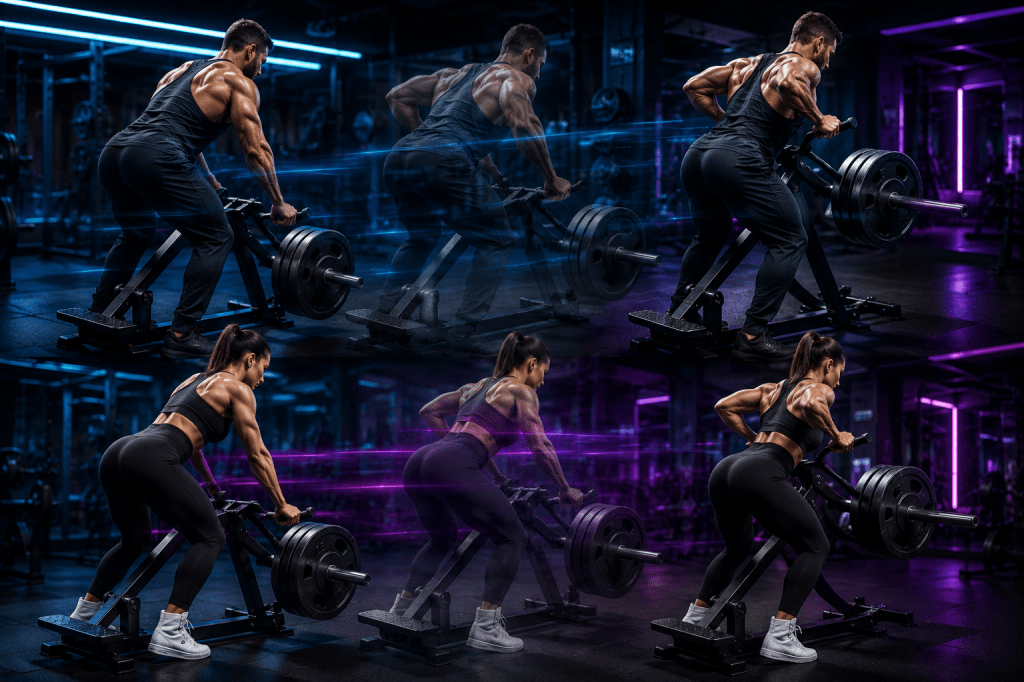
Start by loading a landmine barbell or dedicated T-Bar row machine with an appropriate weight. Attach a close-grip V-handle if using a landmine setup.
Stand over the bar with your feet either side and hinge at the hips until your torso sits at roughly 45 degrees. Keep your knees slightly bent, chest lifted and spine neutral.
Grip the handle firmly and brace your core before initiating the pull.
Drive your elbows backwards, pulling the weight towards your lower chest or upper abdomen while squeezing your shoulder blades together.
Pause briefly at the top before lowering the weight under control until your arms are fully extended.
Avoid bouncing the weight or allowing momentum to take over. Every repetition should remain controlled.
Coaching cues:
- Pull your elbows, not your hands.
- Keep your chest proud.
- Brace your core throughout.
- Control the lowering phase.
Common Mistakes
Many lifters make the mistake of turning the movement into a full-body heave by using excessive momentum. While heavier weights are tempting, swinging reduces back activation and shifts stress elsewhere.
Another common error is rounding the lower back. Maintaining a neutral spine throughout every repetition is essential for both performance and safety.
Some lifters also cut the range of motion short. Fully stretching the lats at the bottom and squeezing the shoulder blades together at the top produces the best results.
Finally, avoid shrugging your shoulders excessively. Think about driving your elbows behind you rather than lifting your shoulders towards your ears.
Variations and Alternatives
Beginners may find a chest-supported T-Bar row easier to master, as it removes much of the stability demand and allows them to focus purely on the pulling movement.
For advanced lifters, heavier landmine T-Bar rows or wider grip variations can increase the challenge while shifting emphasis across different parts of the back.
Who Should Use the T-Bar Row?
The T-Bar row suits almost anyone looking to build a stronger back.
Bodybuilders value it for its unmatched ability to add thickness.
Powerlifters use it to strengthen the upper back for improved deadlift and squat stability.
General gym-goers benefit from improved posture and pulling strength, while athletes involved in rugby, wrestling, judo and mixed martial arts use it to develop explosive upper-body power.
Professional wrestlers are particularly fond of the movement. Variations regularly appear in the training routines of stars such as Drew McIntyre and Jinder Mahal, while veteran Tatanka has showcased heavy T-Bar rows during his workouts.
Current powerhouse Jordynne Grace has also made heavy rowing movements a consistent feature of her pull-day sessions. Known for one of the strongest physiques in professional wrestling, Grace uses exercises like the T-Bar row to build the dense upper back, grip strength and pulling power that support her explosive in-ring style. It’s a reminder that this isn’t simply a bodybuilding exercise. It’s a movement capable of developing strength that carries directly into athletic performance.
Disclaimer: This article is intended for entertainment purposes only and does not constitute medical, physiotherapy, coaching or professional training advice. Always consult a qualified healthcare or fitness professional before beginning a new exercise programme. Complete all workouts at your own risk.