Some football matches arrive wrapped in statistics.
Others arrive carrying family history.
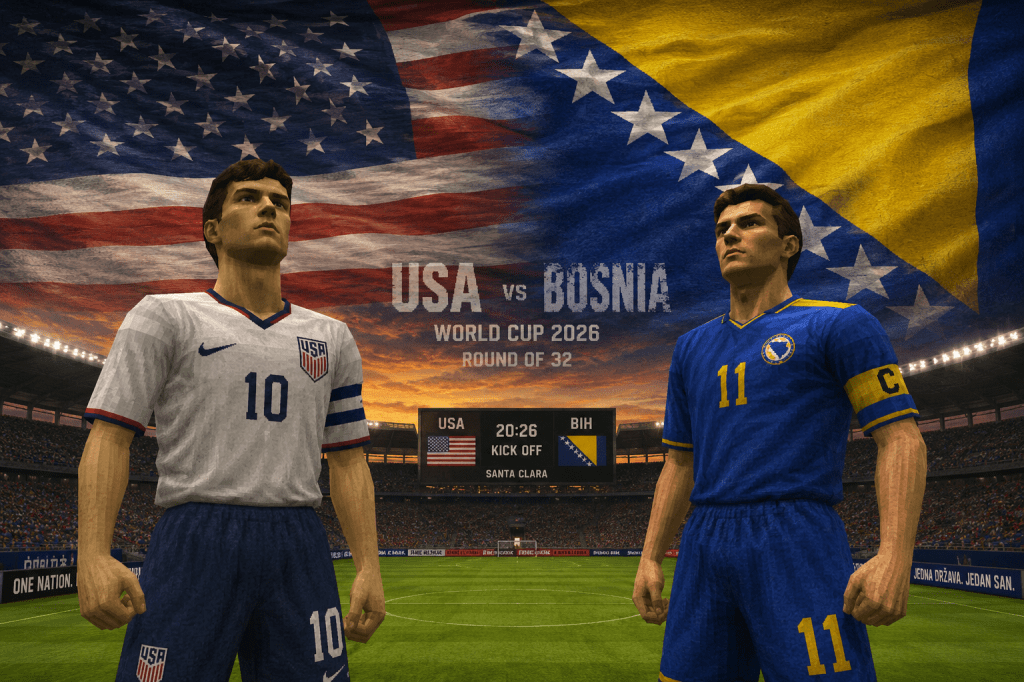
The ball will still roll across the immaculate surface of Levi’s Stadium on Wednesday evening. The television graphics will still remind us that this is simply the Round of 32 at the 2026 FIFA World Cup. Somebody will mention possession percentages before kick-off, somebody else will produce an expected goals graphic before half-time, and somewhere in the American broadcast there will almost certainly be dramatic music explaining why this is the biggest night in US men’s football for a generation.
It probably is.
But it isn’t the whole story.
Because standing somewhere across from Christian Pulisic will be a young man born in Wisconsin who once wore the Stars and Stripes, whose surname quite literally means “flag-bearer”, and who now represents the country his parents escaped before he was even born.
Football has always enjoyed producing these moments. Mechagodzilla-sized narratives stomping through otherwise ordinary matches, flattening tactical discussions beneath their feet.
This one feels impossible to ignore.
America’s Long Wait
American football supporters have become remarkably patient.
They have almost had to.
The United States has not won a World Cup knockout match since defeating Mexico in 2002. Twenty-four years is an awfully long time to spend describing every tournament as the one where everything finally changes.
This generation was supposed to be different.
The infrastructure is bigger.
The academies are better.
The player pool stretches across Europe.
The money involved resembles the GDP of several small nations.
Yet here they stand, still trying to escape the same historical gravity.
Even their route here feels slightly uncomfortable.
Mauricio Pochettino rotated heavily against Turkey in the final group match and watched his side lose 3-2, before spending much of the aftermath arguing with journalists who, in his view, hadn’t properly congratulated his side for winning the group.
Managers do this occasionally.
Results become secondary to narratives.
Narratives become personal.
Press conferences become theatre.
It was framed as defending his players.
It also sounded like a man who knows this tournament has only just begun judging him.
The Boy From Wisconsin
Football likes irony almost as much as supporters like holding grudges.
Esmir Bajraktarević may prove to be the most emotionally complex figure at this entire World Cup.
Born in Appleton, Wisconsin.
Raised in America.
Developed inside the United States youth system.
A senior US international.
Until he wasn’t.
His parents fled Bosnia during the horror surrounding Srebrenica in the mid-1990s, losing family members before eventually building a new life across the Atlantic. America gave Esmir opportunity.
Bosnia gave him identity.
He has spoken openly about growing up wearing Edin Džeko shirts.
About always feeling Bosnian.
About knowing where he belonged.
It is easy to dismiss those comments as football sentiment.
Then you remember what his surname means.
Flag-bearer.
When he converted the decisive penalty against Italy to send Bosnia to this World Cup, he removed his shirt and revealed that name across his back.
Not his first name.
His family name.
That felt deliberate.
Minor gestures usually are.
Now he returns to play against the country that raised him.
Not out of revenge.
Not even rejection.
Simply because life is rarely neat.
The Last Dragon
Every tournament eventually produces one footballer who appears to have quietly ignored the passage of time.
This year it is Edin Džeko.
Forty years old.
One hundred and fifty international appearances.
Seventy-three international goals.
Still wandering into penalty areas with that familiar mixture of elegance and stubbornness.
There is something wonderfully old-fashioned about watching Džeko.
He never relied upon explosive acceleration.
He has never needed elaborate celebrations.
He simply arrives where footballs tend to land.
The body ages.
The timing doesn’t.
Bosnia still revolve around him because some players eventually stop becoming footballers and instead become landmarks.
Opponents don’t merely defend against them.
They navigate around them.
Tim Ream and Chris Richards will probably spend ninety minutes trying to prevent Džeko writing one more chapter into a career that has already outlived several tactical revolutions.
As Džeko himself put it, he’ll keep playing for as long as he can still help.
Simple enough.
Progress Meets Memory
America’s tournament has largely been built upon speed.
Eight goals during the group stage.
Aggressive pressing.
Relentless attacks down the right through Sergiño Dest, Weston McKennie and Alex Freeman.
They have scored early.
Frequently.
Convincingly.
Yet beneath all that attacking confidence remains an awkward truth.
The United States have lost ten consecutive matches against European opposition.
Statistics like that become slightly ridiculous after a while.
Nobody inside the dressing room played every one of those matches.
Some weren’t even professionals.
But football loves inheritance.
Players end up carrying records they never created.
Chris Richards brushed it aside by saying streaks are meant to be broken.
Perhaps.
They usually are.
Eventually.
Bosnia Don’t Care About Your Metrics
Bosnia arrive through football’s side entrance.
Third place.
Six goals conceded.
Little interest in dominating possession.
Minimal open-play creativity.
Set pieces.
Counter attacks.
Determination.
The expanded World Cup has created room for teams exactly like this.
Sides who survive first and explain themselves afterwards.
Their expected goals remain underwhelming.
Their actual resilience doesn’t.
Sometimes football resembles a carefully engineered machine.
Other times it resembles someone holding together an old washing machine with duct tape and optimism.
Bosnia have become rather good at the latter.
Thirty Million People and One Family Story
The broadcasters will tell us roughly thirty million Americans could watch this match.
That matters commercially.
It matters politically.
It matters culturally.
All perfectly reasonable.
Yet one suspects somewhere among those millions will be families watching for entirely different reasons.
Bosnian refugees.
American neighbours.
Children translating between generations.
Parents remembering places they never truly left.
Football occasionally shrinks enormous human experiences into ninety minutes.
It cannot possibly do them justice.
It keeps trying anyway.
Perhaps that is why people keep watching.
The Strange Weight of Knockout Football
Pulisic returns fit enough to start.
America believes.
Bosnia believes slightly differently.
One side sees expectation.
The other sees opportunity.
One has spent decades building towards legitimacy.
The other still feels faintly amazed simply to have arrived.
Neither emotion guarantees anything.
Knockout football rarely rewards certainty.
It rewards whoever copes best when certainty quietly disappears.
Like Mechagodzilla emerging through smoke, these occasions look enormous long before anyone understands how they will actually unfold. The spectacle grabs the attention first. Only afterwards do people notice the smaller human stories moving beneath all that steel.
This feels like one of those nights.
Whatever happens, somebody’s history will become somebody else’s memory.
And those tend to last far longer than any scoreline.
One flag, two homelands
Old dragons wait beneath bright lights
History chooses




One response to “The Flag-Bearer Comes Home: USA vs Bosnia is About Much More Than Football”
[…] dismissal against Bosnia and Herzegovina looked straightforward […]
LikeLike