The blood appeared before the championship did.
Sol Ruca had launched herself over the ropes with an Orihara moonsault, the sort of manoeuvre that makes perfect sense within professional wrestling and considerably less sense when described to somebody who spends their Monday evenings doing something sensible. Somewhere during the collision, Raquel Rodriguez’s nose took the worst of it.
By the time she was back inside the ring, blood was running down her face.
She kept going.
That detail matters because WWE has spent years telling us that Rodriguez is powerful. She is six feet tall, built like someone who could carry most of the Raw roster out of a burning building two at a time, and has spent a considerable portion of her main-roster career standing behind other people looking intimidating.
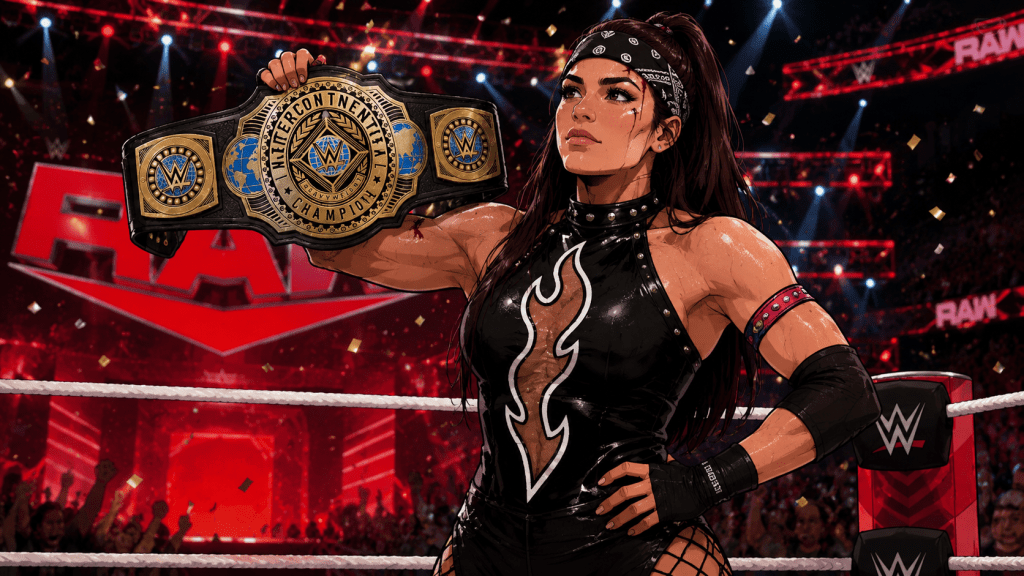
On July 27 at the new Intuit Dome in Inglewood, she finally got something of her own.
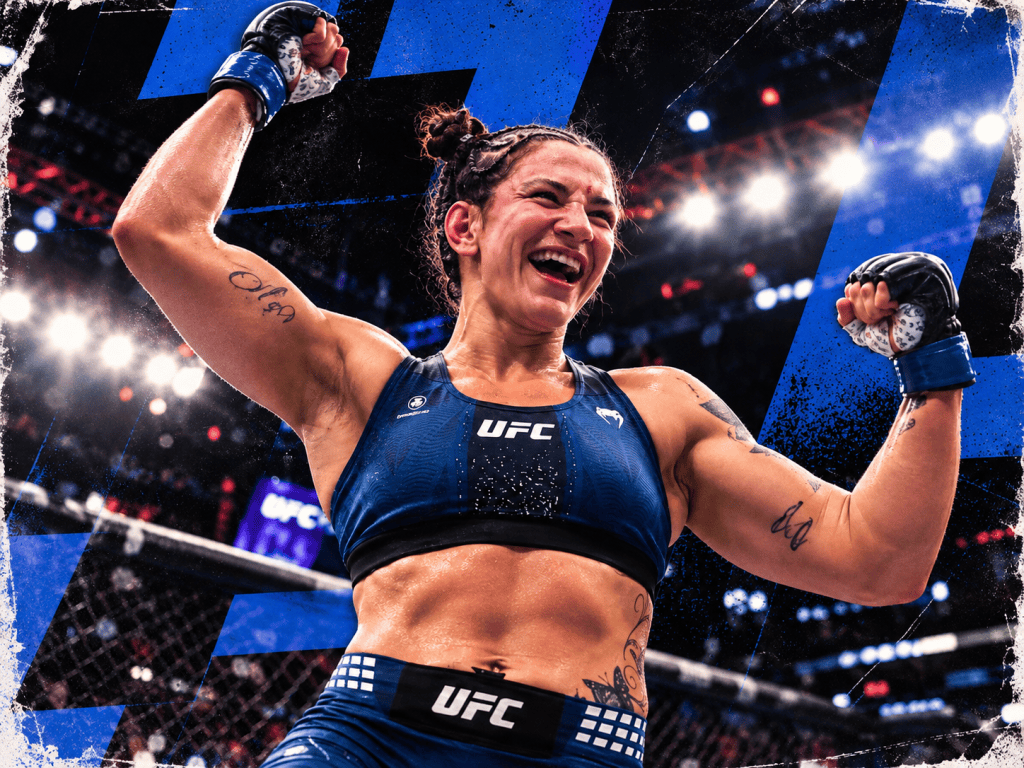
Raquel Rodriguez defeated Sol Ruca to become WWE Women’s Intercontinental Champion, ending Ruca’s reign after 58 days and, more significantly, giving Rodriguez her first singles championship since arriving on WWE’s main roster.
It had taken long enough.
Raquel Rodriguez Had Been Waiting for This
There has always been something slightly peculiar about Rodriguez’s WWE career.
She looks exactly like the sort of wrestler a company would create if somebody entered the words dominant professional wrestler into a particularly unsubtle character generator. She is enormous without being cumbersome, athletic without needing that athleticism constantly pointed out, and has enough presence that simply standing behind another wrestler can constitute meaningful television.
Yet WWE largely turned her into a tag-team specialist.
She won championships. She appeared prominently. She remained relevant.
But there is a difference between being important and being treated as important.
For years, Rodriguez existed somewhere between the two.
Her absence while dealing with Mast Cell Activation Syndrome made the journey considerably more complicated. Wrestling encourages people to think of careers as uninterrupted narratives, just as television does. Somebody disappears, a video package eventually explains why, then the story continues.
Bodies are less cooperative.
Rodriguez returned, eventually becoming part of The Judgment Day and developing the harder-edged persona that had probably always suited her better. There was less smiling, more looming—less Big Mami Cool in the slightly awkward WWE marketing sense and more actual menace.
The machinery finally matched the exterior.
By the time she challenged Ruca, she didn’t particularly need another tag championship. She needed proof that WWE saw her as something beyond an extremely useful piece of somebody else’s faction.
A singles championship does that.
To be fair, wrapping a belt around somebody does not automatically constitute a push, regardless of what several decades of wrestling discourse would have us believe. Championships can become props very quickly.
But this one felt different. Especially how it was a rematch from two weeks ago.
Sol Ruca Wasn’t Exactly an Easy Champion to Replace
The interesting part was the person Rodriguez had to beat.
Sol Ruca’s rise has been unusually fast, even by WWE standards, where six months can transform someone from a developmental prospect to standing beneath indoor fireworks while commentators discuss their childhood.
Ruca came through NXT with the obvious attraction being her athleticism. The Sol Snatcher alone was enough to make her immediately identifiable, a trait that is increasingly valuable in wrestling. Plenty of wrestlers can perform impressive moves. Fewer have one that makes a crowd collectively realise what is happening about half a second before it happens.
Then came the Women’s Intercontinental Championship.
Ruca had beaten Becky Lynch in Turin to claim it and carried the belt for 58 days before arriving in California opposite Rodriguez.
There was an obvious physical contrast.
Ruca at 5’9″ and around 139 pounds against Rodriguez at 6’0″ and 175.
The aerialist against the powerhouse.
Wrestling has been recycling this basic equation since people realised that watching differently shaped humans throw each other around was commercially viable.
It still works.
Ruca moved. Rodriguez stopped her moving.
Then Ruca moved again.
For much of the match, the champion’s athleticism gave Rodriguez problems precisely because overpowering somebody becomes considerably more difficult when they insist on throwing themselves through unusual sections of the atmosphere.
The Orihara moonsault was the ultimate example.
Ruca cleared the ropes.
Rodriguez caught the impact.
Then came the blood.
The Blood Changed Everything
Professional wrestling has a strange relationship with blood.
Too much of it becomes grotesque background decoration. Too little and the sight of it becomes genuinely arresting.
This was the latter.
Rodriguez’s nose was bloodied badly enough that suddenly the match looked different. The polished WWE presentation, the LED screens, immaculate ring canvas and carefully branded championship contest briefly had something uncontrolled running through it.
Raquel looked excellent.
Not because being injured is inherently impressive, nor because wrestlers should be expected to continue regardless of what happens to their bodies. That particular philosophy belongs in wrestling’s large warehouse of terrible historical ideas.
But because it suited the match.
Rodriguez suddenly looked less like the designated Judgment Day powerhouse and more like someone Sol Ruca was going to have to survive physically.
Ruca had broken the exterior.
Unfortunately, everything beneath it continued to work.
Rodriguez had spent years being presented as dangerous.
Now she actually looked it.
And Then Everyone Else Arrived
Naturally, WWE couldn’t simply let two wrestlers decide who was better.
That would have been dangerously straightforward.
Roxanne Perez was already positioned around Rodriguez as part of The Judgment Day machinery, but the final stages expanded into the wider Raw ecosystem involving Liv Morgan and Iyo Sky.
This was partly about the Women’s Intercontinental Championship and partly about SummerSlam, because modern WWE television occasionally resembles six browser tabs playing videos simultaneously.
Morgan’s looming championship programme with Sky bled into proceedings. Perez became involved. Sky arrived.
Everybody had a reason to be there.
Probably.
This is the Judgment Day problem and, depending on your tolerance for wrestling factions, occasionally the Judgment Day appeal.
Nothing happens alone.
Rodriguez could theoretically go shopping for milk and return accompanied by three stablemates, a rival faction and somebody holding a Money in the Bank briefcase.
For Sol, that became decisive.
The interference created the opening Rodriguez needed, and eventually she hauled Ruca up from the second rope.
The Tejana Bomb followed.
One, two, three.
After 10 minutes and 24 seconds, there was a new Women’s Intercontinental Champion.
Sol Ruca Losing Isn’t Necessarily a Problem
Predictably, some supporters were unhappy.
Ruca had held the championship for only 58 days. She was gaining momentum. Other possible programmes, including one involving Lyra Valkyria, appeared to be hovering somewhere in WWE’s enormous narrative waiting room.
Then the belt disappeared.
Wrestling fans have become understandably suspicious of short championship reigns because they often suggest somebody changed their mind.
But they have also developed a peculiar habit of treating a wrestler’s loss of a match as evidence of imminent professional extinction.
Ruca will be fine.
Probably.
She lost a championship match involving Judgment Day interference to a six-foot powerhouse who continued wrestling with blood pouring from her nose. There are less flattering ways to lose.
If anything, the circumstances give Ruca somewhere to go.
Chasing is useful.
Being wronged is useful.
Having several people responsible for taking something from you is particularly useful when your employer needs several hours of television filled every week.
The concern about Ruca being dragged into the so-called Judgment Day vortex is understandable. Faction stories can consume wrestlers rather than elevate them, particularly when every match becomes another exercise in waiting for somebody at ringside to climb onto the apron.
But there is also a perfectly good babyface story sitting there.
Sol Ruca was beaten.
She wasn’t conquered.
Wrestling occasionally remembers the difference.
Something Finally Belongs to Raquel
The more interesting story, though, is Rodriguez.
WWE has spent years giving her almost everything except this.
Tag championships established her reliability. Judgment Day gave her renewed prominence. Her physical presence ensured she never disappeared completely into the middle of the roster.
But singles championships are different.
They require somebody to stand alone, even when surrounded by an absurd number of interfering friends.
Rodriguez can now walk onto Raw carrying something that represents her rather than a partnership.
There is an irony that her first main-roster singles championship came while she was deeper inside a faction than ever before.
Wrestling likes contradictions.
The following Raw, Rodriguez introduced a customised version of the championship wrapped in real barbed wire, because apparently carrying a normal belt wasn’t threatening enough.
Subtlety had left the building.
Still, it worked.
This version of Rodriguez feels considerably more coherent than some of those that came before it. The smiling powerhouse never quite made sense. Neither did repeatedly pairing someone of her physical stature with partners and asking her to become half of something.
Now WWE has something simpler.
Raquel Rodriguez is the champion.
Let everyone else try to move her.
The reaction to the title change will remain divided because wrestling fans are required by ancient custom to immediately decide whether every booking decision is either magnificent or catastrophic. Rodriguez deserved the opportunity. Ruca perhaps deserved longer. Both things can be true.
What mattered in Inglewood was that after injuries, tag-team reigns, faction reshuffles and years spent being presented as somebody who could become a major singles wrestler, Rodriguez finally became one.
It took a broken nose, outside interference and a second-rope Tejana Bomb.
Nothing is allowed to be straightforward.
Especially not in wrestling.