
There are seasons that define clubs.
Then there are seasons that reveal them.
For JEF United, the 2026 J1 100 Year Vision League felt less like a triumphant homecoming and more like a brutally honest audit.
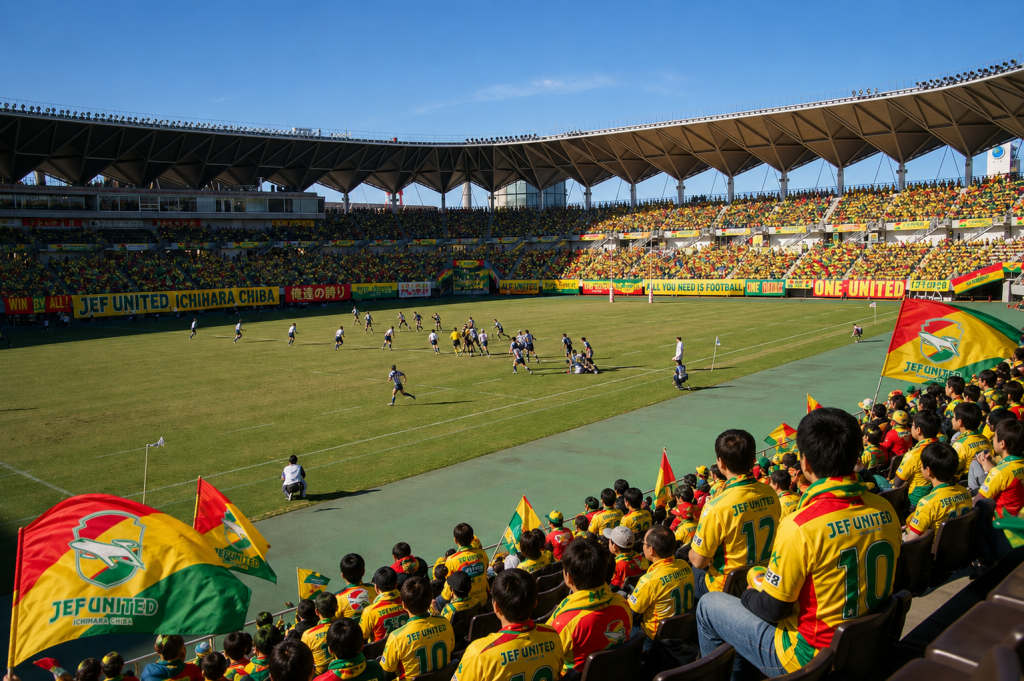
After 16 long years in the wilderness, one of Japan’s sleeping giants finally returned to the top flight. Supporters packed Fukuda Denshi Arena. The yellow flags waved. The famous Japanese soccer chants rolled through the stands with the same passion that had endured for nearly two decades outside the spotlight.
But passion alone does not survive in J1.
The league exposed every weakness.
The speed was faster.
The pressing was harsher.
The margins were smaller.
JEF United finished bottom of the table. Then lost the playoff, where the winning could grin and bear the moniker of the 19th-best team in Japan.
Yet amid the disappointment, one story refused to disappear.
His name was Makoto Himeno.
And by the end of the campaign, the 17-year-old academy graduate had become the most important reason for optimism in Chiba.
A Boy With Dangerous Ambition
Most teenagers entering professional football are careful.
They speak in rehearsed clichés.
They talk about learning, improving and gaining experience.
Makoto Himeno did something different.
Before the season began, he made a declaration.
“I want to score five goals.”
It was the kind of statement that could easily backfire.
JEF were newly promoted.
The club had not played top-flight football for nearly two decades.
The squad was full of players adapting to a dramatically higher level.
And here was a teenager announcing his intentions before he had even properly arrived.
The season would prove far harder than anybody imagined.
But the ambition mattered.
Because Himeno never looked like somebody who believed he was merely participating.
He looked like somebody who belonged.
Learning Football the Hard Way
The romantic version of youth development suggests talented youngsters gradually ease into senior football.
That was never going to happen here.
JEF United spent much of the season chasing games, defending deep and fighting simply to remain competitive.
Possession was often scarce.
Attacking opportunities arrived in brief, chaotic bursts.
For a young attacking midfielder, it was the equivalent of trying to paint a masterpiece while standing in a storm.
Every touch mattered.
Every mistake was punished.
Every run had to be repeated.
The physical demands were relentless.
Veteran defenders targeted space before Himeno could reach it.
Passing lanes vanished before he could exploit them.
The realities of J1 football arrived with an atavistic brutality that statistics cannot fully explain.
Yet the teenager kept returning.
Again.
And again.
And again.
There was something quietly impressive about the way he absorbed setbacks.
No dramatic tantrums.
No disappearing acts.
Just steady growth.
Kobayashi’s Challenge
Manager Yoshiyuki Kobayashi never treated Himeno like a child.
That may have been the greatest compliment he could offer.
Following the Chibagin Cup defeat to Kashiwa Reysol, Kobayashi acknowledged the youngster’s positive contribution before immediately raising expectations.
“Mako can do more,” he said.
“He must aim to change the team’s struggling situation himself.”
Some managers protect young talent.
Kobayashi challenged it.
He recognised something many outside the club were beginning to notice.
Himeno possessed unusual confidence.
Not arrogance.
Confidence.
The sort of belief that allows a teenager to demand the ball even when everything around him is collapsing.
As the season progressed, Kobayashi gradually trusted him with greater responsibility.
The role evolved.
The freedom increased.
The expectations rose.
And Himeno responded.
The Goal That Changed Everything
Every breakout season has a defining moment.
For Himeno, it arrived on May 6.
FC Tokyo against JEF United.
Hostile surroundings.
A difficult afternoon.
Himeno entered after 70 minutes.
Three minutes later, he changed the match.
A loose ball broke inside the penalty area.
While others hesitated, the teenager reacted instantly.
He darted forward, reached the ball ahead of former Japan international Yuto Nagatomo and calmly finished.
The celebration carried the unmistakable energy of a player who knew exactly what the moment meant.
Not wild.
Not theatrical.
Just pure release.
JEF United were on their way to a stunning 3-0 victory.
The goal itself may only count as one entry on a statistics sheet.
But emotionally it was worth far more.
It was proof.
Proof that one of the country’s brightest young Japanese soccer players could influence matches at J1 level.
Proof that he belonged.
Proof that JEF’s academy still had the power to create something special.
Becoming the Face of Hope
Football supporters are remarkably good at spotting authenticity.
They know when somebody genuinely represents their club.
That connection developed quickly between Himeno and the JEF faithful.
In a season defined by defeats, he became the symbol of possibility.
The numbers were solid.
Eighteen appearances.
Eight starts.
730 minutes.
One goal.
Strong underlying chance-creation metrics.
But numbers only tell part of the story.
What supporters saw was courage.
They saw a local academy graduate demanding responsibility when experienced players often struggled.
They saw somebody willing to attack defenders.
Willing to take risks.
Willing to fail.
When voting opened for the DAZN All-Star Cup, supporters overwhelmingly chose Himeno.
Not a veteran.
Not an imported star.
Not a club legend.
A 17-year-old kid from their own academy.
That decision said everything.
The Sacrifice
The emotional peak of the season arrived shortly afterwards.
Having topped the club’s fan vote, Himeno looked destined to enjoy a celebration among the league’s brightest talents.
Instead, he withdrew.
Japan’s U-19 national team came calling.
North America awaited.
International football demanded priority.
The decision felt bittersweet.
Supporters wanted to see their young star celebrated.
Yet there was also pride.
Because his absence represented success.
The wider football world had noticed what Chiba already knew.
Makoto Himeno was becoming impossible to ignore.
The Bigger Lesson for JEF United
The temptation after finishing last would be to view the campaign as a failure.
That would be too simplistic.
Painful?
Absolutely.
Humbling?
Without question.
But failure?
Not necessarily.
The 100 Year Vision League may ultimately prove to be one of the most valuable experiences JEF United could have had.
Had the club entered a normal J1 season immediately after promotion, many of these weaknesses might have remained hidden until survival points were already at stake.
Instead, the transitional format provided something priceless.
Information.
The competition revealed where recruitment is required.
Where physical levels must improve.
Where tactical systems need refinement.
Where depth remains insufficient.
Some promoted clubs become recidivist organisations, repeatedly making the same mistakes every time they reach a higher level.
JEF now have an opportunity to avoid that trap.
The league exposed them.
But exposure creates learning.
And learning creates opportunity.
The support base remains exceptional.
Few Japanese soccer team fanbases would continue filling stadiums after sixteen years away and a bottom-place finish.
The atmosphere remains one of the club’s greatest strengths.
The japanese soccer chants still thunder around Fukuda Denshi Arena.
The connection between city and club remains intact.
Now comes the difficult part.
Turning lessons into progress.
The Future Arrives Early
By the end of the season, Himeno had collected the league’s Best Young Player award.
For many footballers, that would represent a destination.
For him, it feels like a starting point.
There is still plenty to improve.
More goals.
More assists.
Greater consistency.
Additional physical development.
But the foundation is already there.
JEF United’s future is not guaranteed.
The coming campaign will likely involve another fierce fight for survival.
Yet for the first time in a long time, supporters can look beyond the immediate struggle and see something larger.
They can see a future international.
They can see an academy success story.
They can see a player growing alongside a club attempting to rebuild its place among Japan’s elite.
The 2026 season was supposed to be about JEF United’s return to J1.
Instead, it became something else.
It became the year Makoto Himeno arrived.
And in a season filled with difficult truths, that might have been the most important discovery of all.
JEF United finished bottom of the 2026 J1 100 Year Vision League. Yet the emergence of Makoto Himeno, winner of the league’s Best Young Player award, offered a glimpse of a brighter future for one of Japan’s most passionately supported clubs.



 doragon sports