The third goal was the one that lingered.
Not because it was the best of them. Not because it settled the game. But because it arrived before half-time, turning what was supposed to be a competitive Scandinavian derby into something closer to a public demonstration.
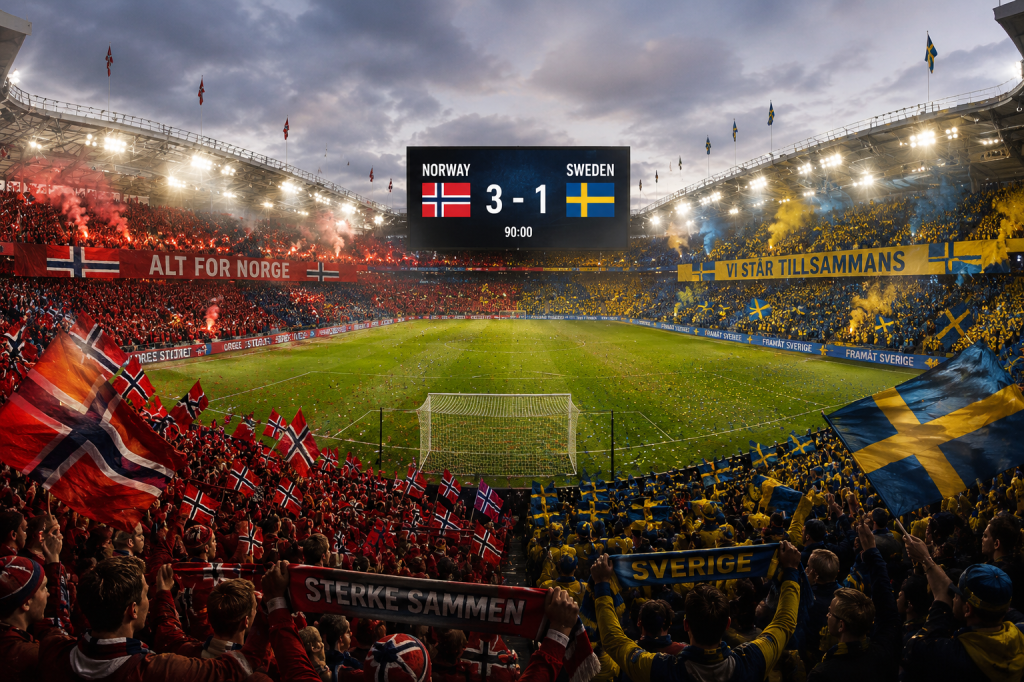
By the 37th minute, Norway were 3-0 up against Sweden in Oslo.
The rain threatened. The crowd roared. Graham Potter looked like a man watching a software update fail halfway through installation.
And somewhere in the stands, with Erling Haaland and Martin Ødegaard enjoying an evening off, Norway were proving something they have spent years trying to convince everyone else of.
This team is no longer about one or two superstars.
Norway Have Finally Become A Team
For most of the past decade, Norway’s international identity has been strangely fragile.
Every discussion eventually returned to the same question.
Yes, but what happens if Haaland doesn’t play?
It followed them everywhere.
They had the world’s most feared striker. They had one of Europe’s finest creative midfielders in Ødegaard. Yet they somehow managed to miss tournament after tournament. The talent was obvious. The collective wasn’t.
That question feels increasingly outdated.
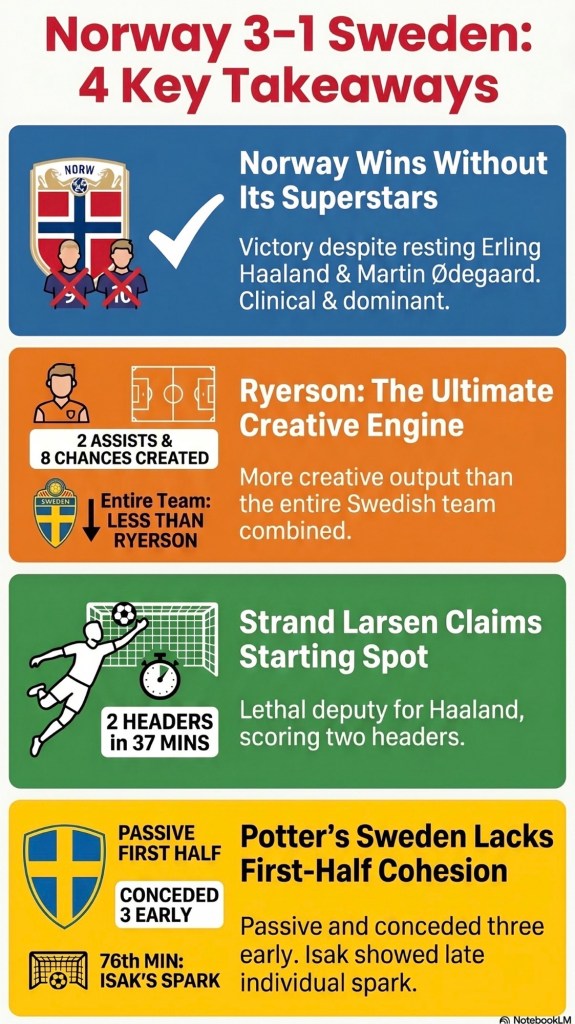
Against Sweden, neither Haaland nor Ødegaard played a minute.
Norway still recorded 22 shots.
Norway still generated 2.42 expected goals.
Norway still battered Sweden 3-1.
This was not a backup performance. It was a continuation of a trend.
The country that bulldozed its way through World Cup qualifying with 37 goals in eight matches now looks deeper than it has at any point since the 1990s.
Ståle Solbakken’s greatest achievement may not be developing stars.
It may be making Norway less dependent on them.
Jørgen Strand Larsen Is More Than A Reserve
There is something slightly unfortunate about being known as “the Haaland understudy.”
Because it implies your entire footballing existence is waiting for somebody else to sit down.
Jørgen Strand Larsen deserves better than that.
His two goals against Sweden showcased exactly why.
The first was intelligent movement and anticipation.
The second was brute force.
Together they represented the complete centre-forward package.
He bullied defenders. Won aerial duels. Occupied centre-backs. Finished chances.
Most importantly, he looked like he belonged.
Football history is littered with nations who discover too late that their entire tactical structure depends upon one superstar remaining healthy. It is the international equivalent of building a castle on a single support beam.
Norway increasingly resemble something sturdier.
Strand Larsen may not be Haaland.
Very few people are.
But he looks capable of being exactly what Norway need him to be.
Which is often more valuable.
Antonio Nusa Might Be The Most Important Player Nobody Talks About
Every successful tournament team tends to have one player who changes the emotional temperature of matches.
Not necessarily the best player.
The most unpredictable one.
For Norway, that player may be Antonio Nusa.
His goal after eighteen minutes was brilliant. The sort of finish that turns defenders into spectators.
But it was everything around it that stood out.
The acceleration.
The willingness to attack space.
The complete absence of fear.
Modern football increasingly resembles a game designed by committees. Systems. Structures. Triggers. Positional responsibilities.
Useful things.
Necessary things.
But occasionally a player arrives who simply decides to run directly through the instructions.
Nusa feels like that.
The kind of footballer capable of turning organised matches into arguments.
As Solbakken himself has noted, Norway now possess genuine attacking “X-factor”.
Nusa might be the purest expression of it.
Sweden Learned That Rebuilds Are Usually Ugly
Football supporters love the concept of a rebuild.
The actual experience is significantly less enjoyable.
A rebuild sounds exciting when presented in a press conference.
On a football pitch it often looks like Sweden did in the first half.
Disjointed.
Confused.
Late to everything.
Graham Potter’s experimental 3-5-2 left enormous spaces down both flanks. Norway found them immediately and repeatedly.
By half-time Potter had made eight substitutions.
Eight.
At that point it stops being tactical flexibility and starts resembling somebody frantically throwing buckets of water at a kitchen fire.
To be fair, Sweden improved afterwards.
They regained some control.
The bleeding stopped.
But the damage had already been done.
Nobody will remember the substitutions.
Everybody will remember the scoreboard.
Alexander Isak Remains Sweden’s Great Hope
One of football’s stranger habits is assuming club form automatically transfers to international football.
It rarely works like that.
Alexander Isak arrived carrying the baggage of a difficult season at Liverpool.
Injuries.
Limited minutes.
Three goals.
Questions.
Then he came off the bench and reminded everybody why Sweden continue to build around him.
The finish was exceptional.
A dipping strike hit with complete conviction.
For a brief moment Norway’s dominance paused and Sweden remembered they still possess elite-level talent.
International football has always been slightly different.
Systems are simpler.
Relationships are shorter.
Confidence matters more.
Isak looked liberated.
This was not the hesitant version seen during large stretches of his club campaign.
This was the player Sweden need in America.
The challenge now is ensuring he doesn’t have to rescue every game on his own.
Scandinavia’s Balance Of Power Has Changed
Perhaps the biggest lesson from Oslo wasn’t tactical.
It was cultural.
For decades Sweden occupied the position of Scandinavian football’s elder sibling.
The bigger tournament history.
The stronger reputation.
The greater expectation.
Norway were the talented neighbour occasionally capable of causing problems.
Not anymore.
These shifts happen slowly.
Then all at once.
Norway have not lost to Sweden at home since the 1990s.
They qualified comfortably for the World Cup.
Sweden scraped through the play-offs.
Norway rested their superstars and still won comfortably.
The scoreline felt significant because it reflected a broader reality.
The hierarchy has changed.
People simply haven’t updated their assumptions yet.
What We Learned Before The World Cup
Friendly matches are strange creatures.
Everybody insists they do not matter.
Then spends several days discussing them afterwards.
This one mattered.
Not because Norway beat Sweden.
Because of how they did it.
Norway demonstrated depth, confidence and tactical clarity. They looked like a team comfortable in its own identity. A little like Mechagodzilla once the final components have been bolted into place. Not just powerful, but fully operational. The individual parts are impressive. The machine is more impressive still.
Sweden learned that Graham Potter’s reconstruction project remains unfinished.
Alexander Isak reminded everybody he remains capable of carrying hope on his shoulders.
Jørgen Strand Larsen announced himself as considerably more than a reserve striker.
Antonio Nusa continued to look like football’s answer to controlled electricity.
And Norway walked away looking something increasingly dangerous.
Not dark horses.
Just good.
Which is often much harder to stop.
Oslo sang loud
Old stories changed in the rain
Summer waits ahead