
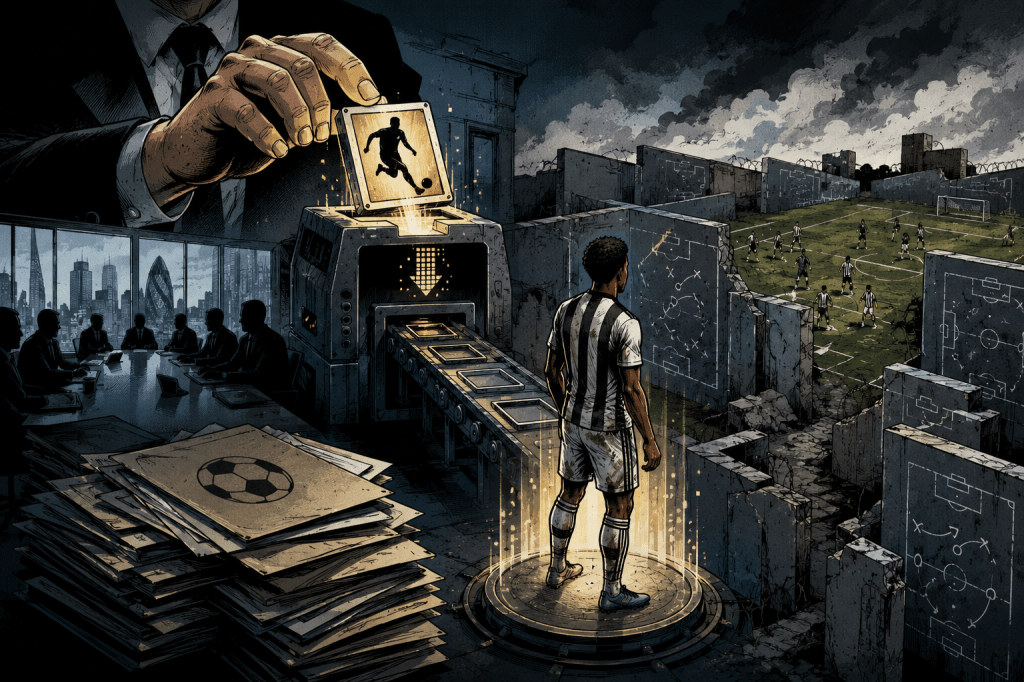
There are football transfers that fail quietly.
Then there are transfers that fail so publicly, so expensively, and so awkwardly that they begin to resemble a parliamentary inquiry conducted inside a collapsing shopping centre aquarium.
Juventus and Loïs Openda increasingly feels like one of those.
Not because Openda suddenly became a bad footballer overnight. Football rarely works that cleanly. Players do not wake up one morning and simply misplace their talent like car keys. What tends to happen instead is something slower and more bureaucratically cruel. The environment changes. The geometry changes. The assumptions collapse beneath them.
And suddenly a striker built for velocity looks like he is running through wet cement.
Openda arrived in Turin carrying the energy of a panic purchase. The pursuit of Randal Kolo Muani had fallen apart, the transfer window clock was screaming in everyone’s ears, and Juventus reacted in the way giant clubs often do when frightened: by throwing €40 million at the nearest available solution and hoping narrative momentum would do the rest.
It didn’t.
Two goals. Roughly 34 appearances. Just over 1,000 minutes. An obligation-to-buy clause hanging over the club like a parking fine attached to a nuclear submarine.
The numbers themselves are bleak enough. But the extrospection around Openda has been even harsher. You could feel the atmosphere changing around him by February. Supporters stopped discussing him as a project and began discussing him as accounting damage.
That phrase began floating around Italian football media circles too:
“Juventus’ worst transfer in recent years.”
Which is quite a competitive category, to be fair.
The Speed Problem Nobody Properly Considered
The strange thing is that the warning signs were always visible if anybody had bothered to look past the tachymetry.
Because tachymetry, in football terms, can seduce clubs into believing speed itself is a tactical identity.
At RB Leipzig, Openda was devastating precisely because the Bundesliga often behaves like somebody accidentally left all the emergency exits open. Space everywhere. Vertical chaos. Transitional football that resembles shopping trolleys racing downhill without supervision.
Openda thrived in that ecosystem.
Twenty-four league goals. Violent acceleration. Channel-running. A striker whose best work arrived not through intricate positional play but through rupture. He was a counter-attacking weapon disguised as a centre-forward.
In Germany, defenders backed away from him like villagers watching Mechagodzilla emerge through coastal fog.
In Italy, the gates simply closed.
Serie A defensive structures treated him like a virus entering a secure facility. Low blocks. Compact lines. Tactical suffocation. Centre-backs who looked deeply offended by the concept of open grass.
Instead of sprinting into chaos, Openda spent most of the season receiving the ball with his back to goal while three defenders compressed around him like elevator walls.
It was football claustrophobia.
And the more he struggled, the more Juventus seemed to panic about having bought him in the first place.
Luciano Spalletti and the Quiet Freezing-Out
If Igor Tudor at least hinted at possible usage patterns, the arrival of Luciano Spalletti effectively turned Openda into decorative furniture.
That sounds cruel. It probably was cruel.
Spalletti’s possession-heavy structure removed almost every environmental condition Openda requires to function naturally. The Belgian repeatedly explained his own profile openly:
“My strengths are speed and power. I’m a quick player, I like to exploit space.”
Which was unfortunate, because Juventus increasingly played as though space itself was morally unacceptable.
The relationship between player and manager developed into something oddly ghostlike. Weston McKennie occasionally appeared ahead of him as a false nine. Jeremie Boga was preferred in certain attacking structures. By spring, Openda was barely leaving the bench.
Then came Spalletti’s strange semi-apology.
“That is another mistake I’ve made.”
Managers do this sometimes after destroying a player’s confidence. A brief public acknowledgement arrives long after the damage has already flooded the building.
Not for the first time, professionalism became the least rewarded quality in football.
The Galatasaray Humiliation
The Champions League tie against Galatasaray S.K. felt like the emotional autopsy.
Juventus were collapsing. The attack lacked pace. The entire structure needed disruption.
And still Openda barely played.
Eleven minutes in the first leg of a 5-2 humiliation. Then introduced in the 109th minute of the second leg like an afterthought somebody remembered while leaving the stadium.
Three touches.
One lost duel.
Two possession losses.
Elimination.
These are the tiny statistical gravestones football leaves behind. Minor moments people pretend to forget, precisely because they explain too much.
The World Cup Consequence
The saddest part of this entire collapse is probably the international damage.
Being dropped from Belgium national football team’s 2026 World Cup squad transformed this from “poor club season” into something existential.
That is where football becomes genuinely brutal.
One year earlier Openda looked like part of Belgium’s attacking future. Suddenly he was outside the 26-man squad entirely, sacrificed to club form, minutes, rhythm, and perception.
Football careers are strange because momentum is treated as evidence of personal worth. Once confidence disappears, people begin retrospectively rewriting the player himself.
Suddenly everyone claims they always saw flaws.
Would Leeds United Actually Make Sense?
This is where the conversation becomes awkward. Almost as awkward as Brock Lesnar’s return to WWE – after leaving exactly 1.5 months in retirement m.
Because in theory, Leeds United F.C. under Daniel Farke should make a certain kind of sense for Loïs Openda. Leeds are at their best when matches become emotionally unstable. Transitional football. Vertical running. Full-backs appearing in places full-backs probably shouldn’t be. The sort of environment where games stop resembling tactical diagrams and start resembling a supermarket trolley rolling downhill without supervision.
And to be fair, Farke has shown he can rehabilitate damaged forwards before. Dominic Calvert-Lewin arrived at Elland Road carrying the energy of a player people had already emotionally retired. Injuries. Confidence erosion. Endless discourse about whether his legs still worked properly. Yet Leeds gradually found a functional version of him again, largely because the system gave him clarity rather than philosophical homework.
So you can absolutely imagine the argument internally.
Get Openda running into channels again. Simplify the role. Reduce the tactical congestion. Let Elland Road’s chaos do some of the psychological lifting. These things matter more than analysts pretending football is entirely solved through geometry.
But there’s another side to this discussion that becomes difficult to ignore once you stare directly at the numbers.
They are horrific.
Not disappointing. Not underwhelming. Properly alarming.
Two goals. Zero assists. Barely any shots. An xG profile that looked like a flatlining hospital monitor. By the end at Juventus, Openda resembled a player who had forgotten not just where the goal was, but why he was on the pitch in the first place. Juventus effectively seemed ready to “renounce ownership” of the entire situation, which is football’s version of quietly leaving a washing machine on the pavement outside your house with a note saying “still works probably”.
And that is the concern for Leeds.
Because rejuvenation stories are romantic right until recruitment departments realise they are trying to rescue a player one of Europe’s biggest clubs no longer even wants to look at. Especially after only twelve months.
Farke could perhaps restore fragments of the old Openda. The tachymetry is still there. The acceleration too. You do not accidentally lose the ability to terrify open grass overnight. But Leeds would also need to ask themselves a fairly brutal question:
Was Juventus simply the wrong tactical ecosystem?
Or did the season expose limitations that were always there once the chaos disappeared?
Those are two very different scouting conclusions. And one of them costs about £40 million to discover the hard way.
The Sadness of the Modern Panic Buy like Software Companies
Big clubs increasingly recruit players like software company owners forcing through a rushed workplace management platform two weeks days before a contract deadline.
Nobody asks the engineers whether the infrastructure actually supports it. Nobody checks whether the thing integrates properly with the rest of the system. The executives just want something visible, something downloadable, something they can point at during presentations while insisting everything is now “streamlined”.
Then six months later the staff are still logging holidays through three different portals, the payroll crashes every Thursday, and somebody from middle management is explaining that the bugs are actually “part of an exciting transition period”.
That increasingly felt like Juventus and Loïs Openda.
A transfer assembled at speed because inactivity looks worse to executives than bad decision-making. The club missed out on one target, panicked slightly, and downloaded the nearest available solution without properly considering whether the tactical operating system underneath could actually run him.
And like a lot of rushed software in modern Britain, the problem was not necessarily that the product itself was useless. It was that the environment it had been dropped into was completely incompatible with what it had originally been designed to do.




3 responses to “Loïs Openda, Juventus, and the Problem of Buying a Mechagodzilla for Medieval Streets”
[…] Leeds transfer news, Leeds rumours and LUFC rumours, his name keeps resurfacing. Well, as much as Loïs Openda, at […]
LikeLike
[…] generations, Juventus and Torino have occupied the same city while representing entirely different ideas of power. […]
LikeLike
[…] because of that, I spent almost seventeen minutes in Turin desperately hoping Rhea Ripley would retain the WWE Women’s […]
LikeLike